
Phoenix Tailings scales up zero-emission extraction of rare earth metals from U.S. mining waste with federal support
 AI-made
Phoenix Tailings, a startup founded by MIT alumni and based in Woburn, Massachusetts, is scaling up what it describes as the only facility in the world producing rare earth metals from mining waste — with no toxic byproducts and no carbon emissions. Co-founded by MIT graduates Tomás Villalón and Michelle Chao, along with Nick Myers and Anthony Balladon, the company is targeting production of more than 3,000 tons of critical metals by 2026. Backing it up: Department of Energy ARPA-E grants totaling more than $2 million.
Phoenix Tailings expands rare earth production with DOE backing
The Woburn facility is still in pilot phase, but the numbers are hard to ignore. More than 3,000 tons of critical metals by 2026 — that would’ve been roughly 7% of total U.S. output last year. Two ARPA-E grants totaling more than $2 million are now funding new extraction capabilities and an accelerated timeline for a second production facility.
Co-founders Villalón and Chao both studied materials science and engineering at MIT. That federal money gives the company room to move faster than it could on its own, and a second facility would push capacity well beyond what the current Woburn refinery can handle.
Demand for rare earths, copper, nickel, and other critical metals is forecast to rise sharply, and right now that supply chain runs heavily through one country.
Why rare earth supply has become a national security concern
The urgency here isn’t just commercial. China currently refines around 60% of the world’s rare earth elements. The Biden administration has called that concentration a national and economic security threat—and the reasoning isn’t hard to follow.
Clean energy deployment is accelerating: more wind farms, more EVs, more grid-scale storage. Demand for rare earths, copper, nickel, and other critical metals is forecast to rise sharply, and right now that supply chain runs heavily through one country. The pressure builds with each new installation.
What makes it more frustrating is that the raw material isn’t actually scarce in the U.S. Large quantities of rare earth metals are sitting inside mining waste stockpiles across the country. The problem has never been availability — it’s been extraction.
How the extraction process works and what it produces
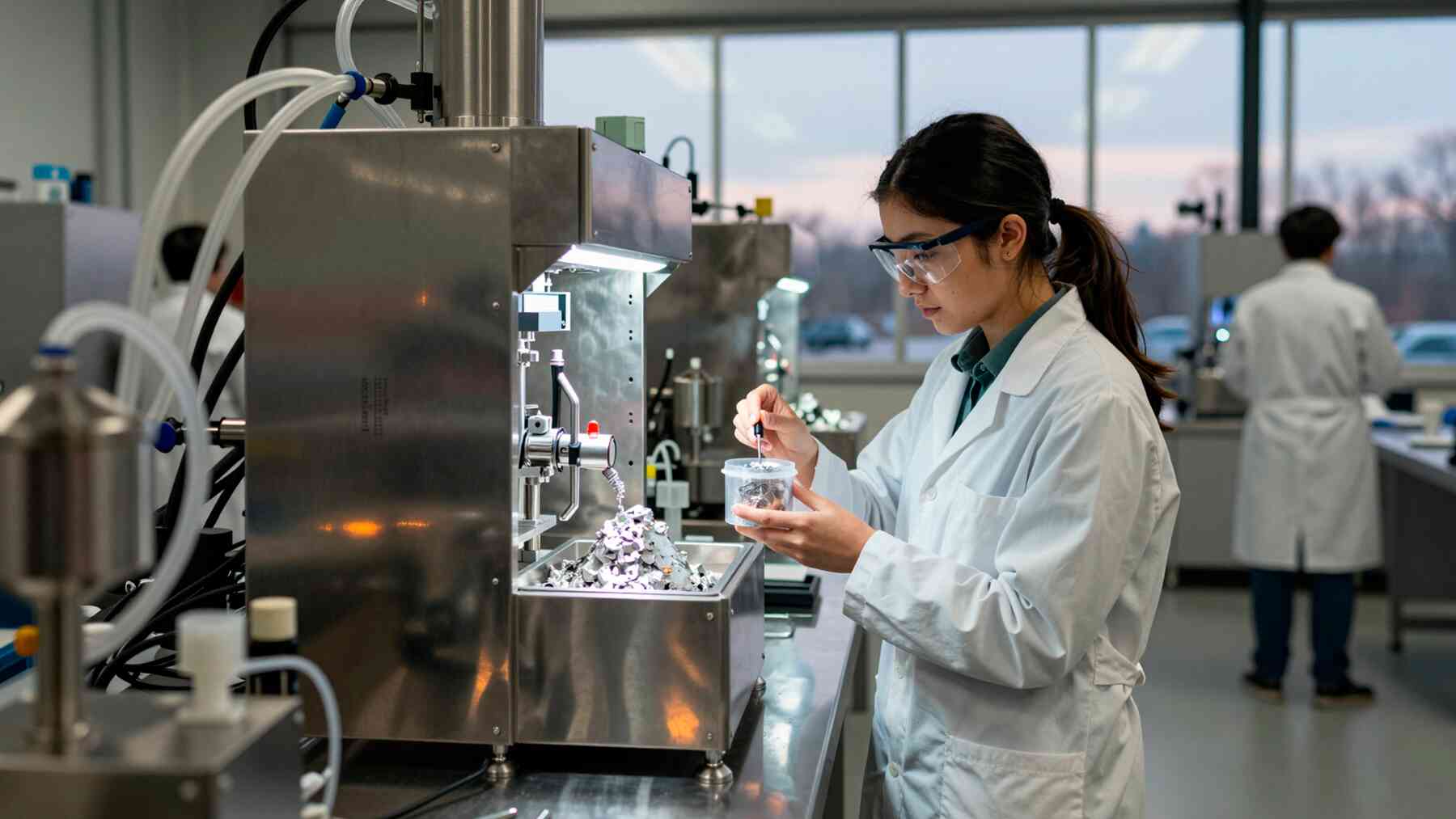
Phoenix Tailings starts with water and recyclable solvents to pull oxidized metal from mining waste. That material then goes into a molten salt mixture heated to around 1,300°F. Apply an electric current, and pure metal collects on an electrode — minimal waste, no toxic byproducts.
Electricity is the one input that could complicate the zero-emission claim, but the company currently offsets its power consumption through renewable energy contracts.
The refinery is already producing neodymium and dysprosium — rare earths essential to high-performance magnets used in wind turbine generators, EV motors, and defense systems. Customers across all three sectors are actively using the materials.
New grants push the company into nickel, magnesium, and iron
Rare earths are just the starting point. A 2023 ARPA-E grant funds a system to extract nickel and magnesium from mining waste using a carbonization process that recycles CO₂ rather than releasing it. Both metals are critical for battery applications in clean energy storage and EVs — strategically, nearly as consequential as rare earths.
The most recent grant takes things in a different direction entirely: adapting the process to produce iron from mining waste, also without emissions or toxic byproducts. That’s a significant expansion of scope, moving Phoenix Tailings from specialty metals into one of the most widely used industrial materials on earth. The company says its process works with a wide range of ore types and waste materials, which gives it flexibility as it pushes into new segments.
Background: The scale of U.S. mining waste and the company’s origins
Feedstock, at least, won’t be a problem anytime soon. Mining and mineral processing generates approximately 1.8 billion tons of waste in the U.S. each year — a continuously replenished supply of raw material.
The company’s origins are a lot less corporate than that scale might suggest. Villalón and Myers met at a Bible study in 2018. A conversation about global electrification turned into a business plan, and a few months later Myers called with $7,000 and one question: when do they start? Villalón brought in Chao, his former MIT classmate, while Myers brought in Anthony Balladon.
Early experiments happened in Villalón’s backyard—purchased red sludge, a type of mining waste, and a prototype reactor that they built themselves. When they finally produced something, they had to borrow equipment just to figure out what it was. It turned out to be rare earth concentrate and pure iron.
The founding team drew directly on MIT coursework in thermodynamics, materials science, and ceramics. Professor Donald Sadoway, whose electrochemical research shaped their approach, became a company advisor. MIT’s Venture Mentoring Service and the NSF I-Corps program provided additional early-stage guidance.
What this means for domestic critical mineral supply
Phoenix Tailings sits at the intersection of several converging pressures: a fragile rare earth supply chain, growing clean energy demand, and billions of tons of underutilized domestic waste. Its zero-emission extraction process—currently producing neodymium and dysprosium in Woburn—has federal backing and a major production milestone in its sights for 2026.
The company is also pushing into nickel, magnesium, and iron, widening its potential impact on U.S. critical mineral supply. Whether it can hit those targets at scale remains an open question. The feedstock, the technology, and the federal support are all in place—execution is what’s left to prove.
Kelly is an experienced writer with 15 years of experience exploring the big stories that shape our world, from tech breakthroughs and space exploration to climate, energy, and the fascinating quirks of science. She has a talent for turning complex ideas into sharp, memorable insights that stay with readers long after they’ve finished reading.
