
Pipeline incident records covering 11 years and 50 states line up with higher fine particle readings in Oklahoma and Louisiana when Texas logs more leaks, and nobody has shown what those particles are made of
There is a real finding here and it is narrower than it sounds.
Somebody counted reported leaks state by state, year by year, and set those counts against fine particle levels next door.
The counts and the levels move together.
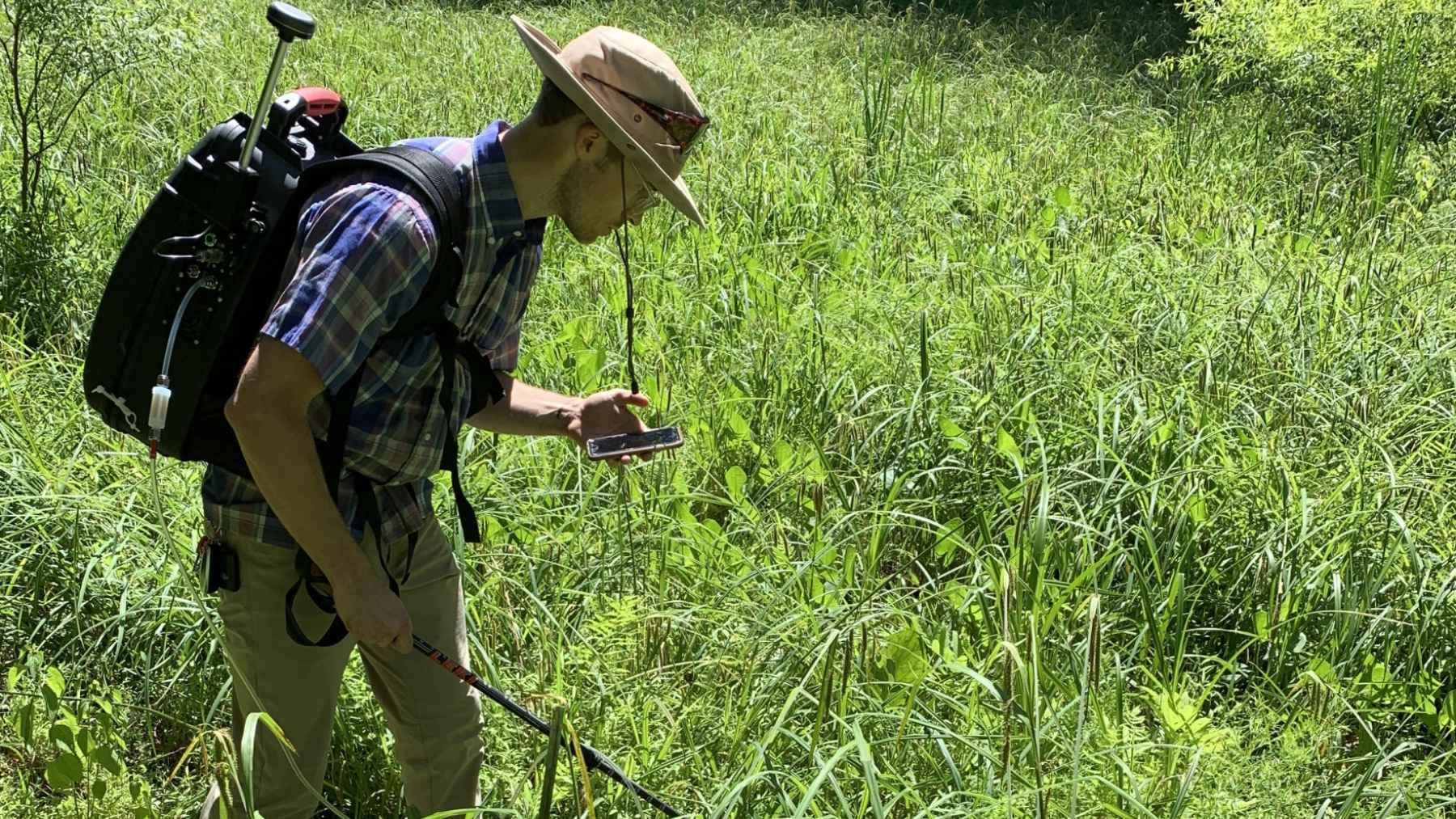
Researchers walked transmission rights of way near Baltimore and Pittsburgh with backpack analyzers in 2021 and found 23 leaks across about twelve miles of survey.
That is worth knowing, and it is not the same as watching pollution travel.
Nothing in that method follows a particle anywhere, or says what the particle is.
Which leaves the most interesting question wide open.
Methane is the wrong suspect for this
Escaping natural gas is mostly methane, and methane is close to inert on the timescale that matters here.
Its lifetime in the atmosphere runs to roughly a decade. Air moving from the Texas panhandle into Oklahoma takes a day.
In that window methane does almost nothing. It is a poor precursor for the kind of secondary aerosol that forms downwind of a city, and treating it as the chemical parent of fine particles overstates a very slow reaction badly.
The plausible pathway sits beside the methane rather than in it.
A gas stream carries heavier hydrocarbons that are far more reactive, and the infrastructure around any leak is full of combustion: compressor engines running on the product, flares, generators, truck traffic on lease roads.
Those produce nitrogen oxides and primary particles directly, which is the ordinary route to a fine particle signal.
So the association can be real while the named culprit is wrong.
Why the signal shows up over one state
Texas carries more pipeline mileage than any other state, and the density is not evenly spread.
Gathering lines run out of the Permian by the thousand, transmission corridors cross the state, and older distribution networks sit under the cities.
Corrosion, equipment failure, excavation damage and material defect all show up in the records, and the volume of reported events follows the mileage.
The wind cooperates too. Prevailing flow across the southern plains carries air toward Oklahoma City, Tulsa and the Louisiana line.
Put a large source region upwind of two smaller ones and any statistical model will find something.
Which is a reason the result is plausible, and also a reason it is hard to attribute.
What the two studies actually did
The cross state work appeared in the journal Risk Analysis on June 4 of 2025, with a society announcement in late May. It is spatial econometrics: reported incidents from the federal pipeline safety database for 2009 through 2019, all 50 states, matched against annual fine particle estimates from a Columbia University dataset.
Its lead author is Younes Ben Zaied, professor of finance and sustainability at EDC Paris Business School, and his framing is about accounting, not chemistry: pollutants and their by products cross state borders while oversight stops at them.
The study also found the mirror image, which rarely gets quoted. States with stricter rules logged fewer incidents and produced a measurable benefit for their neighbors.
The four times figure comes from somewhere else entirely.
Researchers walked transmission rights of way near Baltimore and Pittsburgh with backpack analyzers in 2021 and found 23 leaks across about twelve miles of survey. Five were quantified at close to 172 grams an hour, against an official assumption near 44.
Where the evidence stops
The particle data behind the national study are annual estimates on a grid, not readings pulled off monitors, and an annual average cannot resolve a plume.
The incident data measure reports, not leaks. A state that inspects harder and files more paperwork looks worse than one that does neither, and the model cannot separate those.
The field study is stronger evidence but a much smaller claim: twelve miles walked, five leaks measured, one season, two cities.
Its own lead author is blunt that methane by itself is not a direct health risk beyond what it does to the climate, which is the opposite of the reading now attached to it, in the same way that headline numbers get detached from their methods across a Texas site or any single piece of offshore work.
None of that makes the correlation go away.
The rules were written for explosions
Pipeline safety regulation grew up around rupture, fire and liquid spill, all of which are loud, local and immediate.
A slow release that degrades air quality several counties downwind fits none of those categories, and there is no permit that contemplates it.
The regulator counts events. The air quality system counts concentrations. Neither one carries a column for emissions that leave the state, as the study announcement argues.
Closing that gap needs measurement rather than modeling, and the tools exist already: walking surveys, aerial infrared, satellite retrievals, as the field survey demonstrates.
Until networks are surveyed that way on a schedule, the pipeline incident count stays a proxy.
And a proxy is not a measurement.
Hugo is an engineer with strong technical expertise. Multilingual from an early age, his writing combines technical clarity with a strong interest in science and energy.
