
Proposed across about 28 cranberry bog acres beside a Massachusetts river, a solar project spent years in dispute over a coating nobody named on the permit, until the science arrived to reframe the question
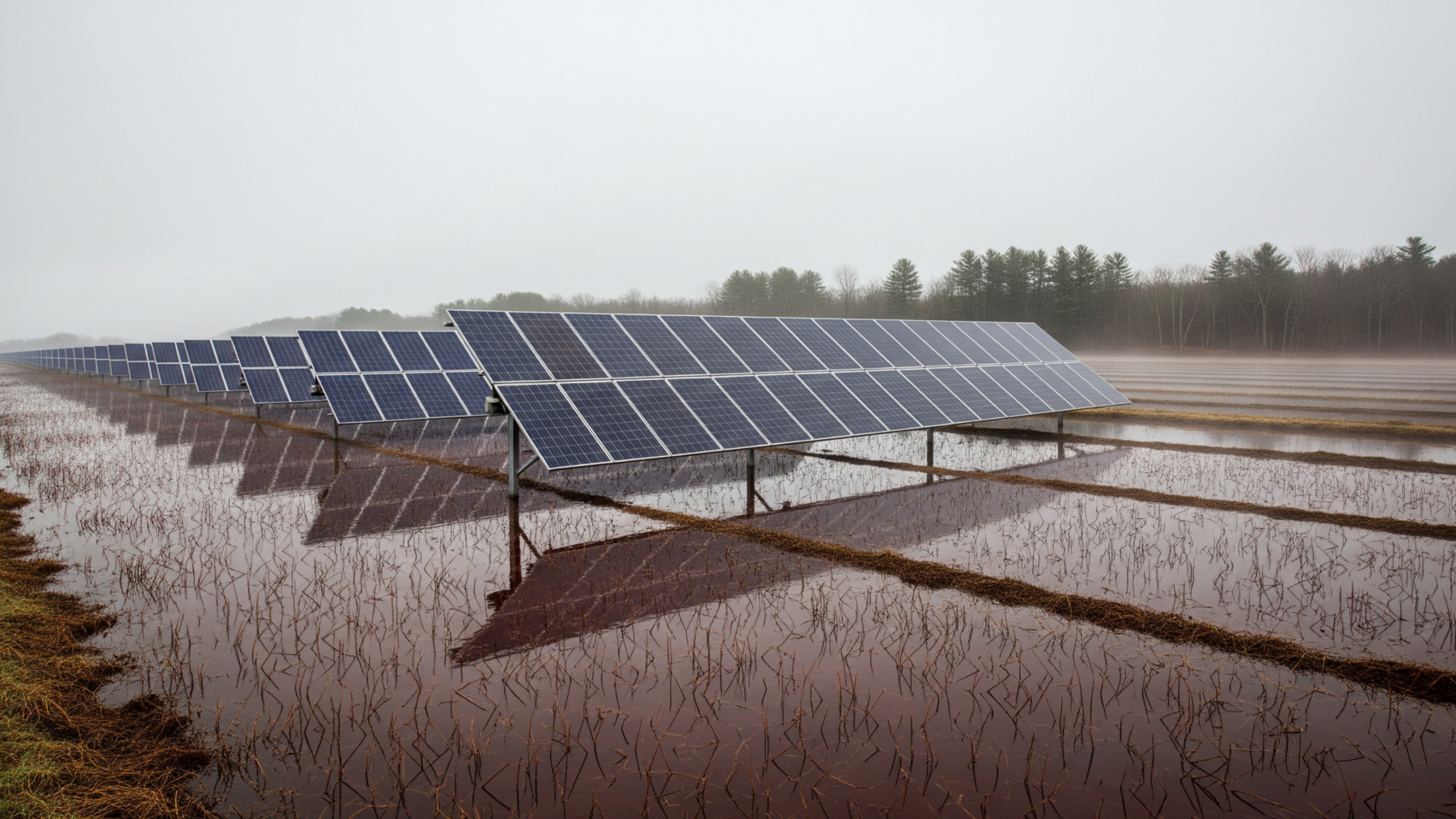
Somewhere in southeastern Massachusetts, where a flat bog turns red every October and river water moves through cranberry vines below ground level, a developer drew a property line that crossed into a riverfront area. The permit described it as a solar energy project. The proposal went through planning boards, then hit a wall at the Conservation Commission. And then a town began asking a question nobody had written an answer to.
A boom that followed the water
Massachusetts sits near the top of every per capita solar ranking in the Northeast, and the pressure to find flat, inexpensive acreage pushed developers steadily toward the one landscape the state has in surplus: its bog country. Large solar projects have been installed in wetland cranberry bogs and along agricultural canals bordering bogs across southeastern Massachusetts. Cranberry farming has been contracting for decades, land prices in Carver and Wareham are far below the Boston suburbs, and a bog that no longer floods on schedule is still perfectly level.
The Rocky Maple project in Carver and Wareham was proposed for a riverfront area on the Weweantic River, which drains into Buzzards Bay and runs through one of the most ecologically sensitive estuarine systems on the Atlantic coast. The solar field would have been built over about 28 acres of cranberry bog, with panels racked a few feet above soil that stayed waterlogged through spring. What nobody discussed loudly at the permit hearings was what was coating the panels themselves.
Three federal officials and a Connecticut senior drinking water health official had all expressed concerns about PFAS leaching from solar panels in the years prior.
The coating nobody named
Modern solar panels are not simply glass and silicon. Every panel carries a suite of polymer films, adhesives, and protective layers, and several of those layers are built from fluorinated compounds. Limited transparency from manufacturers about fluorinated materials in photovoltaic modules, along with the scarcity of publicly available testing data, left real uncertainty in the room at every hearing.
By the early 2020s, community groups, state officials, and federal drinking water managers had begun connecting the words “solar panel” and “PFAS” in public documents and permit challenges. PFAS, per and polyfluoroalkyl substances, are the so-called forever chemicals. They do not break down in soil or water, they accumulate in living tissue, and regulators have been tightening drinking water limits on them for years. For a project proposed on a bog riverfront draining into Buzzards Bay, whose shellfish beds rank among the most economically important on the Massachusetts coast, that was not an abstract worry.
What the permit hearing could not settle
State and local officials found themselves in an uncomfortable position. The science on whether fluorinated compounds in solar panels actually leached into soil and water at harmful concentrations was genuinely unsettled. The Vermont Agency of Natural Resources had reviewed literature surrounding contaminants in solar panels and examined landfills that had received them, finding no observed groundwater impacts. But Vermont’s findings carried no legal weight in Massachusetts, and bog soil is not landfill cover.
Three federal officials and a Connecticut senior drinking water health official had all expressed concerns about PFAS leaching from solar panels in the years prior. Those statements gave community groups real ammunition, and permit challenges in Carver and Wareham cited the fluorochemical question as an unresolved environmental issue. Developers pointed to the absence of documented contamination. Neither side had a definitive study to cite, and that study was not coming until 2026.
What the science finally said
In April 2026, a perspective paper published in MRS Energy & Sustainability by Nain and Anctil became the most comprehensive scientific accounting of PFAS in photovoltaic panels to date. The researchers found that while certain fluoropolymers are used in photovoltaic manufacturing, they are not appropriately classified as toxic PFAS. The distinction matters enormously: fluoropolymers like PTFE are chemically stable, do not migrate readily from solid material, and are not the mobile, bioaccumulative compounds that regulators mean when they say “PFAS.”
The paper did not declare solar panels harmless. The researchers noted that concerns about PFAS presence and potential leaching from solar panels may slow the adoption of photovoltaic technology despite its central role in the renewable energy sector. You can follow solar project finance across the country and never find a materials disclosure that goes that deep. For the communities on the Weweantic, the paper arrived as a partial answer, though the transparency gap that let the fear grow remains open because manufacturers still do not routinely disclose which fluorinated compounds appear in which panel layer.
The question the watts did not answer
The 2026 study should reassure the people of Carver and Wareham, and to a meaningful degree it does. But the episode reveals something about how the solar industry has handled the chemistry of its own products: by leaving the disclosure gap to be filled by fear, and then by science, years later. That silence extends to what panel materials are made of and to what happens to them at the end of a useful life.
Solar panels are genuinely among the cleanest ways to generate electricity over their operating life. The Weweantic River is not in danger from fluoropolymers in panel backsheets, and the bay below it can breathe easier for that finding. But the bogs beside the river were asked to carry years of unresolved uncertainty because the industry that proposed panels on their shores never made its materials chemistry easy to read.
Disclosure would have cost a spreadsheet. The silence cost a town several years of legitimate worry. For the utility scale solar industry to earn the trust it needs for the acres it still wants, closing that gap before the next permit hearing is not optional, it is overdue.
Hugo is an engineer with strong technical expertise. Multilingual from an early age, his writing combines technical clarity with a strong interest in science and energy.
