
Google just signed onto a record-breaking solar-battery project in Arkansas that will outpower the state’s two nuclear reactors combined
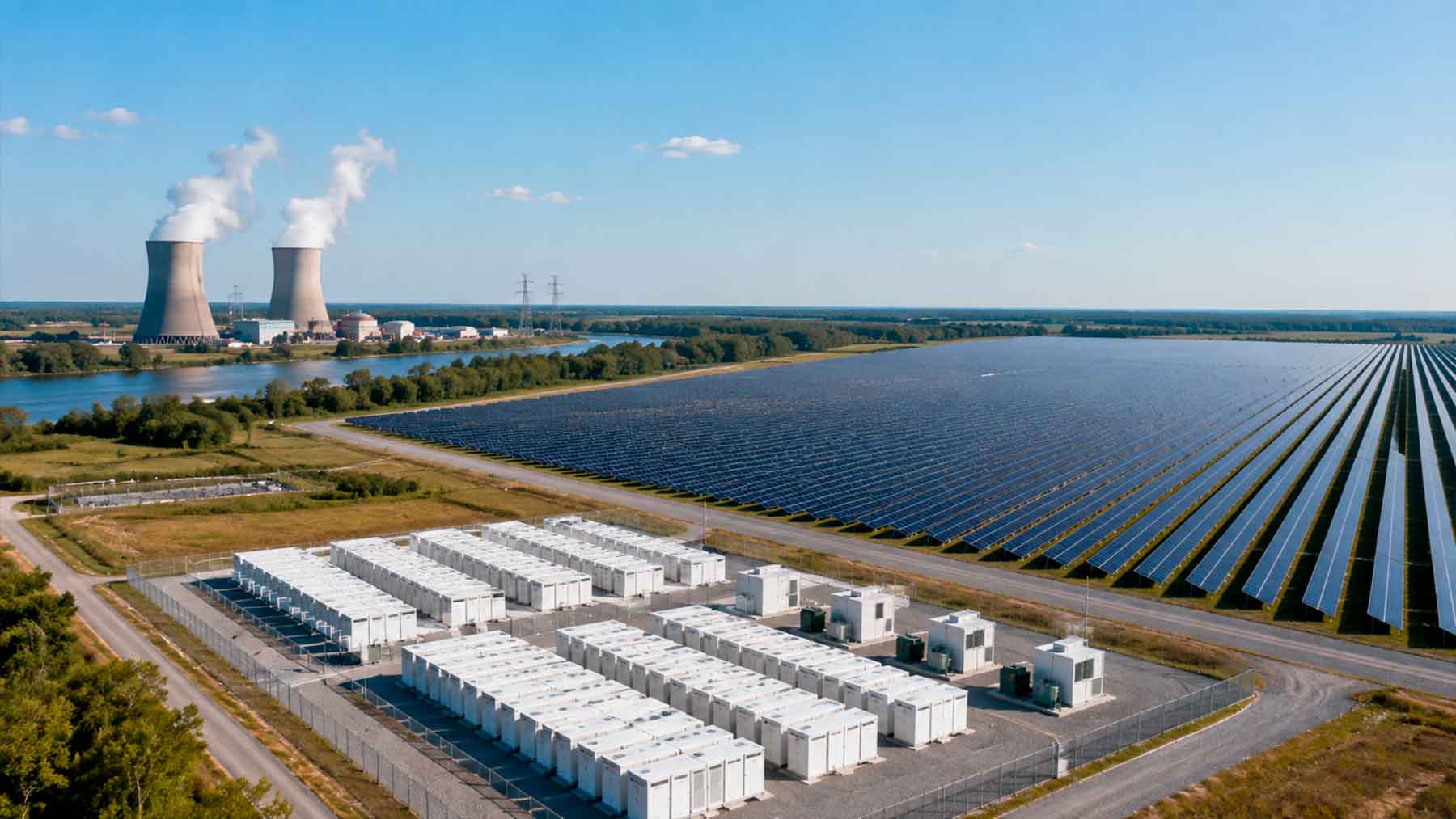 Image generated with artificial intelligence
A solar-and-battery facility unlike anything the United States has built before is taking shape across the sprawling farmland of Mississippi County, Arkansas.
Best known for heavy steel mills and agricultural fields along the Mississippi River, this rural enclave upriver from Memphis is now the backdrop for a massive shift in American energy infrastructure.
Across roughly 11,000 leased acres, an unprecedented clean energy project is rising—one that redefines how bulk power is generated, stored, and sold in the heartland.
Developer Cypress Creek Energy secured $3.5 billion in project financing, backed by major global lenders including Barclays, BNP Paribas, Santander, and Wells Fargo.
A solar plant unlike anything the U.S. has built before
The sheer physical scale of the Steel River Energy Center resets national benchmarks. California’s Edwards & Sanborn facility currently holds the U.S. solar record at 875 megawatts. Steel River shatters that baseline.
Its initial two phases will deliver 1.6 gigawatts of solar capacity paired with 1.9 gigawatt-hours of battery storage. A planned third phase will push those numbers to an astounding 2.45 gigawatts of solar and 2.9 gigawatt-hours of storage by 2029.
Building a mega-facility of this magnitude requires immense capital. Developer Cypress Creek Energy secured $3.5 billion in project financing, backed by major global lenders including Barclays, BNP Paribas, Santander, and Wells Fargo.
Furthermore, solar-plus-storage can be deployed at a fraction of the time required for conventional baseload plants, achieving full operational capacity within a concise three-year construction window.
Google’s AI appetite drives the deal
Behind this massive financial undertaking sits an anchor corporate buyer with an insatiable need for power. The artificial intelligence revolution has triggered an unprecedented surge in electricity demand, forcing major technology companies to secure clean energy at scale.
To support its growing digital footprint, Google committed to purchasing 100% of the electricity generated by Steel River’s initial phases.
The power won’t feed directly into server racks; instead, it will pour into the regional grid managed by Entergy Arkansas. This infrastructure supports major tech hubs, including a planned facility near West Memphis.
Because data centers demand continuous energy, pairing massive solar arrays with utility-scale battery storage provides the fastest and most cost-effective path to supply clean bulk power to the grid during peak demand hours.
Building a solar giant in coal country—without subsidies
What makes Steel River’s rise remarkable is where it is happening. Arkansas offers no state-level renewable energy mandates or financial incentives.
The project operates on pure market economics.
The region’s advantage lies in robust transmission infrastructure and direct connection to the Midcontinent Independent System Operator (MISO), a 15-state wholesale electricity grid.
Despite federal policy hurdles—such as fluctuating material tariffs and expiring tax credits—the market fundamentals remain clear.
As fossil fuel economics shift, utility-scale solar coupled with advanced battery storage has become one of the most affordable electricity sources available.
A rural economic lifeline built from local steel
Steel River is deeply rooted in local industrial heritage. Mississippi County is the nation’s leading steel producer, and Cypress Creek is leveraging that strength by using 100% American-made structural steel.
The project relies on 400,000 steel piles manufactured by Paco Steel in Blytheville, utilizing steel coils from U.S. Steel’s Big River Steel facility just ten miles away in Osceola.
The project’s 3 million solar panels originate from First Solar’s plant in Lawrence County, Alabama, while LG Energy Solution Vertech provides the battery systems.
For a region impacted by agricultural downturns and farm bankruptcies, solar lease payments give family farms a crucial revenue stream. In total, the facility is projected to contribute $300 million to the local tax base over its operational lifespan.
What comes next
As construction progresses toward full completion by 2029, Steel River represents a powerful proof of concept for corporate-backed energy development.
Yet the true significance of this project lies in its staggering power output.
By securing this landmark facility, Google just signed onto a record-breaking solar-battery project in Arkansas that will outpower the state’s two nuclear reactors combined—proving that renewable energy paired with storage can now eclipse traditional nuclear baseload power on pure market terms.
Kelly is an experienced writer with 15 years of experience exploring the big stories that shape our world, from tech breakthroughs and space exploration to climate, energy, and the fascinating quirks of science. She has a talent for turning complex ideas into sharp, memorable insights that stay with readers long after they’ve finished reading.
