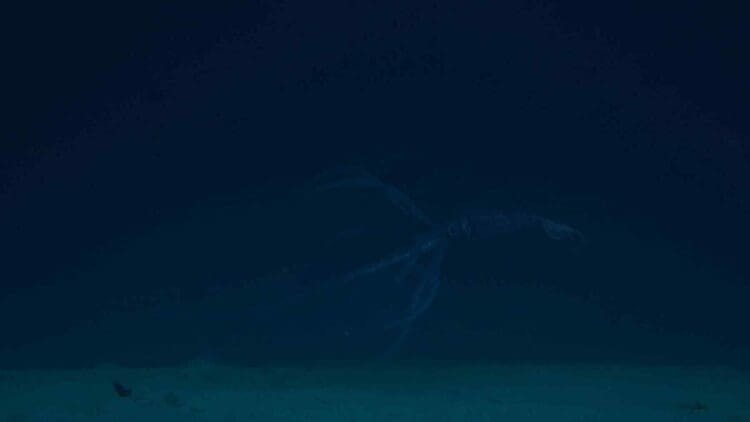

From a mere myth to a pure legend. A colossal creature that has been passed down in myths for centuries has finally been captured on live footage in the Southern Ocean. The Kraken is real, and while it has remained lost to civilization since the 12th century, the species has reemerged from the depths of the ocean. However, this one is a baby, which begs the question, where is the mother of all Krakens?
A legendary creature: Not just a myth
For centuries, a myth about a legendary monster has been passed down, originating from Scandinavian folklore in the twelfth century. This monster plagued the seas and its sailors, allegedly attacking ships and dragging them down to the dark depths of the ocean. You may recall the Kraken from the movie Pirates of the Caribbean. Well, the legendary Kraken has become more than just a myth.
By the 18th century, Carl Linnaeus, a Swedish scientist, logged the Kraken as a real creature. In 2004, pictures of a live squid specimen were taken for the first time, revealing that while the Kraken may not truly be a sea monster, it is real nonetheless. Now, for the first time, live footage of the species has been captured in its natural habitat.


The real Kraken: Alive and thriving in the depths of the ocean
The depths of the ocean are vast and mysterious. With so much left to discover, one must not be surprised when strange creatures and phenomena are uncovered, as was the case with the discovery of dark oxygen under the sea. Now, an international research team, in collaboration with the non-profit called Kollosal, has made yet another eerie discovery, the real Kraken in its natural habitat in the Southern, or Antarctic, Ocean.
The legendary Kraken is believed to be inspired by the colossal squid species (Mesonychoteuthis hamiltoni), which belongs to the glass squid family. Now, for the first time, the research team captured footage of a baby colossal squid, approximately 1 foot in length. The footage was captured during a 35-day expedition on the Schmidt Institute’s research vessel, “Falklor (Too).”
The Schmidt Ocean Institute highlighted how little is known about the colossal squid species, especially its life cycle. They can reach 23 feet in length and nearly 1,100 pounds in weight in adulthood, making them the largest invertebrates on Earth.
The Southern Ocean is hiding more secrets
This footage proves that the Antarctic region is hiding many secrets beyond a new hydrogen type. Several independent experts have been consulted to confirm the footage, including Auckland University of Technology’s Dr. Kat Bolstad. In a statement, Dr. Bolstand commented on how difficult it had been to encounter the species in its natural habitat, as:
“For 100 years, we have mainly encountered them as prey remains in whale and seabird stomachs and as predators of harvested toothfish.”
However, this expedition not only enabled the successful capture of live footage of a colossal squid but also encountered several other secrets of the Southern Ocean. Footage of the elusive glacial glass squid (Galitheuthis glacialis) has also been captured for the first time, and the footage of both squid species was also independently confirmed by glass squid family expert, Dr. Aaron Evans.
As researchers continue to dive deeper into the hidden secrets of the depths of the oceans, we won’t be surprised to discover that more myths, such as the one about the elusive Kraken, turn out to be legendary truths. Perhaps more research will also help us understand certain oceanic events better, including the mysterious darkwaves that have been detected, with two American regions identified as top spots experiencing this strange phenomenon.