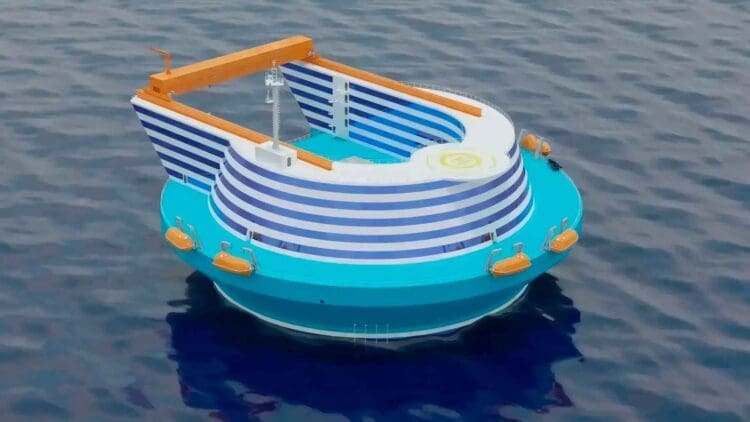

Some take the high seas seeking adventure, but this design is setting sail to power the world.
Fossil fuels have anchored the world for too long, leaving us vulnerable to the dangers of the impending groundswell.
Fortunately, scientists have been charting the course with a new nuclear breakthrough that could reshape the maritime industry.



Will this be the leap the nuclear sector needed to be promoted to captain of electricity?
How fossil fuels are sinking the maritime industry
Long before long-distance travel and trade took flight in the sky, it was primarily moored to the vast ocean.
This method of transportation was the norm for centuries, and today, it still plays a great global role.
However, the maritime industry has remained stuck in the past. While the world has been swiftly transitioning to green energies and fuels, it remains hard to abate.
Now, it is sink-or-swim for the industry. If it chooses to remain captained by fossil fuels, sinking is inevitable.
Traditional renewable sources, such as solar and wind, are unfortunately not enough to keep it “buoyant.”
Giant cargo ships and port hubs consume significant amounts of high-density energy. As the sector takes on water, global economies go down with it.
Emission regulations are tightening the rope, and the environmental tax swell is building.
What will help the industry to navigate this storm and stay afloat?
The powerful “captain” who has been marooned onshore
Maritime is among several other hard-to-abate sectors. These, along with the rapid advancement of smart technology, are putting a significant strain on power grids.
For years, nuclear power seemed like the best candidate to “captain this global energy fleet.”
But after the devastating 1986 Chernobyl accident, many people lost confidence in nuclear power.
Many plants have been “relieved from duty” for decades. However, more and more nations are realizing the need to station the source again.
Its high-density, continuous, carbon-free electricity is what will steer the industry in the right direction.
In Washington State, there are already plans to deploy advanced next-generation nuclear power.
There is still one major problem for maritime when it comes to this source.
It has always been stubbornly stuck on land, until now.
The U.S. coastline will be the first to take this source to the high seas.
Maritime can now dive headfirst into a nuclear pool
Nuclear power plants have been undergoing significant growth. Now, this growth is going afloat by taking the shape of a giant, stationary pool-like design.
In what is known as the “Liberty Program,” CORE POWER and Glosten strategically partnered to engineer floating nuclear power plants.
These plants are envisioned to float in a non-specific port in the Southern U.S. There, they will serve as “plug-and-play” energy buoys for coastal industrial hubs.
The power of floating nuclear to keep maritime afloat
Reactors have been moved into a shipyard-manufactured hull. This significantly cuts construction expenses and enables mass production.
One barge produces 175 GWh of clean power annually, proving this is the “engine room” needed all along.
65% of global gross domestic product (GDP) is localized along coastlines. This makes this maritime upgrade a $2.6 trillion opportunity to reshape trade routes.
Floating nuclear power plants will thus help the industry to survive the green transition, and perhaps lead it.
The weight of fossil fuels anchoring down carbon-heavy industries is finally beginning to ease.
It seems that the “Liberty Program” may only be the first chapter of floating nuclear power taking the steering wheel. Soon, an entire nuclear energy fleet could take to the high seas all over the world.
As various nations continue to secure financial frameworks to revive and advance nuclear power, the future looks greener and brighter.