
Borrowed from a rival’s schedule and carrying 5 steel cylinders per trip from Edinburgh’s harbor, a single ship buried 54 foundations each heavier than 2,000 cars into a winter North Sea, and the Angus coast will never look the same again
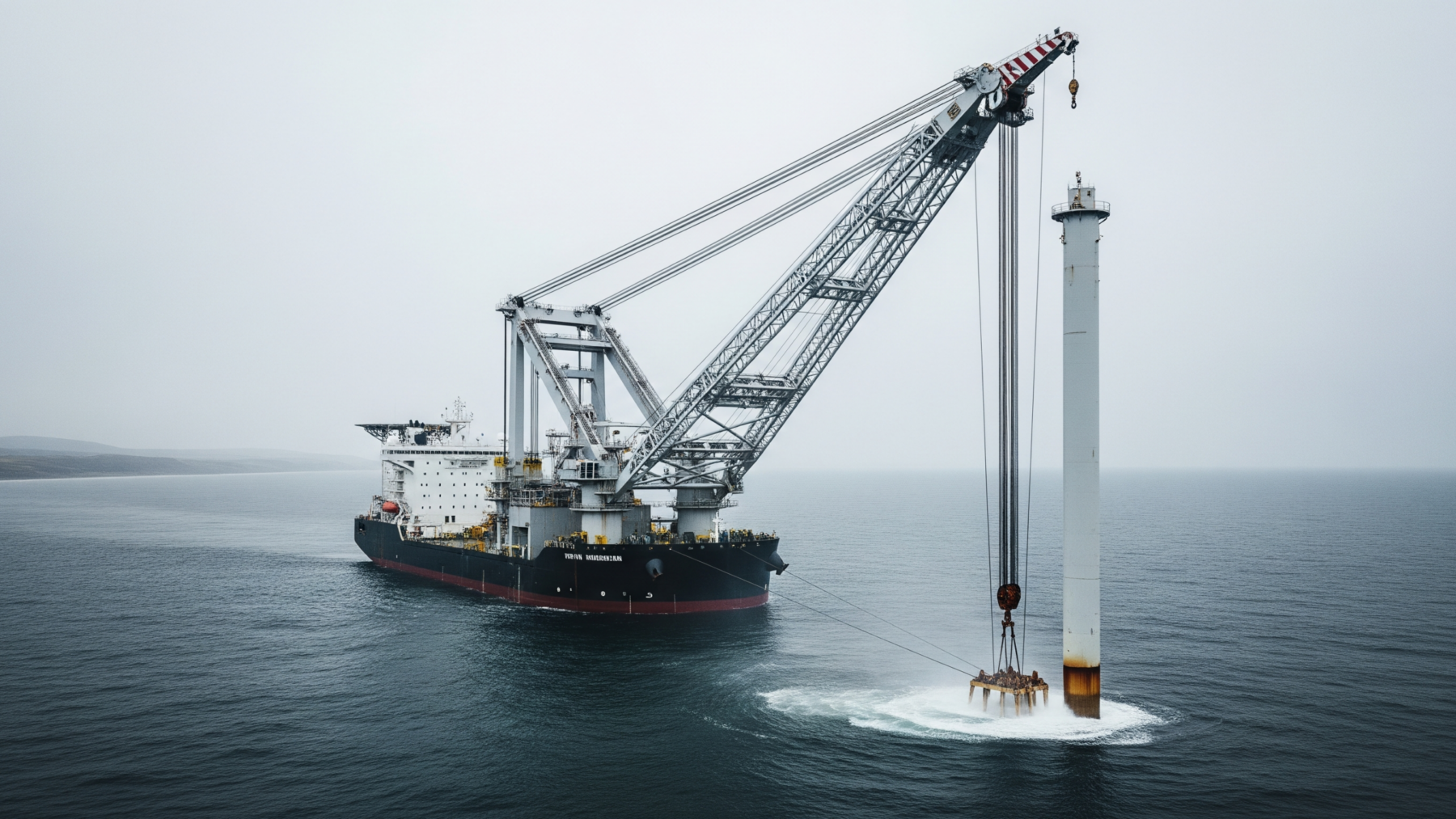
Every six days or so, a ship the size of a skyscraper laid on its side would leave Edinburgh’s harbor and head northeast into the North Sea winter. It carried five steel cylinders, each one longer than a football pitch and heavier than 2,000 family cars. Its destination was a patch of Scottish sea that, within two years, will hum with enough electricity to light half of Scotland’s homes.
A harbor rebuilt for something nobody had tried before
The Port of Leith sits at the mouth of the Water of Leith, a few miles from Edinburgh’s old town, and it has handled whisky, grain, and coal for centuries. But in the months before Christmas 2025, a new deep water berth opened at the port’s edge, the product of a £150 million investment that transformed 175 acres of waterfront into a staging ground for industrial components on a scale the Firth of Forth had never witnessed.
The first eight monopile foundations to arrive were each up to 103 meters long and weighed around 2,300 tons. The berth was engineered with a heavy lift capacity of up to 100 tons per square meter, and a hundred workers based at Leith began loading, inspecting, and preparing each steel tube for the crossing. Around £50 million of the total investment was committed specifically for Inch Cape, making it Forth Ports’ largest offshore wind contract to date, and Edinburgh had in effect rebuilt part of its waterfront for a single wind farm.
Jan De Nul’s Les Alizés had been on long-term charter to RWE, which leased the vessel to Inch Cape during a gap between its own construction projects.
The borrowed giant that made the whole thing possible
The vessel at the center of the campaign was not even under contract to Inch Cape in the usual sense. Jan De Nul’s Les Alizés had been on long-term charter to RWE, which leased the vessel to Inch Cape during a gap between its own construction projects. That narrow window in the global heavy lift calendar was the slot through which an entire 1.1 GW wind farm’s foundations had to pass.
The ship, equipped with a 5,000 ton crane extending to 160 meters at full height, moved five monopiles per voyage from the Port of Leith. Each loaded run required hours of careful rigging at the quayside, then a crossing to the construction site 15 kilometers off the Angus coast, where the crane would position each tube and drive it into the seabed with a hydraulic impact hammer. The rhythm became its own kind of industrial choreography, repeated across a six-month campaign that began in December 2025 and pushed through brutal winter weather without a single foundation skipped.
What 2,300 tons of steel actually means
Numbers on paper rarely capture scale. The monopiles at Inch Cape, fabricated by CWHI and Dajin Heavy Industry, are among the largest ever installed in the offshore wind industry, with diameters of 11.5 meters, lengths of up to 102 meters, and weights of around 2,300 tons. Picture a steel tube wide enough to park two cars side by side inside its mouth, stretching deeper than a 30-story building stands tall.
Fifty-four of those now anchor the Angus coast’s underwater geography permanently. For each placement, the crew established position using dynamic positioning, lifted the tube off the deck, lowered it through the water column, and hammered it to the correct depth before the ship moved on. Les Alizés used an IQIP pile lifting tool and hydraulic impact hammer throughout, a pairing that proved reliable across all 54 installations despite the season’s punishing conditions.
Scotland’s first 15-megawatt wind farm takes shape
Inch Cape, a 50/50 joint venture between ESB and Red Rock Renewables, is developing a 1,080 MW offshore wind farm 15 kilometers off the Angus coast. It will generate enough clean electricity to power half of all Scottish homes while cutting carbon emissions by 2.5 million tons each year, and it will be the UK’s first offshore wind farm to install 15 MW Vestas turbines, a live test of the machine the European industry is betting its next decade on.
Project director John Hill described the milestone as “a huge achievement for the Inch Cape team and confirmation of the project’s momentum,” noting that the monopiles are among the largest ever installed for an offshore wind farm and that the team overcame significant challenges to reach that point. For a useful European parallel, DEME’s Netherlands contract shows how foundation logistics scale across the continent, while wildlife obstacles remind us that the North Sea’s hardest challenge is not always the seabed.
What the Angus coast is listening for now
The project is on track for first power in late 2026 and full commercial operations in 2027. When the 72 Vestas machines begin turning, each rotor will sweep 236 meters across, and the sum of all 72 will deliver electricity on a scale the Angus coast has never contributed before.
Turbine installation is more weather sensitive and logistically complex than foundation work, and the borrowed vessel model that worked cleanly for the monopile campaign does not automatically extend to every stage ahead. Inch Cape’s developers have acknowledged those challenges openly, and the industry will be watching whether the tight 2026 window holds through the turbine phase.
For now, 54 steel cylinders stand in the seabed off Angus, each one driven in by a ship that arrived on borrowed time, crossed a winter sea five tubes at a time, and left nothing behind but foundations solid enough to last a generation.

Hugo is an engineer with strong technical expertise. Multilingual from an early age, his writing combines technical clarity with a strong interest in science and energy.
