
Scattered across 10,000 desert acres, 19 evicted owls were driven 50 miles and released beside active solar panels, and the artificial burrows installed in the sand became the most productive relocation site a conservation crew had ever attempted
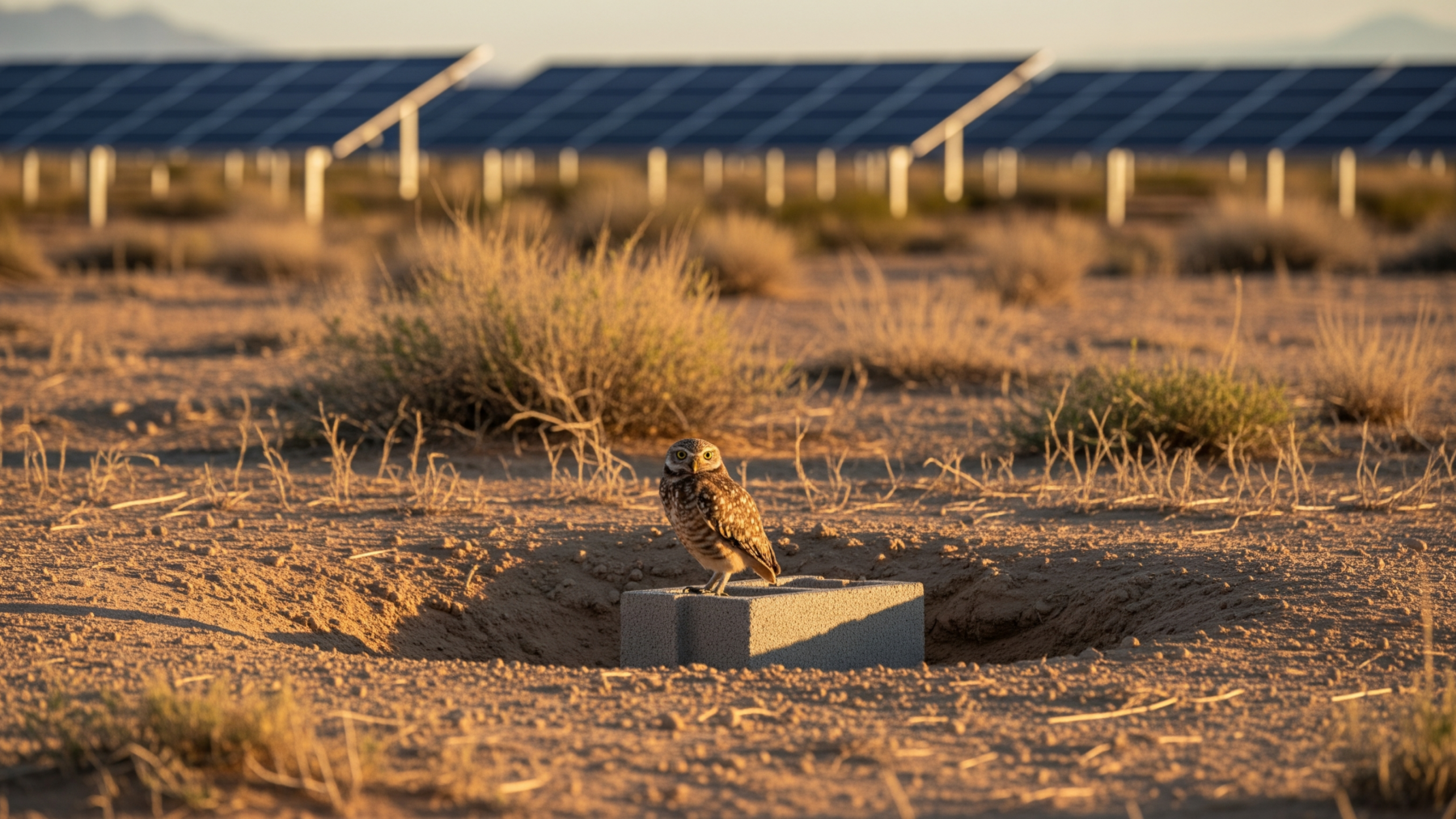
Something was living in the gap between the solar panels.
Not a glitch in the monitoring data, not a maintenance problem.
Something small, barely nine inches tall, with yellow eyes the color of desert marigolds, peering out of a concrete block burrow in the sand.
Clark kept watching the cameras and kept delivering mice, waiting to see whether the desert between the panel rows would give the birds enough to hunt on their own.
The burrow was not there when the array was built.
Neither was the bird.
But now there were thirty of them, and the cameras watching day and night were recording something nobody who signed the energy contract had thought to write down.
A bird that was running out of ground
The burrowing owl has declined across the United States and is considered a serious conservation concern.
Burrowing owls rely on burrows originally dug by other animals, and those sites have been lost through urbanization, agricultural expansion, and habitat fragmentation.
They are birds built for the horizontal world: open, flat, treeless desert, the kind of terrain Phoenix once had in abundance.
As the city’s suburbs pushed west, that terrain kept disappearing.
Arizona-based conservation organizations regularly move entire owl colonies to prevent loss from development.
In 2025, a housing project threatened an established colony of nine owl pairs plus a lone male.
Conservationists searching for relocation sites hit another wall: agricultural lands used in earlier moves were either being developed or rapidly disappearing themselves.
Fifty miles west and a fence line away
The Sun Streams solar farm, located 17 miles west of Buckeye, is built first and foremost to harvest energy.
Its rows of panels run across thousands of acres of Sonoran desert, turning flat sun blasted terrain into electricity.
That same flat terrain happened to look, to an owl’s eye, like home.
Longroad Energy set aside roughly 250 acres between two of its arrays, and in March 2025 the owls made the drive.
Wild at Heart relocated nine owl pairs and one single male from the housing site roughly 50 miles away.
Each pair went into an artificial concrete block burrow ringed with netting at first, so none would simply fly home.
Workers installed lights above the enclosure to pull moths and beetles in from the night air, and brought thawed mice on a daily schedule until the colony found its footing.
Cameras running, colony settling
Motion-activated cameras now track the colony’s 30 open artificial burrow sites around the clock while biologists monitor nesting success and survival.
Greg Clark, burrowing owl habitat coordinator for Wild at Heart, had spent nearly 27 years working to pull this species back from the edge.
He had moved colonies before, into agricultural fields and managed grasslands.
None of those sites were still there.
One month in, all the females had laid eggs.
Clark kept watching the cameras and kept delivering mice, waiting to see whether the desert between the panel rows would give the birds enough to hunt on their own.
He began finding insect remains in their droppings, and understood that the answer was yes.
Thirty-six chicks beneath the Arizona sun
The bird perched at the entrance to the concrete block burrow at the Sun Streams Solar Complex near Tonopah, Arizona, was a burrowing owl.
Its colony had just become the most productive relocation site Wild at Heart had ever attempted at this scale.
By late June 2025, 36 chicks had hatched, and within three months 29 owlets had fledged.
Cameras were tracking about 40 owls across 30 open burrows as of early July 2026.
The story attracted the National Audubon Society, which covered the first full breeding season.
A 2025 Arizona State University study mapped where prime solar sites overlap important burrowing owl habitat across seven Western states and put the figure at 13%.
Build in the wrong spot and a solar farm can hollow out a landscape as thoroughly as any subdivision.
It would be easy to oversell this story: the owls at Sun Streams were evicted by houses, not by panels, and solar did not rescue them from solar.
What the burrows underneath the panels might mean
The honest read is complicated, and the researchers are the first to say so.
The fence that keeps equipment thieves out also keeps coyotes and bobcats away from the burrow entrances.
Clark believes the open landscape beneath the panels lets the birds spot predators from far away.
The panels may also attract the insects the owls feed on, though the team is still learning whether that effect holds across seasons.
Whether that combination can be deliberately designed into future projects is the question driving the study now.
Agrivoltaic researchers tracking what else thrives in the shadow of panels are asking a version of the same question on farmland across the country.
In Tonopah, for now, the answer is a small bright eyed bird standing watch on a weather sensor while thirty burrows wait below it in the sand.
Hugo is an engineer with strong technical expertise. Multilingual from an early age, his writing combines technical clarity with a strong interest in science and energy.
