
A lattice tower on a former Lusatian coal field will carry its nacelle to 984 feet by jacking the whole machine up through itself, and the turbine on top of it is an ordinary 3.8 megawatt unit
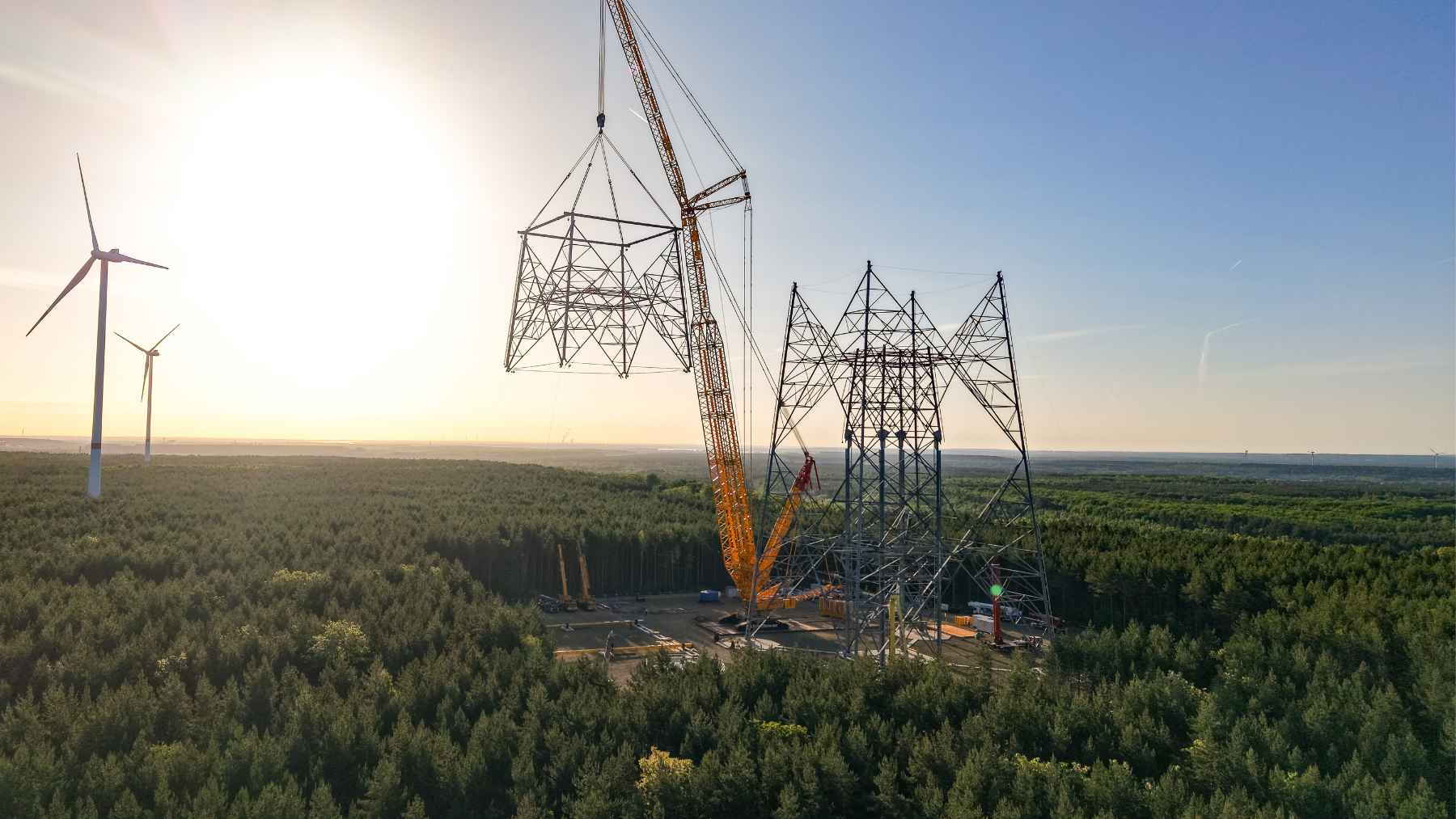
Flat reclaimed ground in eastern Germany, the floor of a lignite region that stopped digging.
Out of it rises a steel lattice frame that looks more like a radio mast than a wind turbine.
It has stood at about 548 feet for months, finished as steel and going no higher.
Total height to the highest blade tip is about 1,198 feet, which makes it the tallest wind turbine anywhere and the second tallest structure in Germany.
The nacelle and the blades go on at that height, on the ground by the standards of this job.
Then the whole assembly gets pushed up.
The hub ends at 984 feet.
Why the machine has to be built low and then raised
A conventional turbine is stacked. Tower sections go up one at a time and a crane lifts the nacelle onto the last of them.
That works until the hub height passes what any crane can reach, and at 984 feet nothing on the market gets close.
So this design splits the tower in two. A fixed outer frame stands permanently, and a second inner tower sits inside it.
The turbine is assembled on the inner tower at the lower height, and hydraulic jacks running on steel strands then drive that inner tower upward through the outer one.
Roughly 827 short tons of nacelle, rotor and inner structure travel up together in one continuous operation.
The crane never reaches the top because the top starts lower.
What is actually standing on the field
Total height to the highest blade tip is about 1,198 feet, which makes it the tallest wind turbine anywhere and the second tallest structure in Germany.
Hub height is 984 feet, and the rotor spans about 413 feet across.
The frame is assembled from roughly 22,000 separate pieces held together with something near 80,000 high strength bolts.
Underneath sit four foundation plates over ground compacted by vibration, with concrete piles driven about 66 feet down into old spoil.
Steelwork was topped out in July, and the lift itself is scheduled for the end of this month, weather permitting.
Twenty two thousand parts, and one that moves.
The detail that says what this project is really testing
Here is the part that gets buried under the record.
The turbine going on top is rated at 3.8 megawatts on a rotor of about 413 feet. By current onshore standards that is a small machine.
Modern land turbines routinely run past 6 megawatts on rotors half again as wide, and a developer chasing output would fit one of those.
This project fitted a modest, proven, off the shelf nacelle instead, and the reason is that the nacelle is not the experiment.
The experiment is the tower and the lift. Putting an unproven turbine on an unproven tower would make a failure impossible to attribute.
If the tower fails, the cause has to be the tower, and that is worth giving up a few megawatts for.
The record is the tower. The turbine is a control.
What 984 feet is supposed to buy
Wind speed rises with height, and the power available rises with the cube of that speed, so a modest gain in speed is a large gain in energy.
Above roughly 650 feet the flow also smooths out, because the drag of trees, buildings and terrain stops reaching that far up.
Steadier wind matters as much as stronger wind, since turbulence costs output and wears gearboxes and bearings.
The claim attached to this design is roughly double the yield of a conventional machine on the same site, and a measurement mast has been standing here since 2023 to test it.
Inland Germany is exactly where that argument bites, because low average wind speeds are what make conventional sites marginal there.
Building capacity is the easy part, as a Spanish region found when its wind capacity stalled after two decades of growth.
The height, the rotor and the turbine model are listed in a reference entry.
Height is free fuel if the steel is affordable.
What still has to be proved after the lift
A successful jacking operation proves the method works once, which is not the same as proving it is economic.
The honest questions start afterward. What a lattice tower this tall costs against a tubular one, how it is inspected, and what maintenance looks like when the nacelle has to come back down to be serviced.
That last point is the design’s quiet advantage and nobody has demonstrated it yet, because the inner tower can in principle be lowered again.
The developer talks about a hundred machines within five to seven years, which is an ambition rather than an order book.
A first machine standing is a milestone and not a market, as a Danish project showed when its first turbine went up.
The steel completion, the current height and the lift sequence are described by an industry portal.
The lattice tower is finished and the interesting minutes are still ahead, sometime this month.
Hugo is an engineer with strong technical expertise. Multilingual from an early age, his writing combines technical clarity with a strong interest in science and energy.
