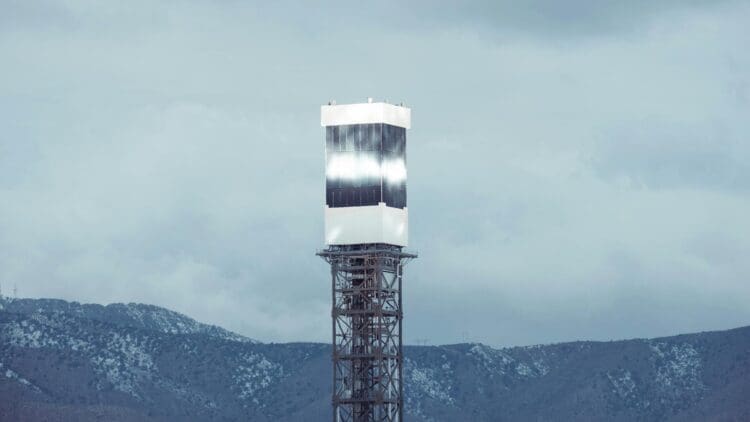

At first glance, it doesn’t look like clean energy at all. No shiny panels. No rooftops. No neat blue rectangles catching sunlight.
Instead, you see something far stranger. Thousands of mirrors slowly turning together, all staring at a single tower, all reflecting light into one blinding point. The air above it shimmers. The heat is intense. It feels less like solar power and more like a controlled sun on Earth.
When solar power abandons panels
For most people, solar energy means one thing: panels. They sit quietly, soak up light, and turn it into electricity. Simple. Familiar. Predictable.
But panels have limits. Clouds pass by. Night falls. Power fades. To keep electricity flowing, batteries step in — expensive, heavy, and far from perfect.

That’s why engineers started asking a strange question. What if solar didn’t need panels at all? What if heat, not electricity, was the real key?
A different idea starts taking shape
Instead of turning sunlight directly into power, this approach does something more primitive — and more powerful. It turns sunlight into extreme heat.
Mirrors, not panels, become the stars of the show. They don’t absorb light. They chase it. All day long, they follow the sun across the sky, redirecting its energy toward one single target.
The result isn’t gentle warmth. It’s something closer to an industrial furnace.
Why heat changes everything
Heat behaves differently than electricity. It can be stored more easily. It doesn’t vanish the moment the sun dips behind a cloud. Once captured, it can be saved and used later.
That means power can keep flowing after sunset. Not for minutes, but for hours. Sometimes all night. For large power plants, this changes everything.
Suddenly, solar doesn’t feel intermittent anymore. It feels dependable.
This is where it’s happening — and what it really is
This massive setup sits in China’s Gobi Desert, near Yiwu Town in Hami. It’s a tower-based concentrating solar power (CSP) plant, built by China Energy Engineering Company.
Around 14,500 mirrors, called heliostats, surround a tall central tower. They track the sun and reflect its light toward the top, where molten salt absorbs the energy. The temperature inside reaches about 1,049°F, hot enough to generate steam and produce electricity — even when the sun goes down.
Instead of batteries, the heat itself is stored, ready to be used whenever needed.
Why this project is turning heads worldwide
Since going online, the plant has quietly broken records. It has delivered massive amounts of electricity and proven it can survive extreme desert conditions, including winds over 80 mph, without damage.
More importantly, it shows a different future for solar power. One where mirrors replace panels. Where heat replaces batteries. Where sunlight becomes a controllable resource, not a fragile one.
Other regions are already watching closely. Similar “seas of mirrors” are appearing in parts of Europe, trying to match what China has achieved.
This may not look like solar anymore.
But it might be what solar grows into next.