Very little compares to designs that evoke the old-world English charm.
Now, old-world English charm has been introduced to modern, renewable energy technology. But how could this even be possible?
By combining the timeless, enchanting, romantic aesthetic of ivy wall coverings with solar panels, that’s how.



The lines between modern sustainability and timeless beauty are finally beginning to blur. Is this truly a new era for the solar power industry?
How a common fairytale feature can reshape solar energy
In tales as old as time, especially fairy tales, the themes of “love” and “transformation” are commonly repeated.
In a love story that involves saving our planet, nations worldwide are facing off against climate change. This requires true transformation, which involves adopting sustainable lifestyles and identities.
Lest we forget that certain aesthetic features are very common in fairy tales to evoke romance and magic.
Fortunately, innovative designers are realizing the importance of bringing these aesthetic features to life in renewable energies.
A very common architectural feature used in most fairy tales is ivy. Samuel Cochran, an architect from Brooklyn, used ivy to reshape the way solar energy is harnessed.
His design evolved from concept to a funded initiative, hinting that the solar industry is ready for a new era.
A timeless makeover for modern solar panels
Solar power is the world’s number one choice as an alternative energy source.
However, in the past, experts in the field had focused on boosting solar efficiencies to new record highs. Now, there is a need and desire for more visually pleasing designs.
The world is growing tired of heavy solar panels that require significant space and are difficult to install.
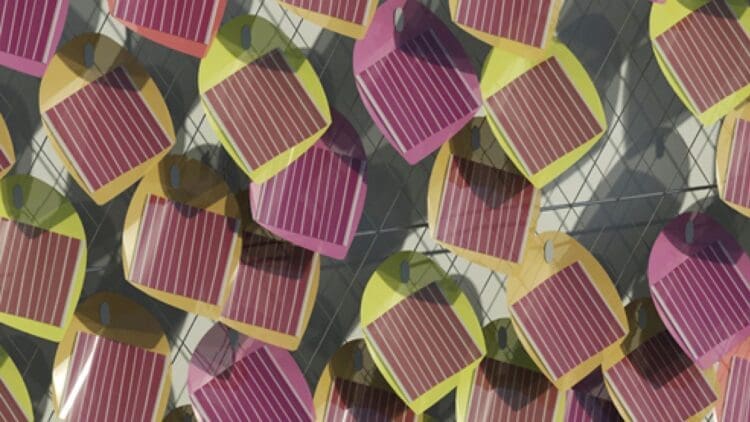
In 2005, Cochran developed a sheet of solar panels shaped as ivy leaves. He called this unique concept “Grow.”
Nations from all over the world are testing solar technology designs inspired by nature. However, Cochran’s design is the first to maintain old-world charm.
Years later, Cochran founded Sustainably Minded Interactive Technology (SMIT). Founders include his sister, Teresita Cochran, and Benjamin Wheeler Howes, a fellow Pratt Institute graduate.
The company, along with the University of Utah, is now developing the next-generation concept of Grow.
Solar Ivy: The next generation of solar power design
SMIT evolved Cochran’s Grow concept into what is now known as Solar Ivy. The company collaborated with German-based Officium to create a large-scale version.
Officium’s wire mesh transformed the entire concept into a feasible building-integrated photovoltaic (BIPV) system.
In recent years, BIPVs have nearly adopted all the colors of the rainbow, increasing their popularity. Solar Ivy is an even more popular choice due to its old-world charm.
How the “leaves” work to produce 4 W each
Hundreds of flexible, thin-film leaf-shaped solar panels are added to the stainless steel mesh wire. The solar leaves vary from organic PVs to efficient CIGS versions.
The wire is also flexible and enables installation onto different surfaces. One leaf can produce up to 4 W, depending on the solar leaf type.
The University of Utah’s Sustainable Campus Fund is backing SMIT Solar Ivy. In 2011, the student-led program provided $42,000 in funding for the project.
The project, “Bringing Solar Ivy to the U,” is part of several projects aimed at making the campus more sustainable.
Solar Ivy is a highly beneficial design. Beyond its fairy-tale aesthetic, it provides shade, is easily maintained, and reportedly has a long-lasting, sustainable footprint.
The concept has come far since its initial design in 2005, but SMIT is continuing its development. It has even incorporated a selection of colors into the design, thanks to Konarka’s printable PVs.
The solar industry is embracing more nature-inspired technologies. Soon, living solar plants could operate all over the world.