
Solar enthusiasts may no longer have to count every penny twice thanks to a new secret weapon.
Conventional clean energy designs are holding the world back from embracing this renewable source once and for all.
Fortunately, the next generation of designs has arrived, and this plate has hit a home run.


Its potential in applications is a hard-hit line drive, but will it win the crowd over once and for all?
How green energy has been stuck at the hot corner
For years, fossil fuels have been key players in the energy game, but their strikeout was inevitable.
That is why researchers and the sector had sought out new sources that could do a “hard 90.”
Then, renewable energy sources, such as solar, were added to the power lineup.
It worked great for a while. But then the sector got stuck at third base, eagerly waiting for that home run.
The pressure was on, and the fast-paced technical line drives were causing more system failures.
Catching the sunlight is one thing, but driving the energy all the way to “home base” is another one entirely.
Another problem is that a significant amount of the energy is lost during the run. This makes the power play much less efficient, defeating the purpose.
As a result, the world has been scouting for a new secret weapon to overcome these obstacles.
Designs that are “flashing the leather” to win
Engineers have attempted highly spectacular defensive plays to save every last watt of energy.
Energy-efficient data centers are expecting more from the sector each day, which is why finding the right approach is essential.
Usually, energy is lost as heat. So, a defensive play would thus particularly focus on this.
In the U.S., Long Island installed 164,000 floating solar panels. The water cools the panels, ensuring high efficiency at all times.
While it is a significant defensive effort, the design itself still faces inherent “errors.”
These involve:
- Parasitic inductance, which is the result of the thick, “brick” design creating internal electricity pathways
- Most bases are made of rigid ceramic, which is costly, heavy, and non-durable
- Inability to handle high-frequency switching between the panels and the grid
No wonder the “best technology” has been benched.
Fortunately, the National Laboratory of the Rockies engineered a device that could drive the runner home.
The solar concept that will make the crowd go wild
The National Laboratory of the Rockies (NREL) decided that “kicking it old-school” was not going to help win the game.
Most researchers have focused on changing the solar material to increase efficiency. However, the NREL team, led by Faisal Khan, the chief power electronics researcher, decided to redesign the entire system.
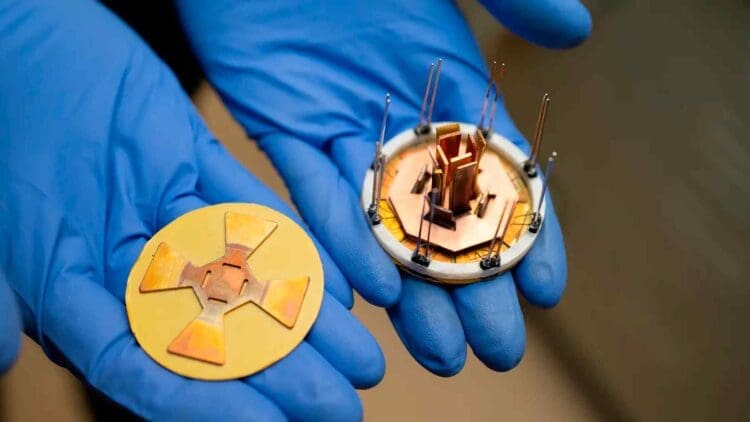
Their new high-tech device is called the ultra-low inductance smart (ULIS) power module.
This new secret weapon overcomes all the obstacles
The ULIS is a 2D octagonal plate with a flat design that cancels out magnetic flux. As a result, parasitic inductance is decreased by 7 to 9 times, enabling uninterrupted power flow.
Temprion, a flexible polymer, was used instead of rigid ceramics. This lowered the production costs from thousands of dollars to mere hundreds.
The plate itself predicts component failure before it happens. This built-in health monitor makes it reliable for high-stakes applications, such as data centers.
This NREL secret weapon certainly hits it out of the park. Its cost-effectiveness, smart capability, and lightweight make it ideal for a game-winning play.
Beyond providing highly efficient power essential for AI and data centers, the military and aviation could also benefit.
While it may be too early to tell whether it will finally win over the crowd, its potential is undeniable. For now, it is safe to say that the solar game has gotten much brighter.