
Australian engineers borrowed the design of a speargun from the ocean and turned it into a tool that could make offshore wind farms far cheaper to build
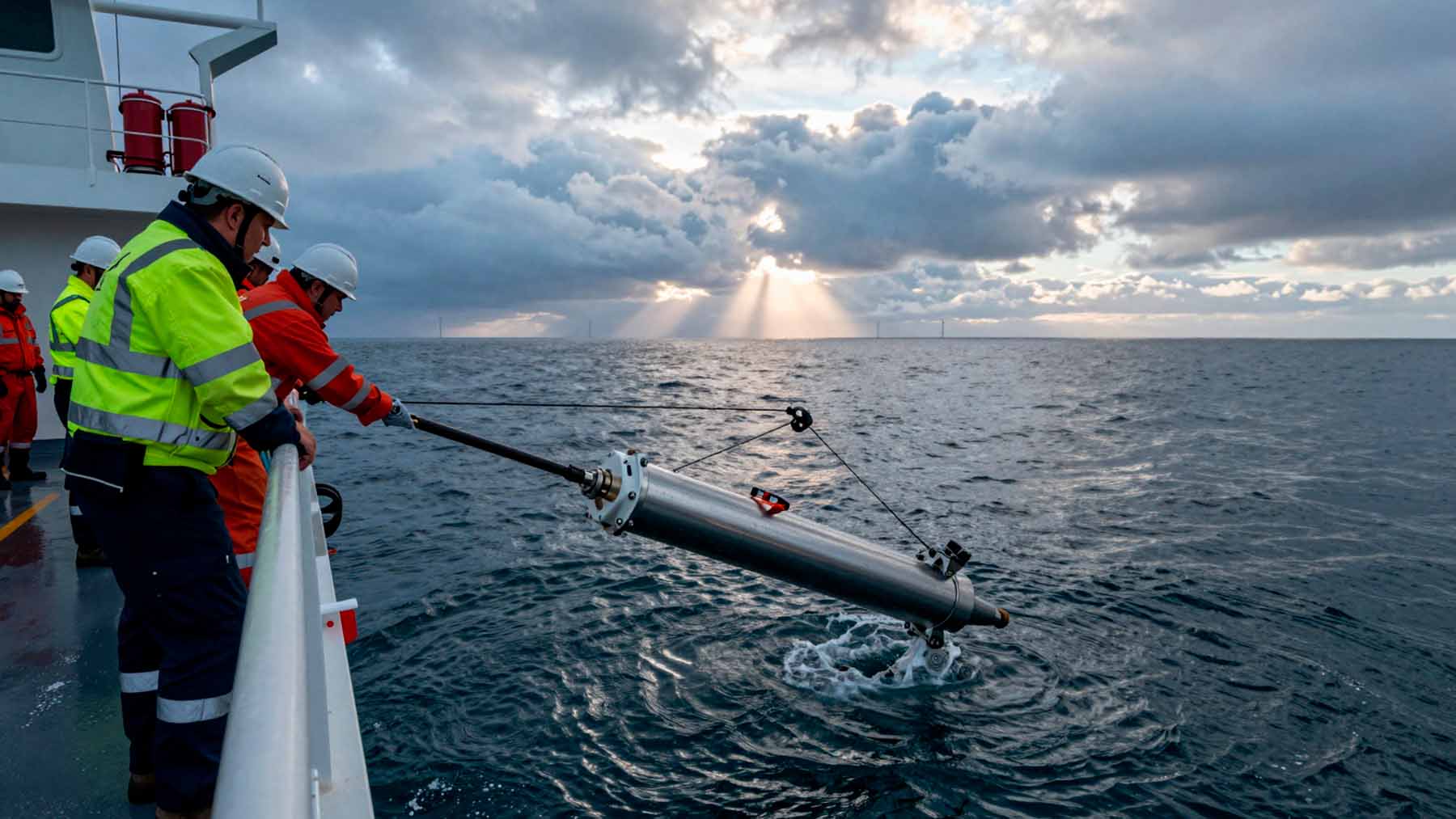 AI-made
A speargun — the kind used for recreational diving — is not the first thing that comes to mind when engineers need to map the ocean floor for a wind farm. Yet that’s exactly where researchers at RMIT University started.
Building offshore wind farms requires precise knowledge of what lies beneath the seabed. Current lightweight probes often struggle to penetrate shallow sandy conditions, while the heavy-duty equipment that actually works can cost up to AU$200,000 a day. An unlikely fix, developed in a university lab, may be about to change that equation.
The problem beneath the waves
Before a single turbine foundation goes in, engineers need to understand what the seabed is made of — and how it will behave under enormous structural loads. That means pushing instrumented probes into the seafloor and measuring how the soil responds. Without that data, foundation design is essentially guesswork.
The research was supported by the Australian Research Council through its Discovery Project scheme and conducted in collaboration with the University of Melbourne.
The standard approach for shallower waters uses lightweight free-fall penetrometers — probes dropped from a vessel that rely on gravity and momentum to drive themselves into the seabed. They work reasonably well in soft, silty conditions. But shallow coastal zones, precisely where many wind farms are being planned, often feature dense, compacted sandy seafloors. In those conditions, free-fall probes simply don’t go deep enough to return useful data.
The alternative is heavy-duty cone penetration testing equipment, which can force probes into even the densest sand. Operating that equipment from a specialized support vessel can cost up to AU$200,000 per day — and for a wind farm site requiring dozens of test locations, that bill adds up fast. It’s a bottleneck that slows development and drives costs higher before construction even begins.
A speargun reimagined as a geotechnical tool
The RMIT team’s insight was straightforward: if gravity isn’t enough to drive a probe into dense sand, add a mechanism that delivers a controlled burst of additional force. A speargun does exactly that — storing elastic energy and releasing it rapidly. Adapting that principle to a geotechnical probe launcher turned out to be a productive idea.
The device was tested inside a water tank at RMIT’s Heavy Structures Laboratory. Researchers tried different probe tip designs across sand mixes of varying density, with an array of sensors recording the forces at play during each penetration event. High-speed cameras captured the moment of impact in detail. The controlled lab environment let the team isolate variables and build a reliable picture of how the launcher performed under repeatable conditions.
Results published in the Canadian Geotechnical Journal were clear. In high-density sandy material — the exact condition where free-fall probes struggle most — the speargun-launched device achieved twice the penetration depth of existing lightweight alternatives. Lead author Junlin Rong described the penetration potential in dense sand as considerably greater than what freely falling probes have previously achieved.
Cost savings and environmental benefits
Doubling penetration depth is useful on its own. The device’s broader appeal, though, lies in what it could mean for project economics. Because it performs meaningfully better than free-fall tools in dense sand, it could reduce how often engineering teams need to call in expensive heavy-duty equipment — and fewer days of AU$200,000 vessel operations translates directly into lower site investigation budgets.
The design also supports reuse. After each deployment, the probe can be retrieved and sent back down again — a “probe and go” approach that keeps operations moving without accumulating equipment costs. That cycle also limits seabed disturbance, which matters in environmentally sensitive coastal zones.
There’s another practical angle: the launcher can be retrofitted onto penetrometer probes that engineering firms already own. No need to scrap existing equipment. Companies can upgrade what they have with minimal additional investment, which lowers the barrier to adoption considerably. Rong was careful to note that conventional cone penetration testing isn’t going away — it will remain the industry standard for detailed site characterization — but the speargun-based launcher could reduce the number of those expensive tests required at each site.
What comes next: from lab tank to open ocean
Laboratory validation is one thing. Performing reliably in open-water conditions — with currents, wave action, and the logistical complexity of offshore operations — is another challenge entirely.
RMIT Professor of Geotechnical Engineering Majid Nazem confirmed that the device is now ready for field trials. The lab experiments demonstrated what the launcher can do under controlled conditions; the priority now is testing that performance where conditions are far less predictable. To get there, the team is actively seeking industrial partners in offshore geotechnical engineering. Collaboration with industry would give the device a pathway from research prototype to something deployable on actual wind farm site surveys. The research was supported by the Australian Research Council through its Discovery Project scheme and conducted in collaboration with the University of Melbourne.
Offshore wind development is accelerating across Australia and globally, and pressure to reduce site investigation costs will only grow as projects move into shallower, sandier coastal waters. If field trials confirm what the lab results suggest, a tool inspired by a recreational diving speargun could become a routine part of the offshore engineer’s toolkit — quietly making clean energy infrastructure a little cheaper to build.
The full study was published by the RMIT University.

Carlos is an engineer with strong expertise in technical and industrial topics. He previously worked at international companies such as Siemens and is multilingual.
