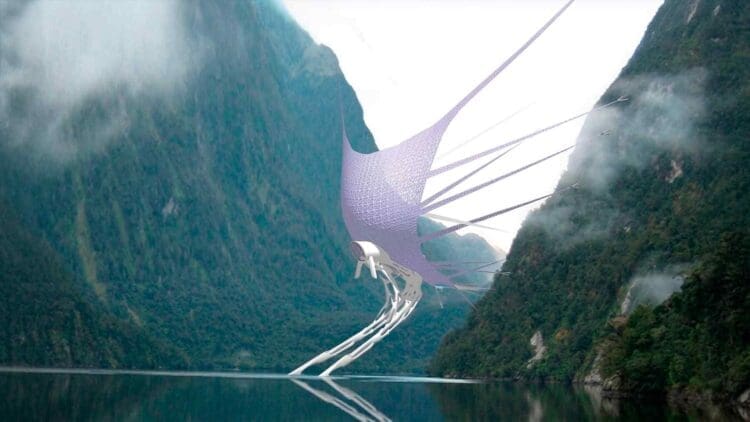

Is it a yacht, or is it a kite, or is it a first-of-its-kind wind turbine design?
The latter is the most likely answer, especially as this innovative invention is suspended across a gorge.
This design was inspired by nature and explores harnessing wind energy from the most unlikely spaces on Earth. As it blends into the landscape, we cannot help but wonder, is this the future of wind power?

How wind energy has been experiencing growing pains
Wind power is the world’s second-best clean power solution. However, it is no secret that wind capacity expansion has encountered some issues over the past few years.
Have you ever wondered why traditional wind turbines are so gigantic?
As the saying goes, “The tallest trees catch the most wind.” In this case, the literal meaning applies to traditional wind turbines.
These turbines tower over landscapes as they function best in high-speed winds.
However, this is also where the figurative meaning begins to apply.
To increase efficiency, more turbine installations are required, which means they need plenty of flat terrain.
Enter the “Not in My Backyard” (NIMBY) movement opposing additional installations that impact the environment and the view.
The logistics of transporting the components are a nightmare. Wind speeds are dropping due to a phenomenon known as “climate stilling,” making power more intermittent. Could this be the end of onshore wind?
It is not the end of onshore wind yet
Wind power remains significantly competitive.
Why? Because it is one of the cheapest forms of new power, despite limited policies and a lack of subsidies.
The search is thus on.
Innovators worldwide have been exploring various designs to address the growing pains of wind energy. Some designs are small, while others can fly, and some wind turbines never even make it beyond concept at all.
The ultimate solution would be to create a design that operates in low-speed winds. It must not require extensive land space, and it must still have a significant power output.
A British architectural firm called Chetwood Associates has developed a unique design that does not use land. However, it also does not fly.
Instead, it stretches over a very unlikely place to produce clean power. It was even inspired by one of Earth’s tiny arthropods.
A wind turbine hanging tight to harvest clean energy
The Chetwood Associates architects created the device called “Wind Dam.” This device was proposed for a project in the mountain gorge near Russia’s Lake Ladoga.
This design may resemble that of the 3 kW Kitepower that flies 1,300 feet in the air. But do not be fooled, as this is a stretched Kevlar sail that looks like a giant spider web.
This “spinnaker” sail funnels wind through 15-20 kW in-line turbines, without any energy escaping the rotors.
The design is more efficient, as wind is harnessed from a wider area, thereby mimicking a hydroelectric dam. Lower wind speeds are also harnessed more effectively.
The proposed project cost £2.5 million, which is approximately $3.3 million.
The Wind Dam has great potential in the U.S. Take the Colorado River, for example. It can be installed across the Grand Canyon and several other gorges and canyons along the Colorado River.
The concept is highly innovative and addresses many growing pains of onshore wind. But what is its current status? Chetwood Associates proposed the Wind Dam in 2007/2008, but it never reached the installation phase in 2009.
Ever since, no further updates have been provided.
It is strange, as it nearly ticked all the right boxes. This makes one wonder, why do sustainable, low-impact alternative wind designs never really make it to the market?