
Goodbye, bad energy, hello, greener energy.
Indoor appliances no longer need the usual drawbacks of batteries, as an alternative power solution has entered the building.
This time, outdoor rooftop solar panels are not the correct answer, as a new, thinner device has been advanced for greater impact.




Indoor power now has an entirely new look, and it is hitting all the right marks.
What led scientists to seek power beyond batteries
At one point or another, a flashlight is suddenly needed, either for an unexpected blackout or some other emergency. The proud feeling of being prepared is suddenly replaced by utter disappointment when the “emergency” flashlight is dead.
Is it Murphy’s Law at play, trying to get a good laugh?
In short, no, it is not. Even though an electronic device remains unused for the better part, its batteries still self-discharge over time.
Most portable devices and small appliances have batteries with a very short life cycle.
Batteries actually have quite a few drawbacks, which include:
- Alkaline leaks, which irreversibly corrode appliances’ metal contacts
- Heating and aging cause them to swell, which may cause thermal fires
- They cost you more over the long term
- Incorrect disposal could contaminate soil and water
Altogether, it makes sense that scientists have been seeking alternative solutions to power indoor appliances.
A solar solution seemed ideal.
Solar panels: It seemed like an ideal solution
Solar power has always been a favorable alternative to provide clean power to businesses and homes.
However, not everyone can afford to install traditional solar power, nor do they have the space for it.
Unique products such as the charming solar panel ivy-mesh are getting ready to enter the market. Yet, these products are still not what consumers need when it comes to powering small appliances.
University College London (UCL) scientists created an international team to engineer a device that meets these particular needs. The team consisted of scientists from China, the UK, and Switzerland.
Such a device had to be able to generate clean power under varying conditions.
It also had to be small enough, yet highly efficient, and obviously last longer than most batteries and solar solutions.
The team decided to use a solar material once seen as the ultimate game-changer, but was forgotten too soon.
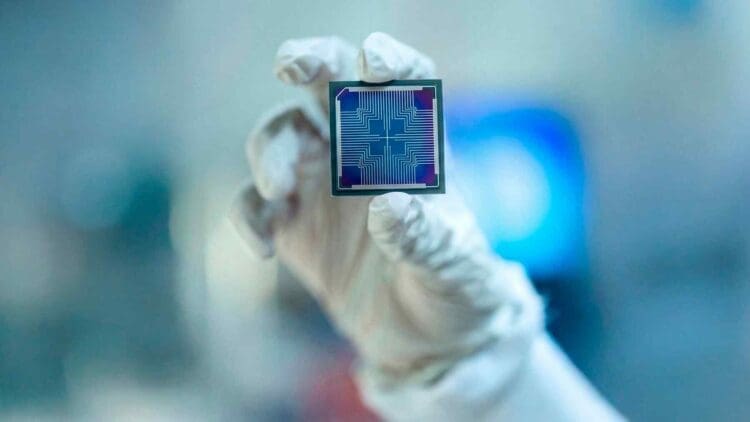
The newly developed thin solar film for indoor power
Perovskite was chosen as the material for the team’s innovative indoor solar cell for power production.
Why perovskite in particular?
Mainly because it is great at absorbing specific wavelengths of indoor light.
However, they had to make a few tweaks first, as perovskite had drawbacks of its own. This is why perovskite is mainly used in tandem with silicon-based solar cells.
The solar material has low durability due to “traps.” Traps are small imperfections that disrupt power flow by trapping electrons in the crystal structures and overheat the material.
Fortunately, the team solved this problem in no time.
Rubidium chloride, iodide, and bromide ions were added to perovskite.
This significantly reduced the number of traps and increased perovskite’s stability.
Affordable. Efficient. Durable
The result was a highly affordable, durable indoor solar cell with an efficiency six times higher than comparable indoor cells.
The team’s findings were published in Advanced Functional Materials. The lead author of the study, Dr. Mojtaba Abdi Jalebi from UCL, believes their device is ideal to replace batteries.
The reason for this entails the Internet of Things (IoT). The IoT is rapidly growing across various industries, meaning billions of small appliances will require small-scale power solutions.
Seeing as batteries are highly unsustainable, indoor solar cells could truly be the future of smart, small-scale electronics.
Anke Maree is a writer with a clear and engaging editorial style. Her work focuses on making complex topics accessible, informative, and relevant for readers across different areas of interest.