
Spread across three New Mexico counties after 20 years of waiting, 916 steel rotors are finally turning together, and the desert corridor carrying their power 550 miles west rewrites what a single wind farm can do to a grid
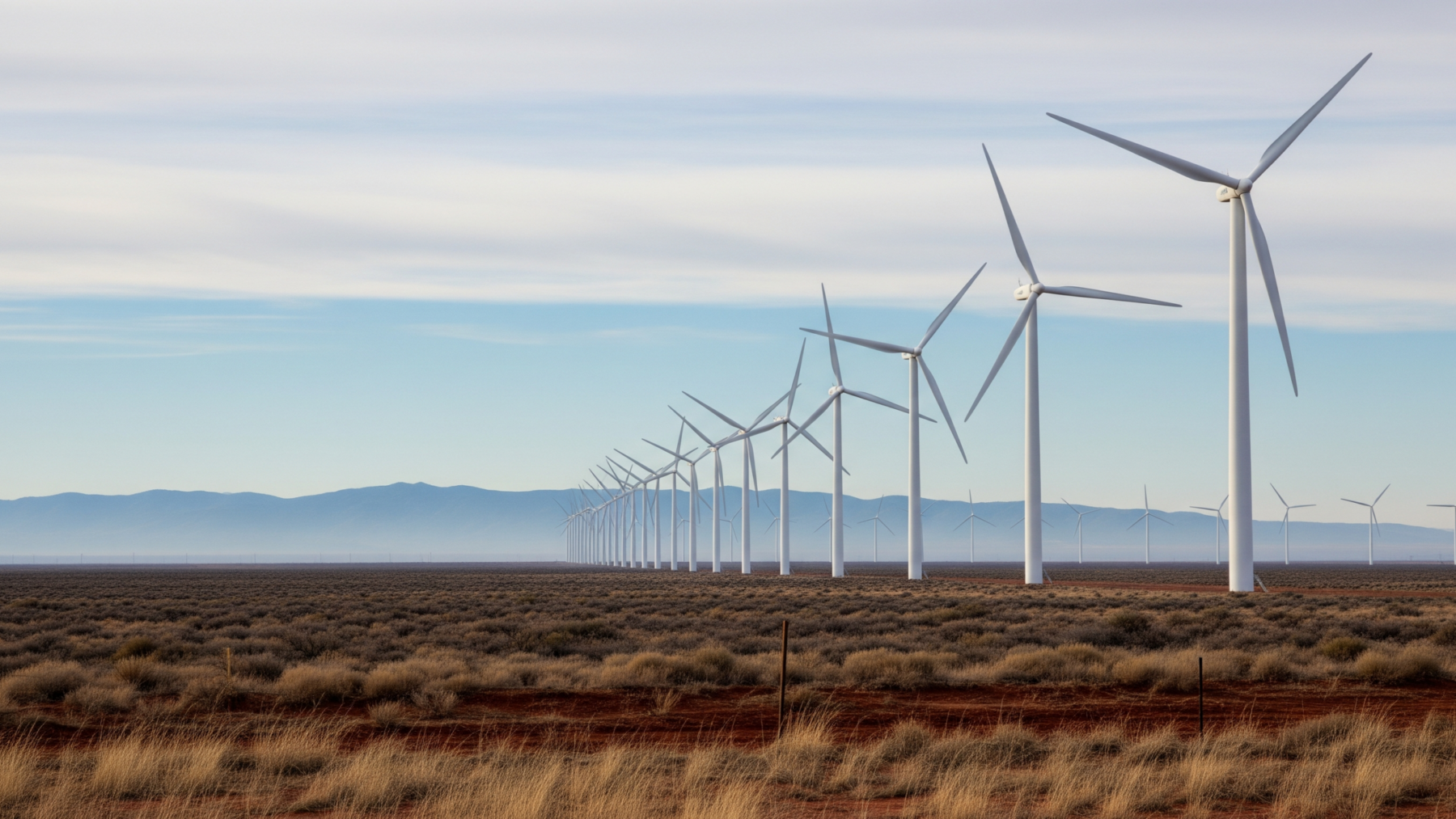
The desert between Vaughn and Carrizozo, New Mexico, does not look like the future of American power. Red earth, sparse grass, a horizon so flat and wide that the sky feels oversized. For most of the last century, this stretch of Lincoln and Torrance counties was ranch land and little else. Then, in June 2026, 916 wind turbines switched on together, and everything changed.
Twenty years to flip a switch
The planning for what became the SunZia Wind Project began in 2006. Two decades of environmental reviews, federal permitting on Bureau of Land Management land, route negotiations and financing rounds followed before a single blade turned. Total investment across both the wind and transmission components stands at $11 billion, with construction having begun in 2023 following nearly two decades of development.
That timeline is not a story of incompetence. It is a story of genuine complexity. The project needed to cross jurisdictions, satisfy wildlife agencies, negotiate with ranchers and Pueblo communities, and then build not just a wind farm but an entirely new electrical highway. Each of those steps had its own clock, and Pattern Energy broke ground in September 2023. Less than three years later, the machines were running.
Grid integration at this scale demands constant attention from CAISO operators still learning how a single farm this large behaves across a full seasonal cycle.
A number that takes a moment to land
The wind farm carries a total net summer generating capacity of 3,650 megawatts spread across 916 turbines. To feel the weight of that figure, consider what sits beside it: SunZia’s capacity is more than three times larger than the next two biggest wind farms in the country, Alta Wind in Southern California at 1,098 MW and Great Prairie in northern Texas at 1,027 MW. Not a step forward but a leap.
Commissioned in June 2026, the project became the largest wind power development in the Western Hemisphere, capable of supplying three million U.S. households. On May 15, 2026, CAISO’s Hourly Electric Grid Monitor recorded 7,122 MW of hourly wind generation, 20 percent above the previous annual record of 5,922 MW set in 2024, with SunZia’s turbines contributing during the testing phase. The record fell while the farm was still warming up.
The corridor nobody sees
Power generated in central New Mexico is not especially useful to Los Angeles or Phoenix on its own, so moving it required solving a second engineering problem almost as large as the first. The answer was a 550-mile, 525-kilovolt high voltage direct current transmission corridor running from Lincoln County to Arizona and Southern California, losing far less energy over long distances than conventional alternating current lines.
Before SunZia came online, net summer wind generating capacity in New Mexico totaled 3,997 MW. The new capacity brings the state total to 7,647 MW, meaning wind now accounts for 45 percent of the capacity mix, followed by 19 percent each from solar and natural gas. The desert did not just add capacity. It changed the math entirely.
What the SunZia wind farm actually is
This is the reveal that took two decades to deliver. Pattern Energy’s SunZia wind and transmission projects, now fully operational, are the largest clean energy infrastructure project in U.S. history, delivering power to California customers. Power purchase agreements cover 12 offtakers, eight of them California community choice aggregators, including Silicon Valley Clean Energy, Clean Power Alliance, and Peninsula Clean Energy.
In July 2026 Pattern Energy signed a 600 MW power purchase agreement with Salt River Project, a not for profit public utility in Arizona. That single deal is itself larger than many entire wind farms. The company described its approach plainly: “We seek to build partnerships and bring long term benefits to the communities where we operate.”
The total economic benefits for New Mexico and Arizona are estimated at $20.5 billion, and the projects created more than 2,000 construction jobs and 100 permanent positions. You can read more about supply deals shaping the same turbine technology globally, and about the offshore construction complementing the onshore push SunZia represents. For ranching counties that have watched young people leave for decades, 100 permanent jobs in a remote landscape is not a footnote.
What comes after the record
SunZia will not hold its title unchallenged for long. Developers around the world are already planning projects at multiples of its capacity, and China alone installed 130 GW of new wind in 2025. But those projects remain on paper. SunZia is in the ground, spinning, and delivering electrons to households right now.
Grid integration at this scale demands constant attention from CAISO operators still learning how a single farm this large behaves across a full seasonal cycle. Maintenance and repowering will test Pattern Energy’s commitment to those ranching communities in ways a ribbon cutting never can.
Still, something genuine happened in the New Mexico desert. A rancher driving the county road between Vaughn and Corona now passes 916 turbines where there were none three years ago. The wind that has always moved across that plain is moving something else now: power for a million households in two states that never had to burn a barrel of fuel to get it.

Hugo is an engineer with strong technical expertise. Multilingual from an early age, his writing combines technical clarity with a strong interest in science and energy.
