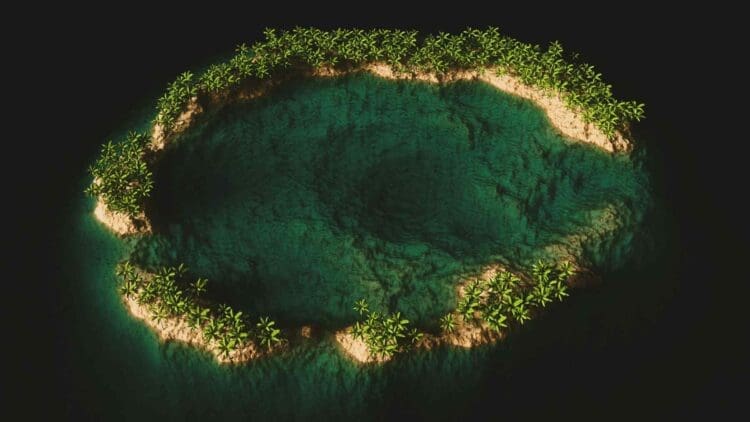

The vast ocean hides many secrets, with some more mysterious than others, including a recently discovered ‘sunken continent’ that once hosted abundant and lush life. Yet, these continents disappear under the depths of the ocean. What’s more, this discovery unveiled a hidden treasure crucial in the energy transition, mapping the future of climate change mitigation. Why do these continents disappear, and is this hidden treasure a blessing or a curse?
Earth’s continents: Highly complex formations
Planet Earth is perceived as the most unique planet in the entire solar system, as it is the only one confirmed to be able to sustain life. To add to this uniqueness, several complex forces on and around the planet contribute to Earth’s ever-changing. Geologically speaking, landmasses have continued to change over billions of years, with some splitting or assembling, while others simply disappear from the map.
This is evident in the discovery of a ‘sunken continent’ near America, in a region that has sparked increased interest worldwide, but for significantly different reasons. While this discovery forms new insights into the internal forces driving geological changes, it also offers significant implications for the global energy transition. Will it boost economic potential, or increase environmental risks?


The discovery of a ‘sunken continent’ near America
Approximately 745 miles of the coast of Brazil’s southernmost state, Rio Grande do Sul, is one of the South Atlantic’s most complex and unique geological formations, and a research team led by the University of São Paulo has uncovered a new truth about this formation. The research team also consisted of researchers from universities in the UK, Germany, and Japan.
After 10 years of research, it was discovered that the Rio Grande Rise was once a lively tropical island. According to Professor Luigi Jovane, rock and sediment analysis revealed that the Rio Grande Rise was indeed a piece of continental crust, with the region’s formations dating back to between 540 million and 2 billion years. Volcanic rock samples were found to be approximately 47 million years old.
So, volcanic activity and the tropical conditions thus led to the formation of the Rio Grande Rise, but cooling and tectonic movement led to it “sinking.” However, the main interest of this discovery was the site’s crucial minerals, which are needed for the global energy transition, and North America is in dire need of.
The implications of this discovery on the global energy transition
The Brazilian government has requested that the UN add the site to its continental shelf, as the environmental implications of mining these minerals could be devastating. The Rio Grande Rise is significantly rich in the following minerals:
- Nickels
- Manganese
- Cobalt
- Tellurium
- Rare Earths
The reason why the Rio Grande Rise’s minerals are of international interest is that mineral-poor nations require these rare minerals for renewable energy technologies, such as solar panels, wind turbines, batteries, and other electronic devices. Professor Jovane underscored that deep-sea mineral mining and its environmental impact have not been adequately explored. He added that:
“To know whether resources can be viably extracted from the sea floor, we need to analyze the sustainability and impacts of this extraction….When you interfere with an area, you have to know how this will affect animals, fungi and corals, and understand the impact you’ll have on the cumulative processes involved.”
If the UN finally accepts the request made by the Brazilian government, Brazil will have exclusive access to the Rio Grande Rise, giving the country a unique opportunity to secure a geopolitical and scientific advantage over other nations. However, the country will also have a significant responsibility to ensure the sustainability of the site and its surrounding ecosystems. One thing is certain: it could play a key role in diversifying Brazil’s energy sector.