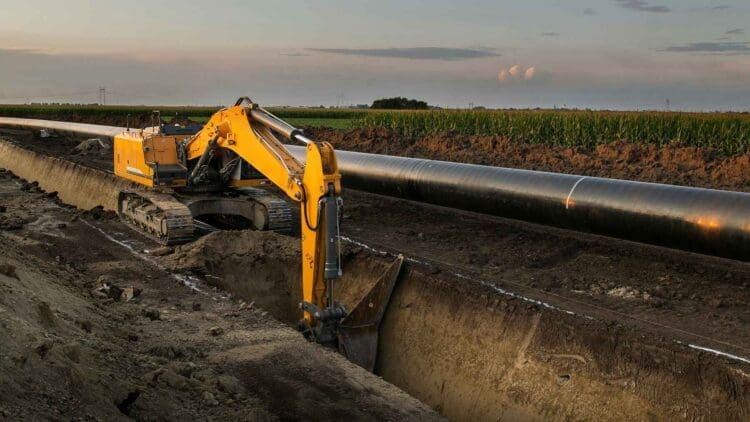

A commercially-driven pre-construction milestone. A major pipeline expansion is rarely driven by construction alone. Pipeline companies work closely with their customers before starting the process of construction through a series of commercial energy agreements. These agreements allow all parties to assess whether or not the customer’s capital requirements can be combined with the pipeline company’s ability to execute and take the associated risks.
A commercial step that precedes construction
In addition, these commercial agreements set the foundation for how the project can move forward and the implications for Canada’s LNG aspirations.
TC Energy has announced that Coastal GasLink has entered into new commercial agreements with LNG Canada. This represents an important milestone for the proposed Phase 2 expansion of the pipeline. As such, these agreements do not represent authorization to construct the pipeline. However, they do create the necessary commercial framework for advancing Front End Engineering Design (FEED), as well as planning for executing the project. Ultimately, the project still requires a final investment decision (FID) by LNG Canada and its JV partners, as well as additional regulatory approvals from Coastal GasLink.



Currently, no new capacity is being constructed. Instead, the focus is on determining how to allocate risk and responsibility should Phase 2 proceed. In other words, the parties are establishing the necessary foundations to enable LNG Canada to determine whether the expansion can proceed under acceptable financial and governance terms and conditions.
Why Phase 2 is important in today’s evolving LNG market environment
Coastal GasLink is essential for delivering natural gas supplies from northern BC to the LNG Canada export facility located on the west coast. Phase 2 will essentially double the current capacity of the pipeline by utilizing the existing route and infrastructure.
While technically challenging, this expansion is seen as an essential component to enabling future LNG exports from Canada to international markets, including Asia.
Timing is everything here. TC Energy’s senior management team indicated an increased likelihood that there will be an increase in demand for additional LNG export capacity due to recent disruptions in global LNG supply and increasingly uncertain geopolitics. In this environment, permitted, completed, and capable of expansion assets hold particular strategic value. Phase 2 will position Coastal GasLink as a scalable asset within this larger strategic context.
An introduction of a new execution model to manage risk
One of the most interesting aspects of the proposed commercial agreements is the planned execution model. Should Phase 2 proceed, LNG Canada would serve as Construction Execution Manager (CEM). Additionally, Coastal GasLink would provide Technical Advisory Services. Most importantly, the commercial agreement constrains Coastal GasLink’s capital contributions and liabilities related to construction cost and schedule performance.
The use of CEM and Technical Advisory Services reflects TC Energy’s overall strategy of reducing execution and capital commitment risk in respect of large-scale projects. Under this structure, Coastal GasLink will not bear the entire burden of expanding its own facilities. Rather, it redistributes responsibility in a manner intended to support the viability of FID while maintaining long-term ownership and operation of Coastal GasLink’s pipeline assets.
The significance of this commercial agreement going forward
While establishing a commercial agreement framework does not necessarily mean that Coastal GasLink Phase 2 will ultimately proceed, it indicates that the project has advanced from conceptualization to decision-making. Through providing clarity regarding roles, costs, and risks, TC Energy and LNG Canada have significantly reduced uncertainty at a time when it was most pressing.
Going forward, we expect that those who develop and build LNG-related infrastructure that can grow through orderly and controlled steps will be distinguished from others in a rapidly evolving LNG marketplace. As such, Coastal GasLink Phase 2 exemplifies how commercial frameworks and structures may prove to be as critical or more so than speed of construction in determining whether or not subsequent phases of energy-related infrastructure development become a reality.