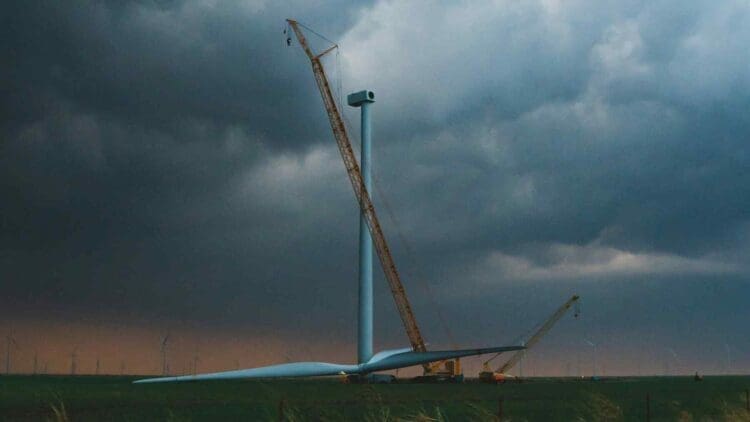

Costly ‘structural debts’ are being incurred in the rush to scale renewables.
Clean energy designs have become technically and structurally highly evolved to stand the test of time.
However, a particular wind turbine farm seems to go against all statistical odds due to its unique problems.
Usually, it is three strikes, and you are out, so how many losses will it take before it is over for good?
How wind turbines play a critical role in the modern world
The world has quite rapidly transformed into a highly advanced, technologically driven society.
However, this transformation came with a long list of consequences, among which are high power demands.
The electrical grid is struggling to keep up as a result. This is why modern turbines have gone from passive wind energy collectors to cutting-edge “stabilizers.”
Sole reliance on coal and gas plants is now a no-go. Their unreliability and massive carbon footprints have paved the way for wind farms to provide synthetic inertia.
These towering giants have thus become the “invisible” guardians of an uninterrupted clean power supply, even in sudden weather shifts.
While some have made these machines near-indestructible, others have transformed them into mystical art pieces.
This proves that wind energy can be as aesthetic as it is powerful.
Yet, it is far from perfect. Some of them are now presenting structural failures that are baffling the world.
Wind power wears a coat of many colors
In general, all forms of renewable energy and their associated technologies have become enigmas.
It is no secret that giant wind installations have quite the environmental impact. But recently, it has been discovered that turbines have a positive impact on pollinators and honey production.
As environmental impact studies uncover the hidden benefits of wind farms, other experts are leaning into unique designs.
Many local groups, such as the “Not in my Backyard” movement, are displeased with the visual impact of turbines. To improve wind power’s repertoire, turbines can now create a beautiful light spectacle at night.
So, from powerful grid stabilizers to creating safer environments for some species, to lighting up the sky. It goes to show just how flexible wind power can be.
However, at Sweden’s Björkvattnet Wind Farm, it seems this coat of many colors is taking on a darker, unprecedented hue.
Three strikes: When “indestructible” blades fail
The deliberate removal of a turbine blade to decrease noise is one thing. But the accidental loss of a blade is another thing entirely.
The 175 MW Swedish wind farm was supposed to be a monument of reliability. Now, it is the focus point of a case study investigating mechanical failure.
One of the GE Vernova Cypress turbines has lost a blade for the third time since 2021. The authorities had to seal off the site due to these strange failures.
From an engineering headache to a crisis for Google
The Cypress model itself is supposed to be an engineering marvel. It features carbon-fiber-reinforced blades that can withstand the region’s brutal and turbulent winds.
The company has previously attributed these break-offs to “production deviations” and “insufficient bonding.” However, the recurring failures may indicate a greater “structural debt” in the rush to scale.
The stakes are much higher for Google, as it relies on Björkvattnet to provide carbon-free power for operations.
This proves that the chain of technologies responsible for the green transition is only as strong as its weakest link.
For tech giants such as Google, this weak link could lead to dire disruptions in electricity and goals.
The wind industry must realize that deadlines and scalability rushes must not trump precision. As GE Vernova investigates these blade losses, we hope that this does not mean more bad news for wind power.
Disclaimer: Our coverage of events affecting companies is purely informative and descriptive. Under no circumstances does it seek to promote an opinion or create a trend, nor can it be taken as investment advice or a recommendation of any kind.