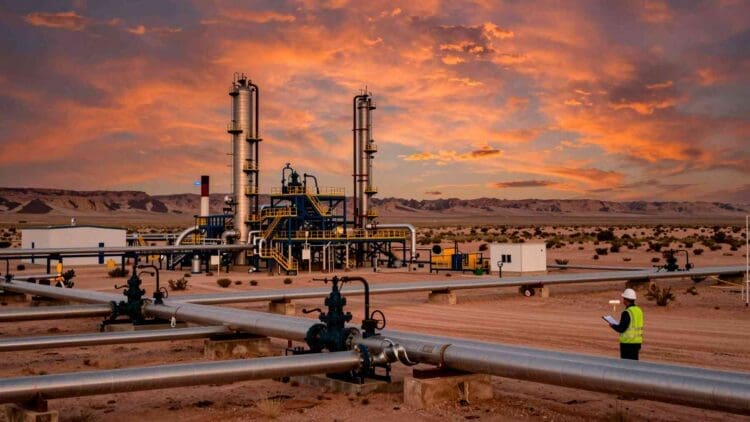

Trace is moving to expand its Northern Delaware Basin gas processing and pipeline system, the company has announced. The project calls for a new gas processing plant, additional gathering pipelines, and compressor stations—with completion targeted for late 2027.
Trace announces Delaware Basin expansion
The announcement confirms that Trace intends to build out its Northern Delaware Basin gas processing and pipeline system in a substantial way. This is not a minor upgrade. It combines a new gas processing plant with additional gathering pipelines and compressor stations — four distinct infrastructure additions working in concert to increase the system’s overall capacity.
The target completion date is late 2027, giving producers in the region a concrete horizon for when additional midstream capacity will come online. For Trace, it represents a multi-year commitment to growing its footprint in one of the most productive corners of the Permian Basin.


The expansion builds directly on Trace’s existing Northern Delaware Basin infrastructure. Rather than starting from scratch, the company is extending and reinforcing what it has already put in place, adding new components that integrate with the current system.
Why Trace is investing in additional capacity
The driving force is straightforward: natural gas production volumes in the Delaware Basin have been climbing, and existing midstream infrastructure is being pushed toward its operational limits. When gathering and processing systems approach capacity, producers face constraints that can slow or complicate their operations.
Operators across the Permian Basin’s Delaware sub-basin have steadily increased drilling activity in recent years. More wells mean more associated natural gas — gas that comes up alongside oil and must be captured, gathered, processed, and transported rather than flared or left unmonetized. That upstream growth creates direct pressure on midstream providers.
Companies like Trace must either expand their systems or risk losing producer customers to competitors with available capacity. The economics of the Delaware Basin make investment in new infrastructure a logical response to sustained production growth.
What the expansion will deliver
The centerpiece of the project is the new gas processing plant. Processing plants separate raw natural gas into its component products — pipeline-quality gas, natural gas liquids, and other streams — making the gas usable and saleable. A new plant increases the volume of gas Trace can handle from producers connected to its system.
New gathering pipelines will extend the physical reach of Trace’s collection network. These lines are the arteries that pull gas from individual wellheads and move it toward processing facilities. Extending them means Trace can connect production areas its current network does not yet reach, pulling additional volumes into the system.
Compressor stations play a supporting but essential role—maintaining the pressure needed to move gas efficiently through pipelines across long distances and varying terrain. Adding them alongside new pipelines ensures the expanded network can sustain adequate flow as volumes increase. Taken together, the plant, pipelines, and compressors address different parts of the midstream value chain, and their combination is what makes this a genuine capacity increase rather than an incremental improvement.
Background: The Delaware Basin midstream landscape
The Delaware Basin sits within the broader Permian Basin, spanning parts of West Texas and southeastern New Mexico. It ranks among the most active oil and gas-producing regions in the United States, with operators continuing to develop its prolific formations at a significant pace.
Midstream infrastructure is not optional in a basin like this. Associated natural gas — produced alongside oil as a byproduct of drilling — must be gathered and processed before it has commercial value. Without adequate midstream capacity, producers cannot fully monetize their output and may face regulatory or operational pressure to curtail production.
That reality has pushed multiple midstream operators to expand their Delaware Basin systems in recent years. Upstream activity has consistently outpaced the infrastructure built to support it, making capacity expansion a recurring theme across the region.
Trace already operates an established Northern Delaware Basin system serving producers in the area. This expansion is not a new market entry — it is a deliberate decision to scale up an existing platform, leveraging infrastructure already in place to meet growing producer demand more effectively.
Completion is targeted for late 2027
Trace’s expansion of its Northern Delaware Basin gas processing and pipeline system reflects a clear pattern: rising upstream production in the Delaware Basin is generating demand for more midstream capacity, and midstream operators are responding with new investment.
The project adds a gas processing plant, gathering pipelines, and compressor stations—a combination that addresses throughput, reach, and flow pressure across the system. Completion is targeted for late 2027.
For producers in the Northern Delaware Basin, the expansion signals that additional processing and gathering options will be available as drilling activity continues. For Trace, it is a strategic investment in a region where production growth shows no sign of slowing.
Kelly is an experienced writer with 15 years of experience exploring the big stories that shape our world, from tech breakthroughs and space exploration to climate, energy, and the fascinating quirks of science. She has a talent for turning complex ideas into sharp, memorable insights that stay with readers long after they’ve finished reading.