
A 240 foot blade cleared the railroad trestle at Stockton Springs on paper and not on the road, and the difference was which side of the highway the truck was driving under
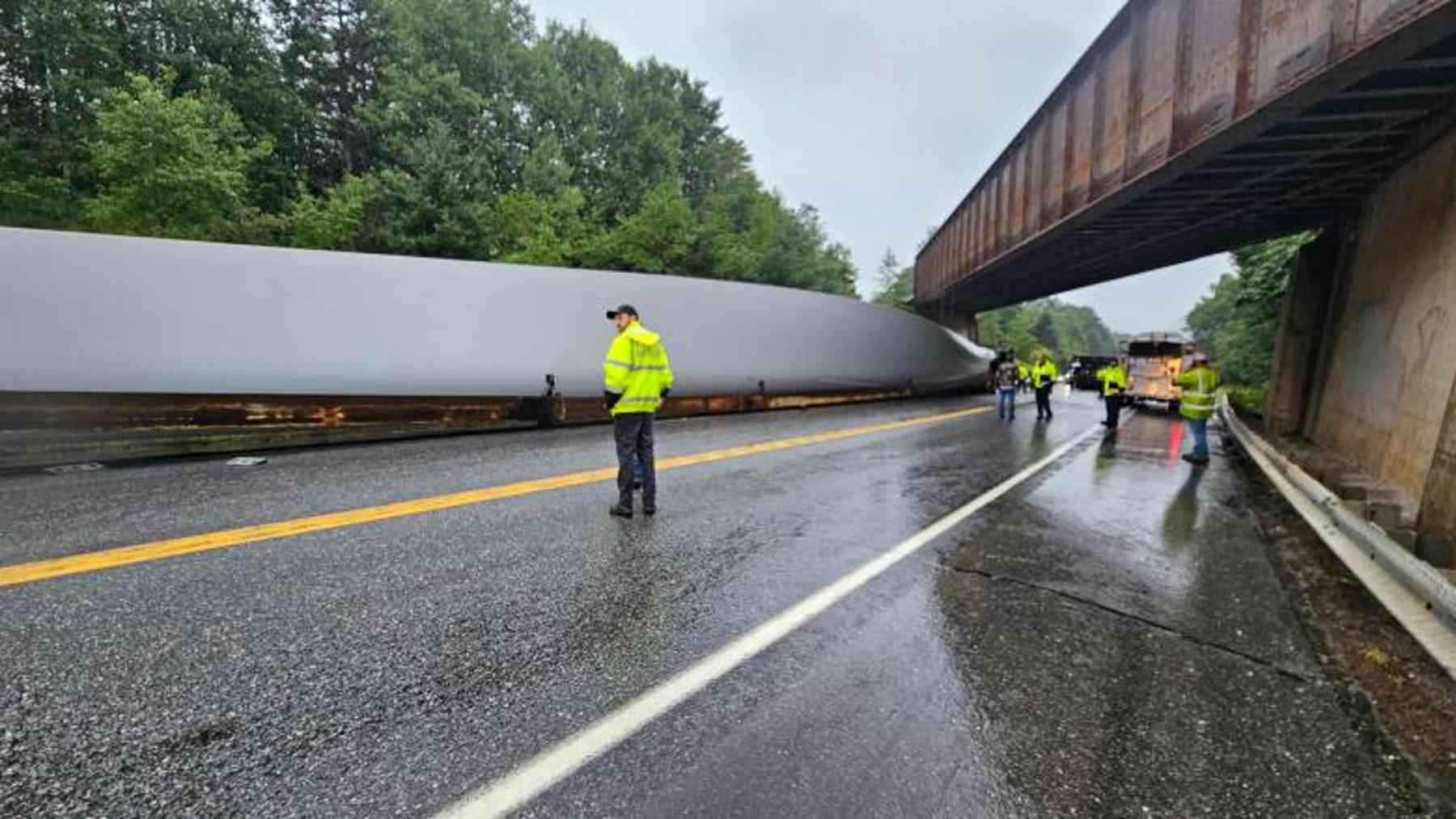
An oversize permit contains one clearance number for every structure on the route.
That number is the vertical distance from the road surface to the lowest point of the thing overhead, and it is checked before anybody is allowed to move.
The assumption buried inside it is that a bridge is level.
The state’s initial finding was blunt and specific, that the truck likely did not move enough to the left to pass under the lower side of the structure.
Most are close enough for the assumption to hold, and for ordinary freight the margin is wide enough that nobody ever finds out.
For a load that fills the carriageway and passes with inches to spare, the assumption stops being safe.
Clearance becomes a position.
A trestle over a road is rarely square to it
Railroads were laid to suit the grade the track needed, not the road that came later or was widened underneath.
So a rail structure crossing a highway is often skewed, sitting at an angle rather than square, and it frequently carries a slope of its own along the direction of the track.
Both of those tilt the steel relative to the pavement, which means one side hangs lower than the other across the width of the road.
A permit clearance is typically the controlling figure, the worst case, the lowest point anywhere over the travelled way.
But the load does not pass under the lowest point. It passes under whichever part of the structure the driver happens to be beneath at that instant.
Being in the correct lane is part of the clearance.
Five thirty in the morning on a coastal highway
The road is a two lane coastal route running up the western shore of a Maine bay, and the crossing is an old railroad trestle spanning it.
The load was a single wind turbine blade, 240 feet from root to tip, riding on a stretched trailer behind a tractor with escorts front and rear.
A blade that long is not rigid in the way a steel beam is. It flexes, it overhangs by an enormous margin, and steering it involves a long slow arc rather than a correction.
The move was timed for the emptiest hour there is, before the commuter traffic and before the light, which is standard practice and also removes most of the visual reference a driver has.
The plan required the rig to swing left as it approached, putting the blade under the higher side of the trestle and away from the low edge.
It did not go far enough left.
The finding was about the left turn
The strike happened at about 5:30 in the morning on August 9 of 2024, at the trestle crossing in Stockton Springs.
The state’s initial finding was blunt and specific, that the truck likely did not move enough to the left to pass under the lower side of the structure.
The blade caught, and because it was longer and heavier than everything holding it, the impact rolled the tractor and trailer onto their side across the road.
Nobody was hurt. The driver got out, and the railroad crossing itself came away without serious damage, which says something about the relative stiffness of an old riveted girder and a composite airfoil.
The highway shut in both directions while crews worked out how to move a 240 foot object that was lying down.
It reopened that afternoon.
Why the paperwork did not catch it
The interesting question is not whether the driver drifted. It is why a system this careful leaves room for drifting to matter.
Route surveys are done in advance and in detail, and the resulting permit can specify a lane, a speed, a time of day and an escort pattern, in the way that a wrongly described load or an ignored order to exit shows the paper working.
What the paper cannot do is hold the wheel. There is no marking on the asphalt that says the useable clearance ends here, no interlock, and at that hour no traffic to define the lane.
Local reporting recorded the outcome plainly, that the blade was transferred to another trailer and taken back the way it came, as the state agencies described it the same day.
The route was never the failure.
The margin keeps getting thinner
Blades are the reason this keeps happening, and they are the one component that has grown without limit.
A road network built for a century of trucks is being asked to pass objects that were not imagined when the structures over it went up.
Every year the loads get longer, the swept paths get wider, and the number of crossings that will accept them without a detour gets smaller.
The industry answer has been better surveys and tighter permits, which works right up to the point where the remaining margin is narrower than a truck can be steered, as the coverage of this one noted at the time.
The railroad trestle was tall enough for the blade.
It was not tall enough everywhere.
Hugo is an engineer with strong technical expertise. Multilingual from an early age, his writing combines technical clarity with a strong interest in science and energy.
