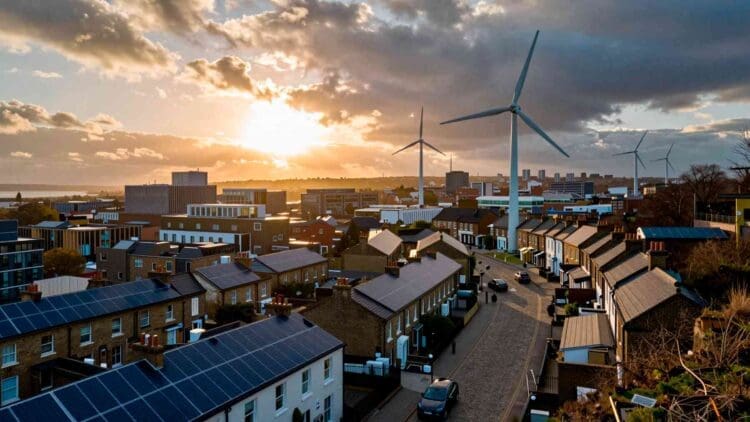

On June 2, the UK government proposed its Seventh Carbon Budget, targeting an approximately 87% reduction in greenhouse gas emissions — a cap of 535 MtCO2e — for the 2038 to 2042 period. The target, endorsed by both the Climate Change Committee and the Environmental Audit Committee, was announced by Energy Secretary Ed Miliband and Climate Minister Katie White.
UK Proposes 87% Emissions Cut Under Seventh Carbon Budget
The proposed budget sets a hard cap of 535 MtCO2e on greenhouse gas emissions across a five-year window — 2038 to 2042 — measured against 1990 levels. The government frames the target as consistent with the Paris Agreement’s goal of limiting global warming to 1.5°C, describing the alternative as “climate disaster for future generations.”
The budget takes a consumer-led approach, assuming that households and businesses will increasingly adopt technologies like solar panels, batteries, and electric vehicles. A formal delivery plan will be published after Parliament approves the budget.




Fossil Fuel Price Shocks and Climate Impacts Drive the Policy
The government’s case for urgency rests on two parallel pressures: economic vulnerability and physical climate risk. The UK has absorbed two fossil fuel price shocks within five years — one following Russia’s invasion of Ukraine, another tied to the Iran War. According to the government, half of UK recessions since 1970 have been linked to fossil fuel price volatility.
Climate impacts are also cited as a direct domestic concern. Record heatwaves and rising flood frequency are presented not as distant projections but as current realities. The Office for Budget Responsibility has noted that the costs of climate damage are rising while the costs of transitioning to net zero are falling — a shift that strengthens the economic case for acting sooner.
Economic and Employment Effects of the Net-Zero Transition
A report from the Energy and Climate Intelligence Unit, supported by analysis from CBI Economics, finds that the net-zero economy already supports over one million jobs in the UK in 2025. Those roles are also highly productive: net-zero positions generate an average of £119,300 in economic value per full-time equivalent — 48% more productive than the UK average.
Wages reflect that productivity gap. Full-time workers in net-zero businesses earn an average of £43,142 per year, and the sector contributed £105 billion in gross value added to the UK economy in 2025 alone.
The government aims to support over 400,000 additional clean energy jobs by 2030. That target is positioned as both a climate measure and a regional economic development strategy, particularly for areas hosting new energy infrastructure.
Investment, Energy Security, and Household Cost Measures
Since July 2024, the UK has attracted over £90 billion in announced private clean energy investment. Projects include carbon capture facilities in Teesside and nuclear development at Sizewell C off the Suffolk coast. A record-breaking renewables auction secured enough clean energy capacity to power the equivalent of 23 million homes.
On household costs, the government points to its £15 billion Warm Homes Plan — described as the largest home upgrade programme in British history — designed to cut energy bills and reduce fuel poverty. The longer-term trajectory is significant: by 2050, the UK could reduce its reliance on fossil fuels from roughly three-quarters of its current energy mix to around 15%, potentially avoiding approximately £445 billion in fossil fuel spending over the next 25 years.
Legislative Framework and International Context
Carbon budgets are five-year emissions caps established under the Climate Change Act 2008 — legislation the government describes as “a great British success story.” The Act created a durable, long-term framework that has attracted private investment and helped establish the UK as a recognized leader in clean energy policy. Since 2008, 60 other countries have adopted similar climate legislation, modeled in part on the UK approach.
Legislating the Seventh Carbon Budget is intended to send a clear signal to investors and businesses, providing the long-term certainty that encourages capital deployment at scale. The transition also carries projected public health benefits — cleaner air from reduced fossil fuel combustion is estimated to deliver around 8,000 fewer hospital admissions per year by 2050, easing sustained pressure on the National Health Service.
The Budget Demands a Huge Carbon Reduction
The Seventh Carbon Budget proposes an 87% reduction in UK greenhouse gas emissions for 2038 to 2042, endorsed by two independent committees and aligned with Paris Agreement targets. The government cites over one million existing net-zero jobs, £105 billion in GVA, and £90 billion in clean energy investment since mid-2024 as evidence the transition is already producing measurable results. A delivery plan will follow parliamentary approval, with the budget designed to reduce fossil fuel dependence, stabilize household energy costs, and provide long-term investment certainty across the economy.