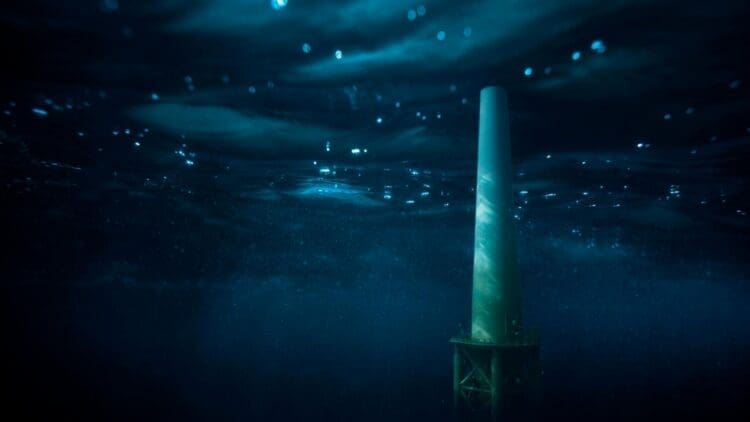

Life is highly unpredictable. No one could have truly predicted that renewable energy technologies would become the new norm for generating power worldwide. Yet, here we stand, with global capacity having reached new heights in 2025. Now, a sunken wind turbine has achieved the unthinkable. The marvel in Scotland hints at what may lie ahead for the future of sustainable power generation, as its results six years after “sinking” have proven highly promising. Could this finally be a new chapter in renewables?
An ingenious technology similar to wind turbines
When it comes to saving the planet, researchers worldwide have been actively thinking outside the box, which is why the market offers several innovative renewable technology designs. The wind energy market, in particular, has significantly stepped out of its “comfort zone” thanks to designs that offer increased application possibilities. However, despite this high versatility, they still face challenges.
While some may have small footprints compared to those of utility-scale, the main challenge is that they have intermittent power output, thus making wind power highly unpredictable. Fortunately, a company has decided to take turbines where no one has ever dared to go before: under the ocean.



The ocean may not have wind energy, but it does present a promising, untapped renewable energy source, and a pioneering design was created to harness this untapped potential. It was sunken over six years ago, but it has risen with promising results.
A sunken Scottish marvel still standing over six years later
This ocean’s energy is perhaps one of the most underrated sources in the world. While there may be significant obstacles to overcome, a relatively new turbine technology has proven that one of the obstacles could be a thing of the past, thanks to the groundbreaking MeyGen tidal energy project. The project is located in Pentland Firth in Scotland, between the uninhabited Stroma Island and the mainland.
SAE Renewables, the project developer, used not one, but four underwater turbines to prove that tidal energy is the future of power production.
One of the main concerns about tidal energy is that turbines have decreased durability in the ocean, as the harsh conditions may necessitate regular maintenance, which can be costly and thus not worth the effort and money. However, in July 2025, the Swiss company, SKF, which developed the seals and bearings for the turbines, announced that one unit had been operating for six-and-a-half years without disruption.
From promising results to a promising future
One of the key benefits of tidal energy compared to wind energy is that it is more predictable and stable. MagGen’s operations and maintenance manager, Fraser Johnson, believes that the record-breaking tidal turbine may continue operations for another year (until approximately mid-2026) before maintenance will be required, breaking records and barriers.
However, tidal turbines present even more benefits, as they are not only durable but also powerful. Each of the four turbines can produce up to 1.5 MW, which totals a combined output that is enough to power 7,000 homes each year. The results of Scotland’s MagGen tidal energy project have the potential to open new doors to a clean future.
A marine renewable energy development expert, Andrea Copping, believes that the other remaining challenges of tidal energy must still be resolved before this energy source becomes commercial. These challenges include environmental concerns, possible conflict with other users of the ocean, and regulatory obstacles. This is why further testing and development is needed. MayGen, on the other hand, aims to add 20 more tidal turbines by 2030 once the grid has been upgraded. Meanwhile, as Scotland is adding turbines under the ocean, France has been adding turbines above the ocean to go live in 2026.