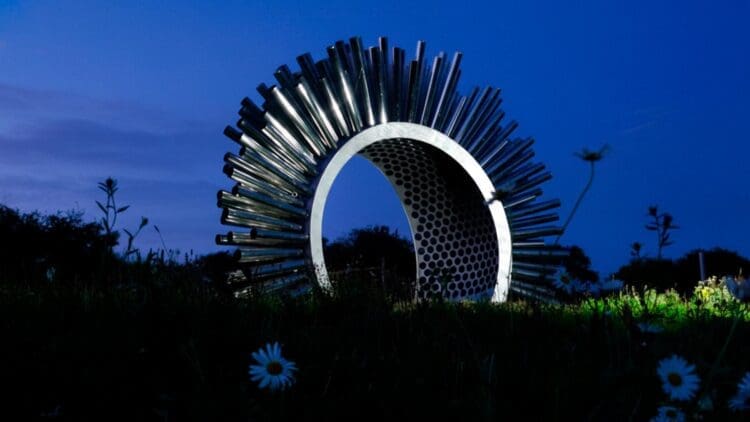

Wind holds significant energy, perhaps more than most people will realize. While mankind has mainly utilized this power to generate clean electricity, it can also be used to bring sound to life. This was evident in the use of 310 steel pipes, and while they may not produce power like turbines, they do power the sound of the wind. This is why it must be understood that this design “isn’t a power plant, it’s art.” However, one must never underestimate the power of functional art, as it evokes “real talk.”
Wind energy is not just for turbines: A brief historical glance
Wind energy is not just for turbines. The practical use of wind energy dates back 7,000 years, when it was harnessed to set sailboats in motion in Egypt, and to power windmills for grain grinding and water pumping in Persia and ancient China. However, it wasn’t until the late 1800s that its potential to generate electricity became evident.
According to a report by Inspire Clean Energy, four historical figures who were respectively Austrian, Scottish, American, and Danish played a key role in wind-powered electricity. These figures were:



- Josef Friedländer in 1883
- Engineered a wind-powered generator for the Vienna International Electrical Exhibition to power motors and lights
- James Blyth in 1887
- Engineered a cloth-sailed turbine for his holiday home in Scotland’s accumulators
- Charles Brush in 1888
- Engineered the first autonomous 12 kW wind turbine to power his Cleveland home
- Poul la Cour in the 1890s
- Engineered advanced, efficient turbines for power production
However, there is another use for wind energy. While it is not for power in the traditional sense, it is used to power the sound of the wind.
Using 310 steel pipes to power the sound of the wind
An innovative British artist, Luke Jerram, redefined how we see and hear wind by using 310 steel pipes to capture wind energy instead of turbines. This functional artwork is known as the Aeolus Wind Pavilion, and can now be seen at its permanent location in the UK at Filton, Bristol. This striking sculpture even had its own UK tour between 2011 and 2012, emphasizing how unique and captivating it is.
Named after the Greek god of winds, the structure is a massive aeolian harp of sleek steel pipes that capture wind from different directions. Its purpose? Functionally, its purpose is to make wind three-dimensional by creating music as the wind hits the pipes. According to Jerram, this allows onlookers to “visualize this shifting wind map by interpreting the sound around them.”
However, just like other functional artwork, such as Seattle’s pulsing solar flowers that bloom, the Aeolus Wind Pavilion serves another purpose.
A functional artwork that inspires conversation and more
Acoustic representation and visual enhancement are not the only reasons behind Jerram’s creation of this functional artwork. Functional art plays a key role in the world of renewable energies, as it inspires conversation about sustainability and our role and responsibility in protecting the environment.
Furthermore, it inspires educational conversation about various subjects beyond sustainability, as this particular artwork shows how intertwined nature, acoustics, engineering, aerodynamics, and architecture can be. Jerram collaborated with the University of Southampton’s Institute of Sound and Vibration Research and the University of Salford’s Acoustics Research Centre to create the artwork.
So, when visiting the UK, why not add Bristol to your itinerary so that you can also experience how these pipes power the sound of the wind? Just remember, “it’s not a power plant, it’s art!” So, if there was ever any doubt, this art proves how multifunctional wind energy can be, and why the world can benefit from more functional art inspired by nature. Soon, they may even power buildings, just like the aesthetically pleasing green, blue, red, and even purple German solar panels.
Disclaimer: Our coverage of events affecting companies is purely informative and descriptive. Under no circumstances does it seek to promote an opinion or create a trend, nor can it be taken as investment advice or a recommendation of any kind.
Anke Maree is a writer with a clear and engaging editorial style. Her work focuses on making complex topics accessible, informative, and relevant for readers across different areas of interest.