
Underwater robots that can “see” waves before they hit could slash the cost of clean energy at sea
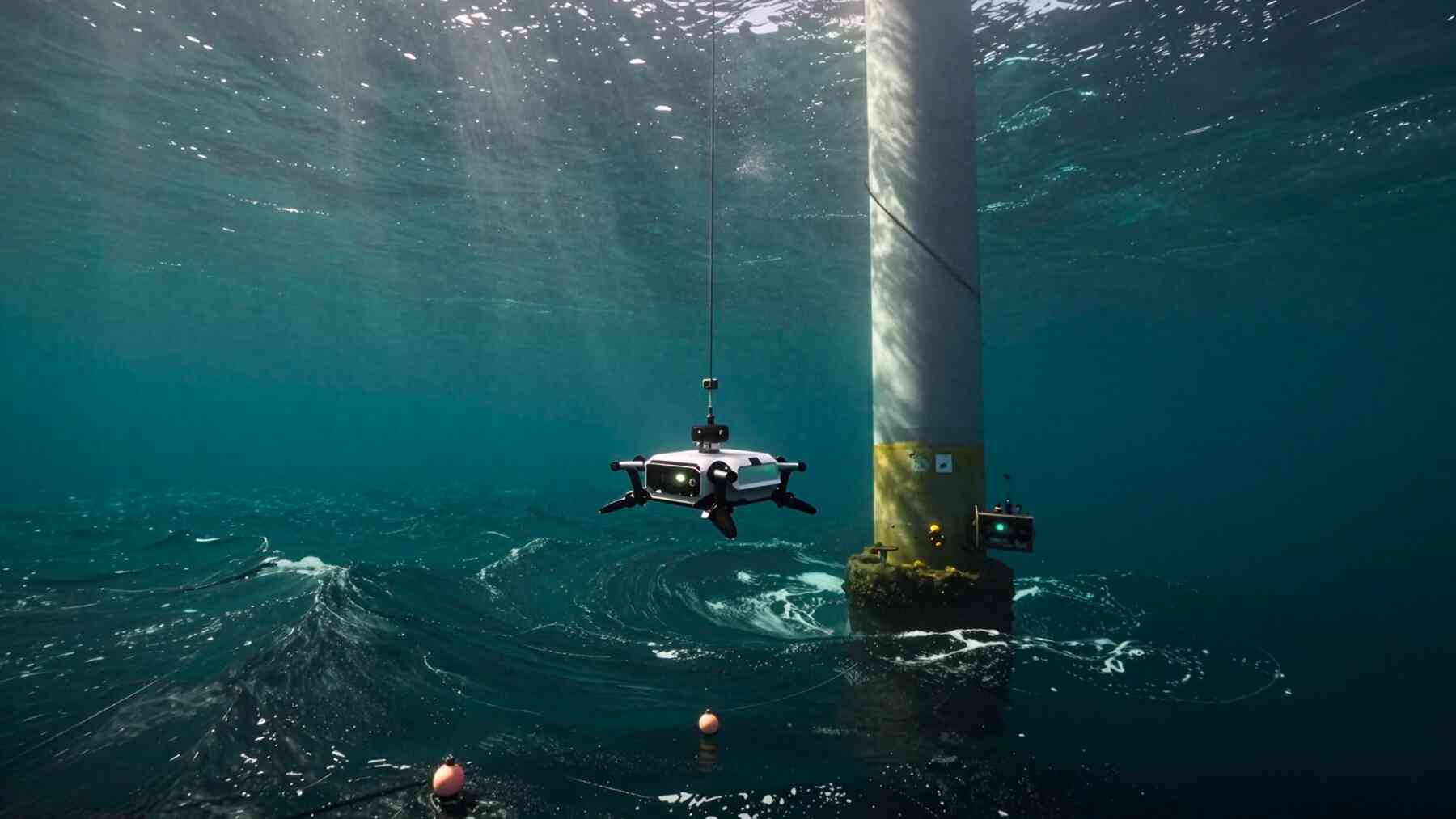 AI-made
Keeping offshore wind turbines and tidal generators running means sending ships into rough seas, lifting heavy equipment by helicopter, and putting workers in genuinely dangerous conditions. It is expensive, slow, and hard to scale as the world builds more clean energy infrastructure farther from shore.
Autonomous underwater robots could change that — but waves have always stood in the way. The constant, irregular surge of the ocean makes it nearly impossible for a robot to hold a steady position, let alone perform precise repair work. Until that problem is solved, the machines stay sidelined.
The problem with keeping robots steady at sea
Offshore wind farms and tidal turbines do not maintain themselves. Blades crack, sensors fail, electrical connections corrode, and every repair job currently means mobilizing ships, coordinating helicopter lifts, or hoisting heavy equipment out of the water — operations that are costly, time-consuming, and hazardous for the people involved.
The researchers describe this as “nonlinear model predictive dynamic positioning.” The core idea is straightforward: anticipation instead of reaction.
Robots seem like an obvious solution. But the ocean does not cooperate. Waves arrive from multiple directions, vary constantly in height and frequency, and push an underwater vehicle off course before it can compensate. Holding a steady position — the basic requirement for any precise task — becomes nearly impossible.
Conventional control systems compound the problem in a subtle but important way. They are reactive: detect a disturbance, then correct for it. In calm water, that lag barely matters. In the irregular surge of the North Sea, it means the robot is always catching up, never quite where it needs to be.
Reading the waves before they hit
Researchers at the University of Edinburgh took a different approach. Rather than waiting for a wave to push the robot off course, they built a system that detects the disturbance in advance and moves to cancel it out before it arrives.
The setup uses wave-detecting buoys tethered to the seafloor. These devices measure incoming wave direction and height in real time, relaying that data to a nearby robot. The control system uses the information to anticipate what is about to happen and adjusts the robot’s thrusters accordingly, before the wave arrives.
The researchers describe this as “nonlinear model predictive dynamic positioning.” The core idea is straightforward: anticipation instead of reaction. That shift makes an enormous practical difference in turbulent conditions.
Dr. Kyle Walker, who developed the work as part of his PhD at the University of Edinburgh, explained that forming a prediction of future wave disturbances and integrating it within the control system expands a robot’s operational range — with little to no change to the robot’s hardware.
Testing in simulated North Sea conditions
The system was not validated in a computer model alone. The researchers trialled it at the University of Edinburgh’s FloWave testing tank, a circular facility capable of generating multidirectional waves. To keep the test realistic, they used actual wave data captured by a buoy operating in the North Sea, recreating the irregular, buffeting conditions a deployed robot would actually face.
Results showed the system works for robots operating near the surface and for those working at greater depths, where wave disturbances can still be felt strongly. That range matters, since many maintenance tasks on offshore structures happen well below the waterline. The study was published in the International Journal of Robotics Research and received funding from the Engineering and Physical Sciences Research Council.
A drop in costs for clean energy
Offshore renewable energy already costs significantly more to produce than fossil fuels. Much of that gap comes from maintenance logistics — the ships, the helicopters, the specialized crews. Replacing routine upkeep with autonomous robots could meaningfully close it.
One practically significant aspect of the new system is what it does not require. Because the predictive algorithm runs in software, it needs little to no hardware modification to the robot itself. Dr. Walker noted that this makes the system applicable to most vehicles currently on the market — a critical point for any technology hoping to see real-world adoption quickly. Dr. Francesco Giorgio-Serchi, who led the study, described the potential as “transformative” for cutting the cost of producing clean energy and for increasing automation in the offshore sector.
What comes next: robotic arms and real-world deployment
Holding a stable position is only the first step. Robots still need to perform useful work while holding that position — tasks like using a robotic arm to scan for rust, replace a sensor, or repair electrical equipment. That is where the Edinburgh team plans to focus its future research.
The work builds on the now-concluded ORCA Hub project, a green energy transition initiative led by Heriot-Watt University and the University of Edinburgh, which provides a pathway from laboratory validation toward real offshore deployment.
As offshore wind and tidal installations push farther from shore and into rougher water, pressure to cut maintenance costs will only grow. A robot that can read the sea and hold its ground may prove to be one of the more consequential tools in making that energy genuinely affordable.
Kelly is an experienced writer with 15 years of experience exploring the big stories that shape our world, from tech breakthroughs and space exploration to climate, energy, and the fascinating quirks of science. She has a talent for turning complex ideas into sharp, memorable insights that stay with readers long after they’ve finished reading.
