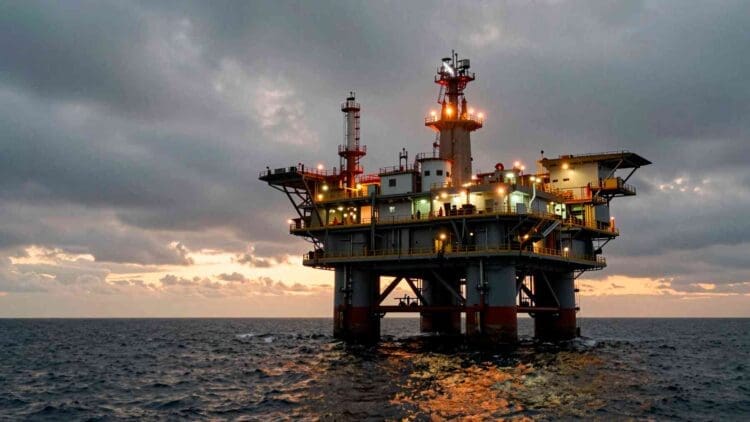

Vår Energi has taken a final investment decision and submitted the Plan for Development and Operations (PDO) for the Ofelia and Gjøa Nord developments to Norway’s Ministry of Energy. Filed today alongside its partners, the subsea project portfolio covers three North Sea discoveries — Ofelia, Gjøa Nord, and Cerisa — representing approximately 76 million barrels of oil equivalent in gross recoverable resources. Vår Energi operates all three developments.
Vår Energi files PDO for three-discovery North Sea project
The PDO submission marks a concrete step forward for Vår Energi’s North Sea portfolio. The company took its final investment decision and filed the plan with its partners, formally committing to develop Ofelia, Gjøa Nord, and Cerisa as a single coordinated subsea project.
All three discoveries will be tied back to two existing offshore facilities: the Gjøa platform and the Duva infrastructure. That approach sidesteps the cost and complexity of building new standalone infrastructure — a meaningful advantage in a basin where development economics are always under scrutiny.

Vår Energi operates all three licenses, holding 40% in Ofelia, 30% in Gjøa Nord, and 30% in Cerisa. Partners across the licenses include Petoro, Harbour, Aker BP, INPEX, Orlen, OKEA, Pandion, and DNO Norge AS.
Project driven by hub strategy and recent asset acquisitions
The development reflects a deliberate focus on building value around existing infrastructure rather than pursuing greenfield projects from scratch. Connecting new subsea wells to facilities already in place avoids duplicating capital expenditure and shortens the path to first production considerably.
Recent corporate activity also strengthened the company’s position in the area. Vår Energi acquired Pandion’s assets and completed an asset swap with DNO on the Norwegian Continental Shelf—both transactions increased its ownership across producing assets and key development projects, including the Gjøa Subsea Projects.
COO Torger Rød described the project as a direct expression of the company’s hub philosophy. “The Gjøa Subsea Projects demonstrate how we continue to develop our core hubs through efficient tie-back developments, leveraging existing infrastructure and exploration success to create long-term value,” he said.
Central to the approach is what Vår Energi calls its “project factory” model—a framework combining standardized technical solutions, coordinated execution across multiple developments, and active use of existing facilities. The aim is to reduce costs, accelerate delivery, and capture synergies across concurrent projects.
First production expected from 2027, with strong project economics
Production from the three discoveries is staggered across two years. Cerisa is scheduled to deliver first oil in the third quarter of 2027, with Ofelia and Gjøa Nord expected to come online in the second half of 2028.
Combined, the project covers approximately 76 million barrels of oil equivalent gross in proved plus probable reserves. Vår Energi’s net share amounts to around 27 million barrels of oil equivalent, reflecting its varying working interests across the licenses.
The economics are described as strong—a breakeven below $35 per barrel of oil equivalent and a rate of return stated to be well above 25%, both figures comfortably within the company’s thresholds for project sanction. Execution will follow a coordinated drilling and installation campaign, drawing on existing supplier relationships to maintain schedule and capture cost efficiencies.
PrThe projectxtends Gjøa hub life and underpins long-term production targets
The Gjøa area holds a central place in Vår Energi’s portfolio, and this project materially shifts its long-term outlook. Without the new development, the area’s economic lifetime was expected to run only into the early 2030s. The Gjøa Subsea Projects push that horizon out to around 2040.
That extension carries implications beyond the new barrels. Higher throughput through the Gjøa facility is expected to reduce unit production costs across the hub, which in turn improves the economics of fields already producing in the area — a compounding benefit that reaches well beyond the three new discoveries themselves.
The development also sets up the next phase of activity. By reinforcing the hub’s infrastructure and economic standing, Vår Energi says the project creates a stronger foundation for additional tie-back developments and near-field exploration across the broader Gjøa area. At the company level, adding roughly 27 million net barrels in proved and probable reserves contributes directly to its stated long-term production target of more than 400 thousand barrels of oil equivalent per day.
Ofelia, Gjøa Nord, and Cerisa working together
The Gjøa Subsea Projects bring together Ofelia, Gjøa Nord, and Cerisa under a single coordinated development plan. Vår Energi operates all three and submitted the PDO to Norway’s Ministry of Energy alongside a broad group of partners.
Tie-backs to existing Gjøa and Duva infrastructure keep capital costs down and support a breakeven below $35 per barrel. First production from Cerisa is targeted for Q3 2027, with the remaining two discoveries following in the second half of 2028.
Beyond the new volumes, the development extends the Gjøa hub’s economic life by roughly a decade, lowers unit costs across existing fields, and strengthens the case for further exploration and development in the area.

Kelly is an experienced writer with 15 years of experience exploring the big stories that shape our world, from tech breakthroughs and space exploration to climate, energy, and the fascinating quirks of science. She has a talent for turning complex ideas into sharp, memorable insights that stay with readers long after they’ve finished reading.