Washington’s Baker River dams use floating fish collectors, including a 1,000-ton structure, to transport young salmon downstream

Every spring, millions of young salmon must swim and reach the Pacif Ocean in Washington to survive.
However, huge, towering concrete hydropower plants prevent them from flowing downstream.
That is because high hydropower dams tend to block natural downstream currents.
Puget Sound Energy combined massive floating surface collectors with upstream and downstream fish taxis, along with other modifications to recover the fish.
That leaves juvenile fish stranded in deep reservoirs.
In the 80s, Washington’s Baker River once threatened to push local sockeye salmon to the brink of extinction.
How does a massive floating barge funnel young salmon across a reservoir and guide them safely past two dams?
The 1985 sockeye crash at the Baker River Hydroelectric plant
The Baker River Hydroelectric Project, comprising two dams, began its development in 1925.
The Lower Baker Dam was completed in 1925, forming Lake Shannon.
The Upper Baker Dam was completed in 1959, forming Baker Lake.
Puget Sound Energy owns and operates the 215-megawatt facility.
Following the construction of Lower Baker Dam in 1925 and Upper Baker Dam in 1959, adult sockeye runs in Baker River remained relatively stable.
Annual adult sockeye returns averaged roughly 3,000 fish since the 1920s.
However, over time, their number began to plummet.
Things culminated in 1985 when returns plunged to an alarming low of just 99 fish.
Looking at the dismal number, Puget Sound Energy decided to respond with an aggressive fish recovery effort.
The company partnered with government resource agencies, local Native American tribes, and other stakeholders to come up with a solution.
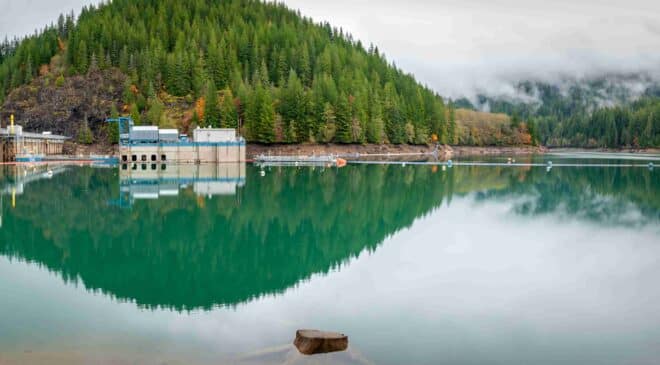
Puget Sound Energy installs its first Floating Surface Collector on Baker Lake
To try and revive the dwindling fish population, Puget Sound Energy constructed a man-made “spawning beach” alongside Baker Lake.
That was to boost the number of salmon fry,
They also made a series of modifications to a fish-attraction barge that had been built in the late 1950s.
However, a much bigger effort had to be made to help juvenile salmon bypass both Baker River dams for downstream migration.
In 2008, Puget Sound Energy took a major leap and constructed its first innovative Floating Surface Collector at Washington’s Baker Lake.
The 1,000-ton Floating Surface Collector produced dramatic results in its first few years of operation,
So the company followed up with a second Floating Surface Collector on Lake Shannon behind Lower Baker Dam in 2013.
The apparatus came equipped with fine-mesh guide nets that stretched from shore to shore and surface to lakebed.
Record 2025 juvenile outmigration at Washington’s Baker River dams
Today Puget Sound Energy operates two Floating Surface Collectors at the Baker Lake Project.
Fully equipped with five-acre shore-to-shore nets, they capture young salmon, guiding them safely around the Upper and Lower Baker Dams.
They operate “fish taxis,” which are specialized tanker trucks.
The fish taxis haul salmon around both the Upper and Lower Baker Dams.
Juvenile salmon are hauled downstream, and adult sockeye are hauled upstream.
Driven by both collectors, combined juvenile outmigration surpassed 1.5 million fish in 2025.
That shattered earlier milestones like the 520,000 fingerling mark set in 2010.
The downstream collectors work alongside a 60-foot-tall aquatic elevator upstream trap below Lower Baker Dam, built in 2010.
Additionally, an upgraded hatchery produces over 5 million sockeye fry annually.
Finally, the adult sockeye returns climbed from 99 in 1985 to a record 65,512 at the trap in 2023.
Outstanding Stewards of America’s Waters award and industry-wide recognition
Puget Sound Energy’s fish recovery efforts have earned them awards and gained them industry-wide recognition.
The National Hydropower Association honored the utility company with an Outstanding Stewards of America’s Waters award.
The National Marine Fisheries Service also cites the system as a model for high-reservoir dams.
Puget Sound Energy combined massive floating surface collectors with upstream and downstream fish taxis, along with other modifications to recover the fish.
This proved that high-head hydropower dams can coexist with thriving wild salmon runs.


Lindi is a copywriter and marketing professional with over 10 years of experience across finance, fintech, luxury lifestyle, and renewable energy. She writes with a keen interest in the business and innovation shaping the energy transition.