
Wheat fields outside Weyburn where 46 turbines sparked a $500 million fight that turned neighbor against neighbor, and the document that finally cleared the way carried six signatures no one expected
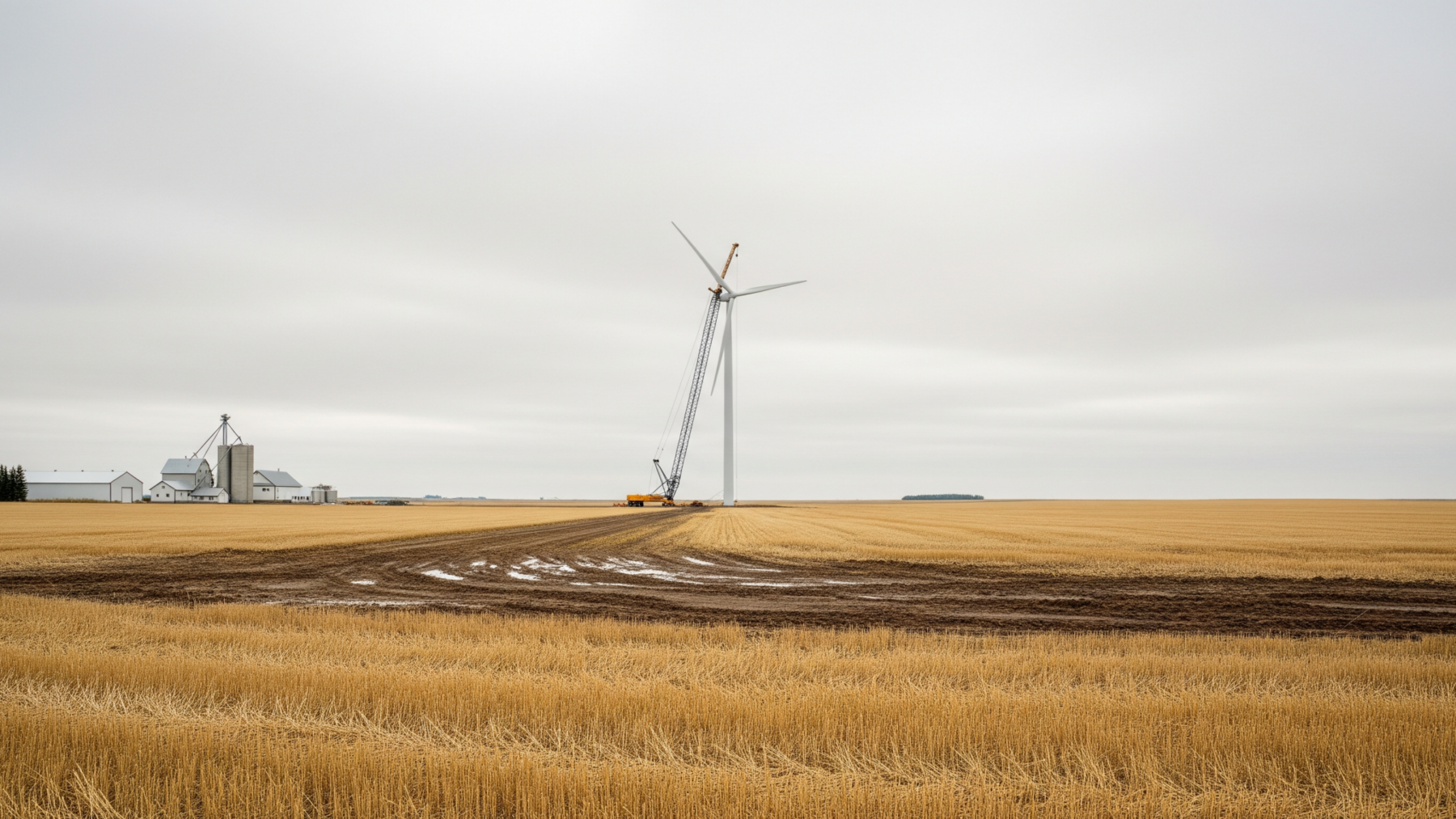
The wheat fields southeast of Weyburn, Saskatchewan, look the same in every direction.
Flat, gold, enormous.
They have been farmed by the same families for generations, and the sky above them has always belonged to the wind.
The neighbors who stopped speaking may yet find themselves living beside turbines that are partly owned by the same nations whose land this prairie once was.
Now 46 turbines are proposed to rise across that sky, and the question of whether they should has torn the community apart.
The project is called Seven Stars, and for two years it has made people here choose sides.
The offer no farmer could ignore, and some did anyway
Enbridge plans to invest more than $500 million into the wind energy operation.
That number lands differently in a rural municipality where the school budget is tight and the roads get rough in spring.
Over the project’s 30-year lifespan, it is expected to deliver over $100 million in local economic benefits, roughly $3.4 to $4 million annually, including tax revenue, lease payments to landowners, and employee salaries.
For some farmers, the lease income was transformative.
For others, the prospect of 46 towers on the horizon was reason enough to say no.
And for at least one resident, the pressure to stay quiet proved to be the hardest part of all.
A community that stopped talking
Don Bourassa, a resident of the Rural Municipality of Weyburn, says one of his neighbors approached him about buying his property to keep him quiet on Enbridge’s Seven Stars Energy Project.
He refused.
Kim Brady, another resident, said the project has pitted neighbors and relatives against one another, adding that people simply will not talk anymore.
Residents packed town halls, urging elected officials not to approve the project.
Half the turbines were to be located in the Rural Municipality of Weyburn, which approved the project’s development permit, while the other half would sit in the Rural Municipality of Griffin, which said it needed environmental documents before making a decision.
That stalemate lasted months.
The city that said yes while the countryside said wait
Inside Weyburn’s city limits, the mood was different.
Mayor Jeff Richards called the project potentially transformative.
A 200-megawatt wind project would provide enough electricity to power 100,000 Saskatchewan homes over its anticipated 30-year lifespan.
The provincial government backed it too, saying the project would increase Indigenous participation in the economy, create jobs, and add generation capacity to the power grid.
That phrase, Indigenous participation, contained a story almost no one was discussing.
And it was about to become the most consequential fact in the whole dispute.
The six signatures that changed what the project actually was
The surface argument in Weyburn had always been about turbines, viewsheds, noise, and lease checks.
But underneath it, something older was at stake.
The project involves a partnership between Enbridge Renewable Generation Inc. and Six Nations Energy Development LP, a newly created consortium of Cowessess First Nation, George Gordon First Nation, Kahkewistahaw First Nation, Métis Nation-Saskatchewan, Pasqua First Nation, and White Bear First Nation.
Together they will own at least 30 percent of the project once it is in operation, as confirmed on the SaskPower project page.
That is not a community benefit fund or a symbolic handshake.
It is a generational asset, the kind that pays into Indigenous communities for as long as the wind blows across the prairie.
The Saskatchewan Ministry of Environment approved the project’s Environmental Impact Statement on July 14 after a review examining potential impacts on wildlife, land, water, cultural resources, and local communities.
The Rural Municipality of Griffin approved the development permit on July 21, 2026, and for the first time both municipalities were aligned.
What the prairie keeps after the turbines turn
Construction is not yet confirmed.
Enbridge still has to decide whether it is going ahead, more than two years after taking over the development from EDF in June 2024.
Across Saskatchewan’s energy sector, the question of how Indigenous nations share in wind revenue is no longer theoretical.
A parallel project offers a glimpse of what full community support can look like.
At Rose Valley Colony, where Saskatchewan’s latest 200-megawatt wind farm will be going up, a Hutterite colony held a groundbreaking event on June 15, with construction anticipated to begin this year.
The difference between those two scenes, one with a celebration and one with a packed and angry town hall, is a reminder that consent and shared ownership are not the same thing as a lease check.
The neighbors who stopped speaking may yet find themselves living beside turbines that are partly owned by the same nations whose land this prairie once was.
That is not a small irony.
It is a different kind of wind energy story entirely, one about who the sky ultimately belongs to, and who gets to share in what it produces.
If the turbines do rise over that flat gold horizon, the most important thing about them may not be their height.
It may be whose name is on the ownership deed.

Hugo is an engineer with strong technical expertise. Multilingual from an early age, his writing combines technical clarity with a strong interest in science and energy.
