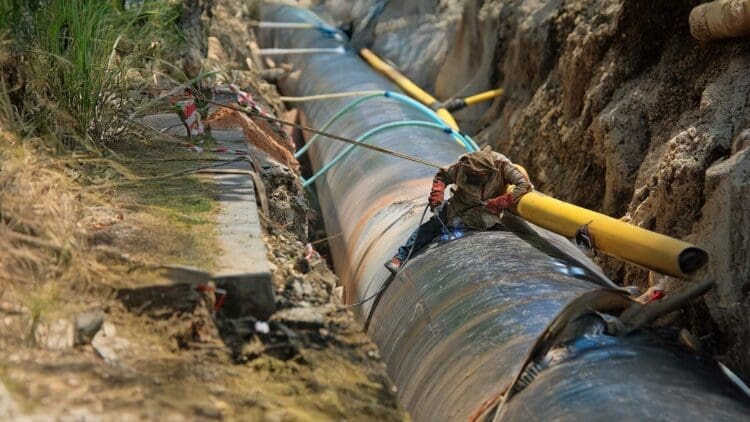

Transco’s natural gas pipeline is perhaps no quieter force in U.S. energy infrastructure than the pipeline itself. Spanning from South Texas to the northeastern United States, it supplies residential consumers, commercial/industrial users, electric power generators, and other end-users who rarely give much thought to their source of gas. This is while evolving consumer demand patterns continue to drive growth demands for additional pipeline capacity.
Williams’ continued efforts raise an obvious question: Why now? And why there?
For decades, the Transco pipeline system has been a primary pathway for energy delivery along the eastern United States. For years, population growth, coal-to-gas electric generation plant conversions, data center and manufacturing facility construction and expansion have all driven upward pressure on current capacity levels.
In contrast to building new pipelines, Williams has opted for increasing the capacity of its existing corridors with minimal disturbance or upset to local communities while responding to those fundamental structural changes in demand.



This strategic decision-making process can be seen throughout Williams’ expansion plans — the focus on developing brownfields (i.e., adding looping sections of pipe; upgrading compression facilities; and/or increasing the output of station upgrades) adjacent to existing pipelines. The rationale behind this approach appears to be centered around the view that reliability and incremental increases in pipeline capacity represent how pipeline systems grow today, versus massive, high-profile megaprojects.
From concept development through implementation at Transco
Williams’ active and planned expansion programs along the Transco pipeline corridor seek to provide customers with expanded transportation capacity using the least amount of environmental and community disruption possible. Perhaps one of the most prominent examples of Williams’ expansion program along the Transco corridor is its Southeast Supply Enhancement Project. It is intended to address increasing customer demand in Virginia, North Carolina, South Carolina, and surrounding areas.
In addition to supplying the equivalent of approximately 10 million homes with an additional 1.6 MMDth/d of incremental natural gas capacity, this project will achieve this goal through looping segments of existing pipeline and making modifications to compressor stations along the pipeline route. Notably, these improvements will occur primarily within previously disturbed corridors as part of Williams’ stated commitment to speed and predictability in executing its expansion plan.
Other recent additions to Transco’s network, such as connectors in both southeastern and Gulf Coast areas, are similar illustrations of the feasibility of this model. Collectively, these illustrate how Williams is taking long-standing customer signal trends and converting them into actual physical pipeline infrastructure without having to redefine the footprint of the original pipeline.
Incremental expansion represents more than just a methodology — It reveals a strategy
It may become apparent after reviewing this final section how Williams does not appear to rely upon sudden changes in markets, but instead upon continuation. By layering on capacity enhancement opportunities along the Transco pipeline system, Williams positions itself to meet rising gas consumption associated with electric generation (e.g., merchant power), LNG exports, and industrial uses — without being faced with completely new permitting hurdles.
Additionally, spreading execution risks — as opposed to relying upon a single defining project — provides Williams flexibility in implementing its expansion program. Instead of a singular large-scale project, Williams is able to incrementally add capacity — thereby providing incremental benefits to both customers and shareholders as each individual segment comes online based upon contractually justifiable need(s). The overall message represents a conservative, non-dramatic position.
Progress along the Transco corridor reflects confidence in the endurance of gas consumption demand, not speculation
As Williams continues to advance its Transco expansion program, the story is far less about disrupting the status quo and far more about fortifying an existing corridor. Reinforcing an existing corridor demonstrates that energy systems develop through accretion (accumulation) rather than innovation/reinvention. Similar dynamic factors at play in both power transmission and liquefied natural gas (LNG) infrastructure are influencing the future direction of U.S. energy delivery systems via incremental upgrade opportunities.