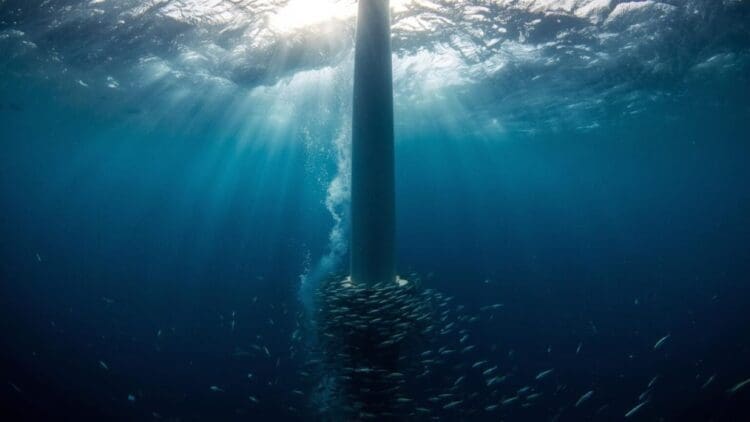

Far from shore, where the horizon looks endless and the sea feels empty, something quiet is changing. There are no headlines. No dramatic images. No sudden events. Just slow movement beneath the surface.
For decades, this part of the ocean was treated as open space — stable, useful, and empty. A place to build, not a place to grow. But now, step by step, that assumption is being challenged.
A seabed designed for machines, not life
Offshore wind farms were never built with marine life in mind. They were placed far from land, chosen for strong winds and stable ground. Everything about them was engineered for durability and efficiency.

The seabed below them reflected that thinking. It was flat and bare. No rocks. No natural reefs. No shelter for fish. Water currents moved freely across the surface, carrying nutrients away instead of letting them settle.
There was no damage. No disaster. Just design. Nature was not removed — it was simply never part of the plan. For years, this underwater silence was considered normal.
Then the shapes began to change
When offshore wind turbines were installed, large foundations were anchored deep into the seabed. Around them, protective materials were added to prevent erosion — rocks, concrete forms, and specially designed structures.
At first, they looked purely technical. Heavy. Functional. Invisible from the surface.
But underwater, these shapes changed the rules.
Rough textures replaced smooth sand. Small gaps formed between materials. Water slowed down in certain areas. Instead of a flat desert floor, there were now surfaces to attach to and spaces to hide in.
And nature noticed.
Life returns where structure appears
The first arrivals were tiny. Algae. Barnacles. Mussels. Small organisms that attach themselves to hard surfaces. Then came the fish.
Young fish found shelter from predators. Shellfish settled into the crevices. Sediment began to stabilize. Water clarity slowly improved. What had once been open and empty started to show movement.
This is known as the “reef effect” — when artificial structures create conditions similar to natural reefs. And this is when the full picture becomes clear.
These changes are happening beneath offshore wind turbines in the Dutch North Sea, at the OranjeWind project developed by RWE and TotalEnergies. Special structures known as Reef Cubes have been placed around turbine foundations — not only to protect the turbines, but to encourage marine habitat formation.
A transformation measured in years, not days
There is no dramatic moment when the seabed suddenly becomes alive. The shift is gradual. Scientists monitor the sites using underwater cameras, divers, and sensors. Month after month, species numbers increase. More complexity appears. More interaction. More life.
The lesson is simple but powerful: structure creates opportunity. When there is texture, shelter, and stability, marine ecosystems begin to rebuild themselves.
For decades, offshore infrastructure was seen as separate from nature. Now researchers are exploring a different idea — that human-built structures can serve as starting points for ecological recovery.
When clean energy starts doing more than expected
Above the surface, the turbines generate renewable electricity. They reduce carbon emissions. They power homes and industries.
Below the surface, something else is happening.
Fish populations are slowly increasing. Shellfish are attaching. Marine habitats are forming where none existed before.
What began as a clean energy solution is now quietly contributing to ecosystem recovery.
In the North Sea, renewable energy is no longer just about reducing harm. With thoughtful design, it may also help restore life.
And the most surprising part is how quietly it all began.