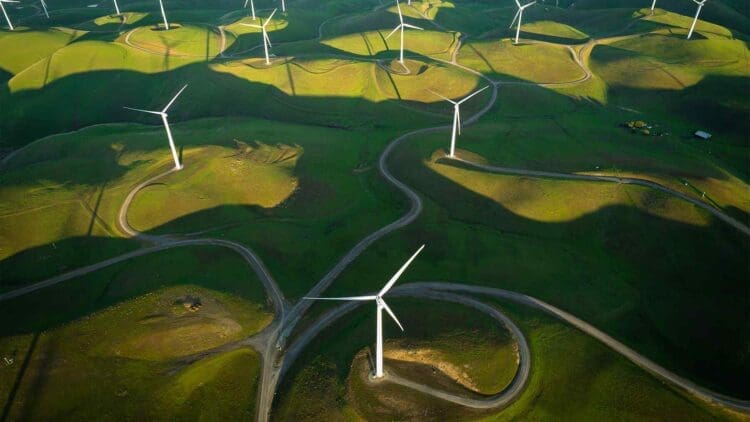

Ten drones “spied with their little eyes” the secret to low turbine efficiency.
When it comes to wind power, the world must learn not to hate the player but the game.
In this case, ultimate survival is the bigger picture, and all forms of renewable energy are key to true sustainability.
However, the technology behind these sources is not producing their full potential, but how can this obstacle be overcome?
How wind power is essential to the global energy transition
Years ago, it became clear that fossil fuels could no longer be the star players of the energy game.
They started to fail to portray true sportsmanship due to their harmful emissions and overall environmental impact.
This is when experts began to realize the hidden potential of investing in renewable energy sources, especially wind energy.
Wind turbines are now essentially the “undisputed heavyweights” of the green energy transition.
They are the ideal complement to solar; they are scalable and offer a high-capacity solution for powering communities.
At some point, it became clear that there was room for significant improvement in their performance.
So, experts decided to change the arena in hopes of seeing improvements. It seemed that a change in scenery delivered the result that they had hoped for.
But little did they know that these giant, towering players were secretly starting to rewrite the rules of the “game.”
Why the future of wind is heading out to sea
Nothing like a whiff of fresh ocean air to increase energy levels. In the case of large-scale offshore wind turbine projects, this is very literal!
Over the vast oceans, these installations benefit from much higher and more consistent wind speeds than the onshore giants.
The absence of towering hills, trees, or buildings that usually slow turbines down significantly boosts efficiency and output.
However, others found that clustering wind turbines closer together really helped to boost “team performance.”
The logic made sense: The more turbines, the more wind could be captured, and the greater the output should be. But whether onshore or offshore, the numbers still did not really add up.
The Deutsches Zentrum für Luft- und Raumfahrt (DLR) decided to investigate the productivity of wind power.
At the WiValdi research wind farm, ten drones were used to “spy” on operational turbines. The efficiency reports were interesting to say the least.
Caught in the act of “stealing” wind
It is no secret that wind turbines have an impact on the surrounding environment.
But it is surprising to learn that they also have an impact on “team performance.”
The drones spilled the tea on an invisible but fierce rivalry. Turbines tend to steal each other’s wind, and this is known as the “near wake” phenomenon.
A lead turbine harnesses wind energy and leaves a slower, more turbulent air trail behind its blades. The “wind shadow” comprises violent vortices that travel far.
Mapping the “energy-theft” in real-time
The ten drones flew in a choreographed formation up to 820 feet high. After staying in position for 15 minutes at a time, the air samples in the transition zones revealed:
- Downwind turbines harness this air with less kinetic energy, lowering output
- Uneven wind pressures vibrate downwind turbine blades, accelerating mechanical wear and tear
The results unveiled by the drones are truly an eye-opener for field experts.
DLR essentially discovered the secret gameplay to end “wind theft” once and for all.
This phenomenon can be overcome by designing wind farm layouts that leave adequate space between turbines. This will ensure that each “player” gets a fair shot at the wind.
This gives the whole giant turbine team a bigger chance to win the global green energy transition game.