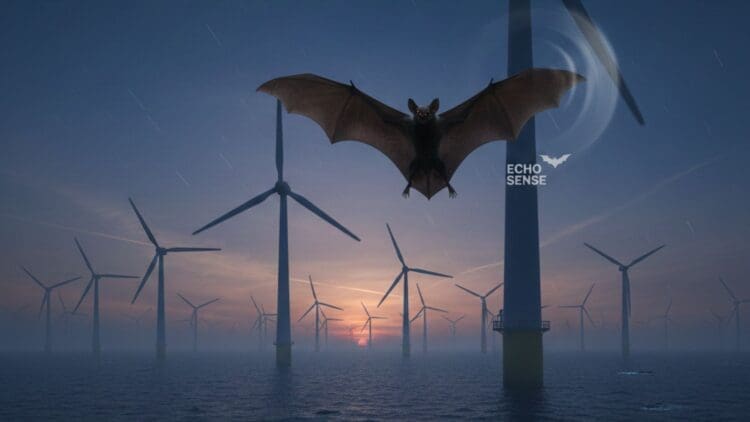

Sometimes we suffer the consequences of our own actions, regardless of whether our intent was for the greater good or not. This is evident regarding our renewable energy technologies. Take wind turbines, for example. The global installed wind capacity at the end of 2025 was predicted to surpass 1,320 GW and reportedly offset nearly 1.3 billion tonnes of carbon emissions annually. Yet, turbines triggered a reaction no one expected, but a certain U.S. technology could make the difference.
Wind turbines triggered a reaction no one expected
Wind energy and its associated technologies have significantly grown in both popularity and capacity. According to the World Wind Energy Association, wind power is now responsible for almost 12% of the global power supply. However, conventional turbine designs have been found to trigger a reaction that no one expected before, until now.
The UN Environment Programme has found that millions of bat fatalities occur on an annual basis due to wind turbines. It added that these fatalities occur globally, as bats are on every continent, excluding Antarctica. For example, the approximate number of annual bat fatalities due to turbines in the following countries is:
- 50,000 in Canada
- More than 200,000 in Germany
- More than 500,000 in the U.S.
Global bat populations are rapidly declining, especially considering their slow reproduction rates and their long gestation period, as per the Animal Diversity Web. Now, a U.S. technology could save nearly 800,000 bats annually. But why exactly do wind turbines lead to bat fatalities? Find out below.
Now, a U.S. technology could save 800,000 bats
A CNN Science report found that the most recent evidence indicates that the majority of bat fatalities are due to direct impact with fast-moving turbine blades. Another cause of death in bats due to turbines is barotrauma. Turbine barotrauma is a low-pressure area near the blades that can rupture bats’ lungs and cause internal bleeding.
One of the current methods to prevent bat fatalities is called “blanket curtailment.” This entails halting wind turbines during low wind speeds, as this is when bats will most likely be present. This reduces bat fatalities by nearly 60%, but it also decreases annual wind energy output by more than 10%. The latest solution? A U.S-based company called EchoSense believes the answer is “smart curtailment.”
Sensors are added to the turbine blades that detect echolocating signals of bats. Once the signal is detected, the turbine is halted to allow bats to pass in a timely manner. This also reduced the amount of lost energy. Unfortunately, bats are not the only wildlife that are impacted by wind turbines. Recent studies have found that offshore wind turbines negatively affect marine mammals.
Other disadvantages of wind turbines that must be addressed
The chief scientist at Bat Conservation International believes that the only way to protect wildlife is to increase focus on wind turbine operation and displacement to keep risks to a minimum. In a statement, he added:
“We want to find ways in which we can maximize energy production, but do that in a way that is ecologically responsible and not causing biodiversity loss.”
Besides wildlife mortality and habitat disruption, other disadvantages of wind turbines that must also be addressed include:
- Visual impact
- Noise pollution
- Radar interference
- Transmission challenges
- Difficulty recycling the blades
- Complex maintenance
In conclusion, while conventional wind turbines may significantly decrease global carbon emissions, adequate research and environmental impact studies must be conducted before new wind projects are developed. Furthermore, regions that experience high wildlife mortalities, especially of bats, should be encouraged to use smart curtailment; otherwise, we may have to say goodbye to a species that is ecologically vital. Adequate research on offshore wind turbines’ impact on marine ecosystems is also vital, as our understanding is still limited.