
A new Wisconsin solar farm is building a “hotel” for more than 300,000 solitary bees that will live beneath the panels and help produce “solar honey”
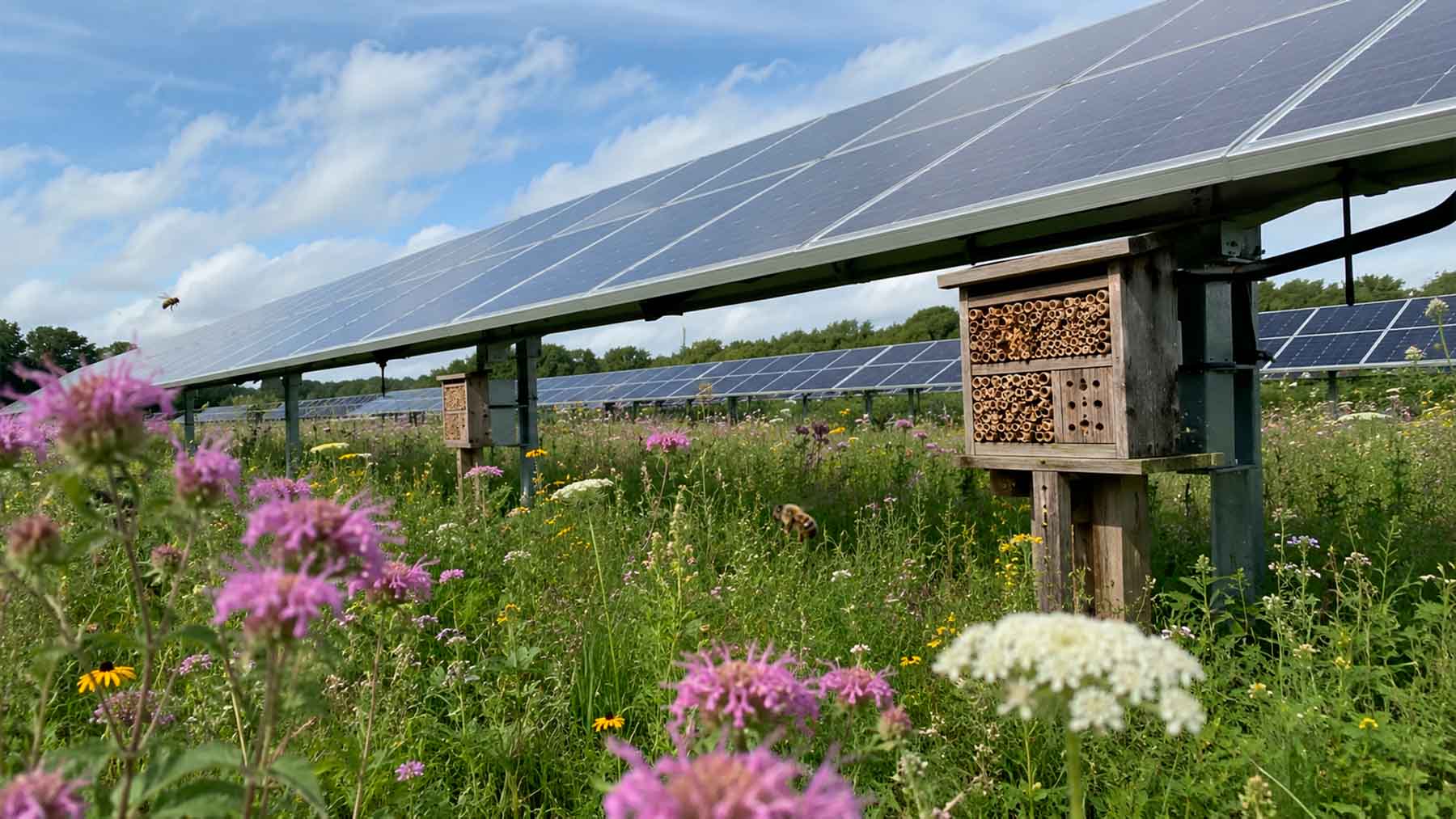 Image generated with artificial intelligence
Wisconsin is expanding its dual-use systems by creating a “bee hotel” on a solar farm.
Growing green capacity is needed to meet rising electricity consumption and international climate targets.
However, large-scale renewable energy projects have historically competed for viable land for development.
However, the Nelson Institute for Environmental Studies is providing insights on the environmental benefits of combining agriculture and solar energy.
This has created significant conflict with agricultural communities, leading to pushback that slows or halts progress.
Will combining the two sectors into one practice help accelerate the shift toward clean energy worldwide?
How a green revolution will serve as a dual solution
The onset of industrialization and digitization has drastically changed the planet.
Landscapes were lush and green, the air was clean, and climate shifts occurred through natural systems.
As human activity increased, vast forests had to give way to urban sprawl, leading to a significant loss of biodiversity.
Today, the population continues to grow, and technology is rapidly evolving.
This has accelerated global electricity demand, with average annual growth of 3.6% expected through 2030.
Electric vehicle adoption, the expansion and electrification of industrial manufacturing, and AI data centers are key drivers.
These advancements have triggered global warming, which is continuously shifting climate patterns.
Nations are now rushing to lower these impacts by reducing reliance on fossil fuels for energy.
International climate agreements are aiming to triple global renewable energy capacity to 11,000 GW by 2030.
Solar energy is the primary tool in this expansion, but the industry is facing major bottlenecks.
The contender that has historically slowed renewable progress
The United States is set to drastically increase its solar capacity thanks to local manufacturing that will secure energy independence.
While this is essential to meeting national climate goals, available land surface for new projects has become a primary challenge.
A typical large-scale solar farm requires five to ten acres per megawatt generated.
Flat, sun-drenched Midwestern farmland is usually targeted for development.
The Department of Energy predicts that future projects could need ten million acres of land by 2050.
This vast land demand has triggered intense conflict with farming communities.
Primary concerns include lower food production, loss of heritage cropland, and altered rural landscapes.
Consequently, several moratoriums or restrictive zoning laws have been passed against solar development.
However, the Nelson Institute for Environmental Studies is providing insights on the environmental benefits of combining agriculture and solar energy.
The research is part of a University of Wisconsin initiative to promote Wisconsin as a leader in agrivoltaics.
Reconciling agriculture and solar energy
Agrivoltaics in real-world settings are delivering promising results.
At the UW-Madison Kegonsa Research Campus in Dunn Township, initiative partner Alliant Energy constructed a 2.25-MW solar facility.
The goal is to establish a living laboratory that balances clean power production, ecological restoration, and agricultural activity.
Central to the project is measuring and revitalizing local pollinator health.
The addition of custom, automated “bee hotels”
These “hotels” are installed directly within and beneath the panels.
They serve as artificial nesting habitats for wild, solitary bees.
Bee activity is monitored using micro-cameras and automated imaging systems.
Population dynamics, foraging habits, and nesting success are captured with sensors.
The overall purpose is to establish the impact of dual-use sites on biodiversity and surrounding agricultural fields.
Grown beneath the panels are native prairie plants to provide forage while stabilizing soil and decreasing erosion.
The American Solar Grazing Association introduced sheep to manage vegetation growth naturally.
The pilot project will directly provide data for Badgervoltaics.
This is a growing network in Wisconsin connecting researchers, farmers, and energy leaders to scale agrivoltaics.
The project’s success will help expand this new practice across the state.
Additionally, it will reconcile farming communities and clean energy companies, paving the path forward to a dual-system future.

Anke Maree is a writer with a clear and engaging editorial style. Her work focuses on making complex topics accessible, informative, and relevant for readers across different areas of interest.
