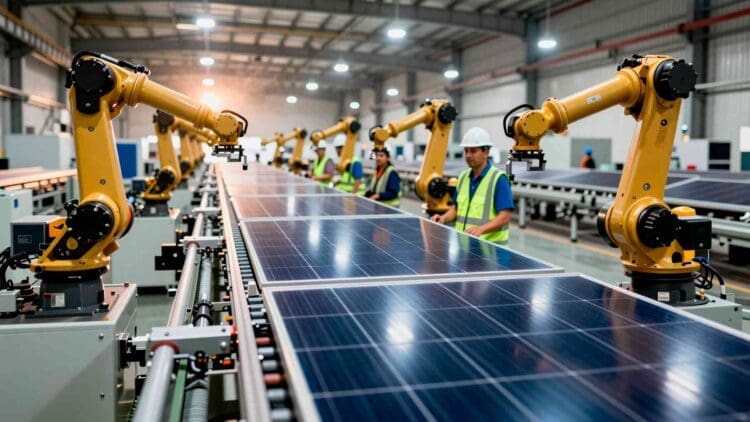

America is one step closer to energy resilience thanks to a domestic solar panel factory.
Modern nations face a paramount challenge regarding global energy security.
Renewables are rising as key solutions as the world struggles to break free from volatile fossil fuel supply chains.


Consequently, the dependence on foreign production is exposing domestic economies to even more unpredictable shocks.
How will Georgia’s new solar factory help the U.S. in its race for absolute independence?
How the world is struggling with fossil fuels
Globally, modern economies are transitioning to complete electrification as part of international climate goals.
This shift is set to free transportation from carbon-heavy fossil fuels.
Yet, progress is slow.
Electric transportation requires substantial amounts of electricity for charging stations.
This, along with rapid industrialization and AI data centers, is surging global energy demands.
This is why many nations remain heavily dependent on traditional fossil fuels.
While renewable installation rates are accelerating, the world’s power consumption continues to outpace them.
To prevent regional grids from collapsing, operators are forced to burn more carbon-heavy fuels.
This prolonged reliance slows the global green energy shift, setting nations significantly behind fast-approaching deadlines.
It also leaves economies vulnerable to highly unpredictable international supply chains.
Geopolitical tensions and regional conflicts can disrupt crucial energy corridors.
Worldwide, nations are impacted almost immediately.
To prevent exposure to external shocks, localized clean energy infrastructure must be established.
America needs domestic solar resilience
The U.S.’s power grid can become more secure by boosting solar energy.
Unlike centralized fossil fuel plants, solar generation is more easily distributed across the nation.
Decentralized solar facilities prevent single-point failures. Consequently, widespread blackouts become significantly less likely.
Furthermore, the installations provide immediate, predictable power during peak daylight times.
When combined with battery energy storage systems, regional grids become less strained during demand spikes.
However, this clean capacity expansion has created a new security risk for the United States.
Historically, America has relied on solar technology imports from foreign factories. This has exposed the U.S. to highly unpredictable trade shocks.
Overseas manufacturing excesses and shipping expenses have destabilized the domestic market.
Additionally, unprecedented geopolitical trade wars routinely interfere with component deliveries.
For these reasons, international policy shifts can immediately stall U.S. energy projects.
To boost true American manufacturing and resilience, Qcells North America constructed a facility in Georgia.
Inside the U.S.’s first vertically integrated solar factory
The new solar megafactory in Cartersville, Georgia, is set to alter the American energy landscape.
The solar cell factory is the biggest in U.S. history.
More crucially, it fundamentally shifts domestic manufacturing.
It is the first and only fully vertically integrated solar facility in the country.
The production lines are already operating at a significant scale.
The panel assembly department has reached full capacity.
The daily finished solar panel output has reached 16,700.
Additionally, solar cell production has officially started on-site.
Production is steadily being scaled up to reach peak operational targets by the third quarter of 2026.
The factory handles every stage of manufacturing consecutively under one roof.
The stages of solar panel production
- Raw elements are refined into high-purity silicon ingots
- The ingots are sliced into thin, conductive silicon wafers
- The wafers are then processed into fully functional solar cells
- The individual solar cells are assembled into completed panels
In America, establishing domestic manufacturing is the ultimate solution to global supply chain vulnerabilities.
The Cartersville factory proves that the U.S. can secure its own green energy future.
By manufacturing 16,700 panels daily, Qcells is successfully decoupling the U.S. grid from foreign dependencies.
Furthermore, securing national power supplies with solar installations makes it easier to achieve national climate targets.
Ultimately, local solar production transforms clean energy into a blueprint for true economic self-reliance.
Anke Maree is a writer with a clear and engaging editorial style. Her work focuses on making complex topics accessible, informative, and relevant for readers across different areas of interest.