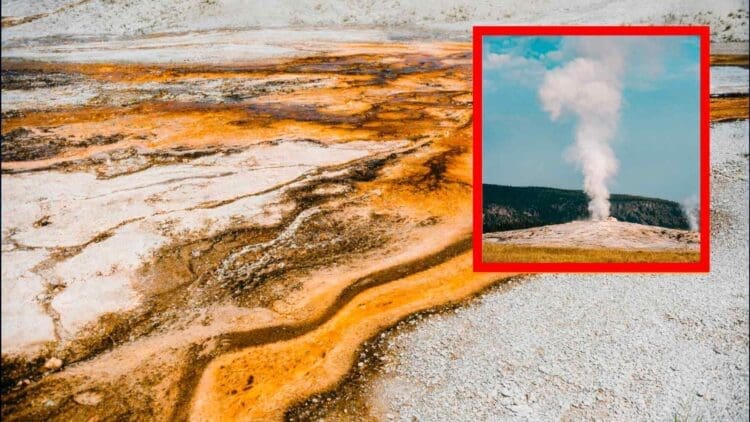

As one of the most predictable sights in the world — with eruptions timed down to minutes — people come to Yellowstone National Park knowing when Old Faithful will go off.
That makes it an interesting subject to study – and researchers are trying to understand why the world’s most famous geyser releases with such regularity.
What exactly is causing the geyser to sync up?


A pattern that refuses to be broken
There is a good reason why we call Old Faithful “Old Faithful.”
In the Upper Geyser Basin of Yellowstone National Park, it is arguably one of the most dependable attractions of all time, attracting millions of people to plan their visit around the eruptions.
It doesn’t erupt randomly, but rather follows a very consistent pattern. According to park rangers, Old Faithful erupts approximately every 91 minutes, based on years of data tracking its eruptions.
At the end of every eruption, the massive column of water and steam blasts hundreds of feet into the air — usually 100 to 180 feet high – from the superheated water and steam below ground.
The eruptions range from one-and-a-half to five minutes in length – either the shorter kind or the longer kind. This degree of dependability is not common.
Most of Yellowstone’s geysers — many located in the same upper geyser basin — have unpredictable eruption times, due to changes in the seismic activity of the area, changing water tables, or blockage of the underground water flow. However, Old Faithful continues to maintain its eruptions on a rather precise and regular basis, allowing experts to predict when the next eruption will occur.
When timing exposes a deeper connection
According to geologists, Old Faithful’s rhythm comes from a repeating process of heat, pressure, and water availability. After each eruption, the underground reservoir of the geyser is replenished as water seeps through porous rock to refill it.
The heat from Yellowstone’s volcanic system then heats the water until there is enough pressure to cause another eruption. This process happens with a frequency and regularity that is rare among hydrothermal systems.
Research on the timing of Old Faithful’s eruptions shows that the eruption timing is generally stable at the 91-minute rhythm, and only varies slightly seasonally or when environmental conditions affect the water flow.
Researchers have recently discussed these findings in visitor information materials, and one finding stands out: the eruptions of Old Faithful are occurring with such a consistent rhythm that they function as a sort of metronome for the entire hydrothermal system.
Visitors are noting that the consistent timing of Old Faithful allows the eruptions of nearby geysers to be accurately predicted, as if Old Faithful were serving as a reliable reference point for the overall system. Even the consistent timing of Old Faithful has generated additional research into the pathways of subsurface water flow and the heat distribution in the volcanic system.
The moment the answer becomes apparent
The “mysterious synchronization” beneath Yellowstone is not indicative of a potential hazard – but rather the visual representation of a highly synchronized and balanced mechanism operating beneath the Earth’s surface.
The dependable 91-minute eruption cycle of Old Faithful results from a recurring cycle of pressure release caused by the heat of Yellowstone’s volcanic engine.
This balance creates a somewhat rhythmic pulse — a phenomenon that seems mysterious only because nature so seldom keeps time.
Old Faithful’s near-perfect timing is an example of the fact that some of the Earth’s most powerful and dynamic forces may work with great steadiness. As scientists continue to study Yellowstone’s geothermal system to learn about the heat generated by volcanoes and the movement of underground waters, one thing has not changed.
Every 91 minutes, the Earth keeps its date with Old Faithful.