
13.2 million metric tons of American gas cleared its first major court challenge off Louisiana, and the roughly 50 creatures that surface to breathe in those same waters are why the math keeps changing
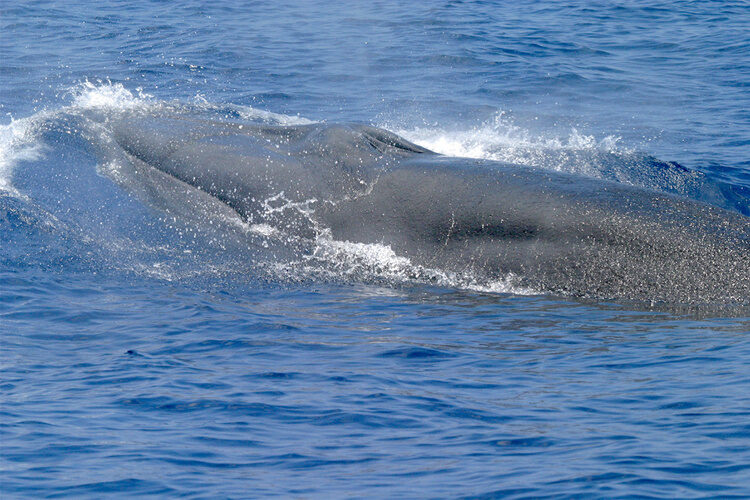 Photo: NOAA
Forty miles off the Louisiana coast, the Gulf of Mexico is deep and dark and, to most people flying over it, completely empty.
It is not empty.
Something rare surfaces there to breathe, sleeps near the water’s surface, and has done so for millennia entirely out of sight of the energy industry filling those same waters with rigs, pipelines, and now a proposal unlike anything built in American waters before.
Research found a significantly higher volume of gas flared in the first two years of a facility’s operation, roughly three times more than in subsequent years.
The pitch for that proposal is simple: cleaner fuel, American jobs, a bridge to the future, shipped from a terminal that floats rather than consuming another inch of Louisiana’s shrinking coastline.
What the pitch leaves out is what lives forty miles offshore, and what forty miles of open Gulf water actually means to a ship moving fast.
A terminal that floats on a promise
The idea behind the Delfin LNG deepwater port is straightforward enough to sketch on a napkin.
Three large vessels would be permanently moored to the Gulf seabed, roughly forty nautical miles off Cameron Parish in southwest Louisiana.
The moored vessels would receive natural gas through subsea pipelines, liquefy it onboard, and transfer it to large export tankers that pull up alongside.
Those tankers would then carry the gas to buyers in Asia and Europe.
The owner, Delfin Midstream, hopes to export 13.2 million metric tons of LNG per year at full buildout.
The offshore location was chosen partly to avoid the coastal land disruption that has made onshore LNG terminals so contentious.
But the Gulf of Mexico does not end at the shoreline.
The permit that kept coming back
The Maritime Administration granted the terminal its first approval in 2017, after a review that included an environmental document.
The project then spent years in limbo, challenged in court and caught between changing administrations.
In early 2025, plaintiffs alleged that permitting agencies reversed a planned delay following President Trump’s energy executive order on his first day in office.
Three environmental groups, the Center for Biological Diversity, the Sierra Club, and the Habitat Recovery Project, brought the fight to the Fifth Circuit Court of Appeals in New Orleans.
Those groups asked the court to vacate the March 2025 license.
The court ruled against them in July 2026.
The terminal cleared a significant legal hurdle in American waters.
What the flares light up at night
Closer to shore, along the Calcasieu River in the same Cameron Parish, a different LNG story has been playing out for years.
The Louisiana Department of Environmental Quality advises residents to limit fish and shellfish consumption to no more than two meals per month.
All seven U.S. liquefied natural gas export terminals violated federal air pollution laws over the past five years, according to one report.
Research found a significantly higher volume of gas flared in the first two years of a facility’s operation, roughly three times more than in subsequent years.
Most environmental assessments overlook the startup phase, meaning health impacts on nearby communities may be underestimated.
Forty miles out to sea, the hidden cost wears a different kind of skin.
Fewer than 50, and the tankers are coming
The Rice’s whale was not recognized as a distinct species until 2021, after Delfin’s original 2017 approval was already on record.
It lives only in the Gulf of Mexico.
The Rice’s whale is an endangered species with a population of approximately 50 individuals and faces serious risk of ship strikes from increased vessel traffic.
Scientists say the whale is particularly vulnerable because it sleeps near the water’s surface, where it is difficult to see.
The 2010 Deepwater Horizon spill caused an estimated population decline of up to 22 percent in the Rice’s whale.
Those tankers are not slow or small.
They cross the whale’s range to reach the open Atlantic, and the animal has no instinct to move for them.
The court found the plaintiffs lacked legal standing to block the project, not that the whale faced no risk.
A bridge fuel and a balancing act
The case for LNG as a bridge fuel is not fabricated.
Gas burns cleaner than coal at the point of combustion, and American LNG has helped European nations reduce reliance on Russian pipeline gas since 2022.
The accounting changes when the full picture includes risk to a species with approximately 50 individuals left on earth.
Delfin Midstream says its project meets all regulatory requirements and disputes conclusions that it threatens protected marine life.
The Habitat Recovery Project has expressed concern about the facility’s impact on Gulf fisheries, and its director noted that fishermen of Cameron Parish stand to lose livelihoods without meaningful consent.
For context on how natural gas output is driving the economics that make projects like Delfin viable, American producers are shipping more gas than ever before.
The Rice’s whale cannot weigh in on the permit.
What it can do is surface, breathe, and sleep in the same dark water that dozens of tankers a year will soon be crossing, and that is the part the brochure does not show, and the part that federal funding for offshore infrastructure has yet to fully answer.
Hugo is an engineer with strong technical expertise. Multilingual from an early age, his writing combines technical clarity with a strong interest in science and energy.
