
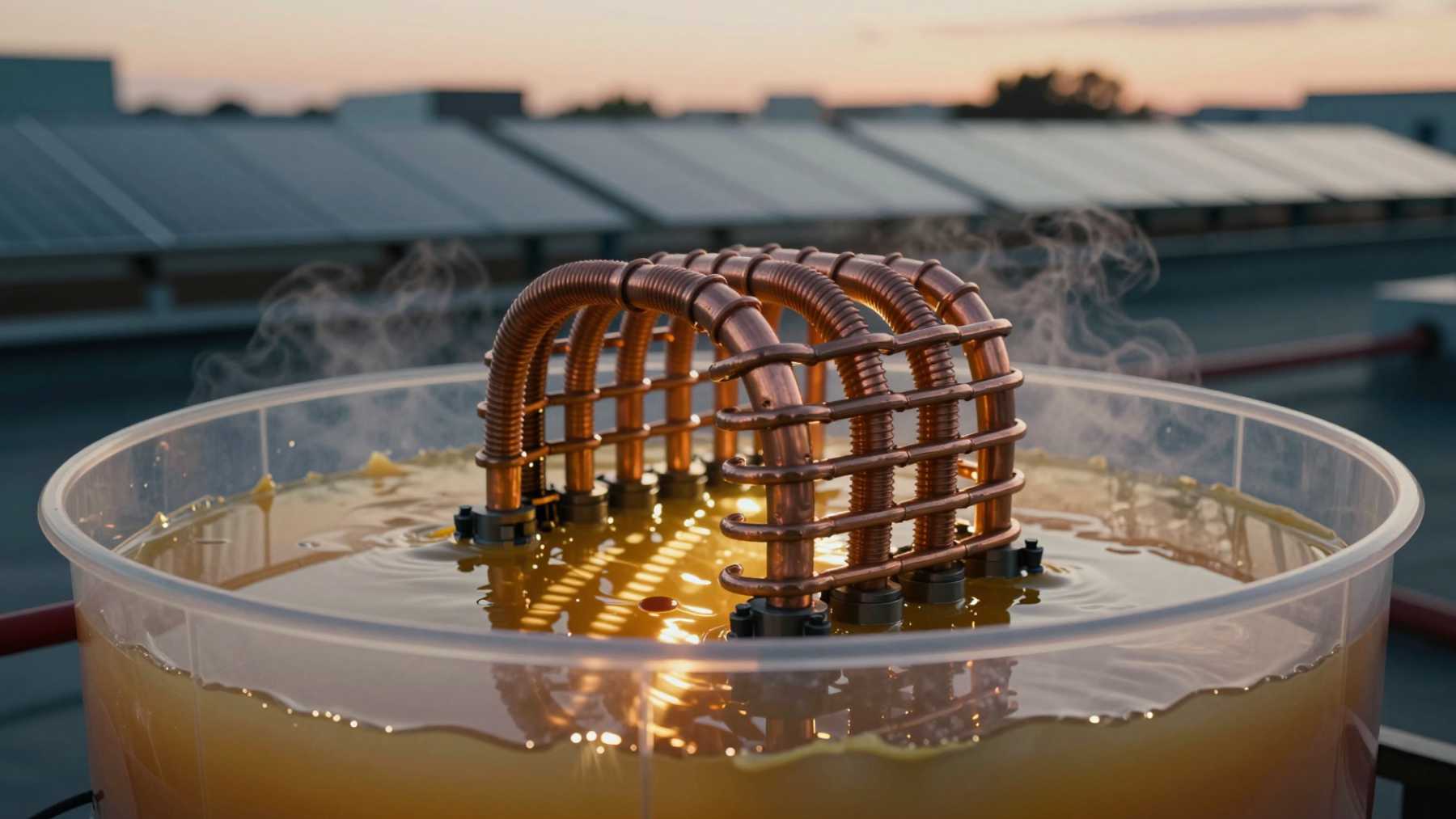
Engineers wrapped a simple metal corkscrew around a pipe, and the wax surrounding it began storing and releasing solar heat far faster than before
 AI-made
Solar panels catch sunlight beautifully. Storing that energy is another story entirely. When the sun sets or clouds roll in, standard systems struggle to hold onto heat. Releasing it reliably remains a major engineering headache.
On cold winter nights, you want that heat instantly. One clever fix uses a phase-change material inside the storage tank.
This special substance melts to absorb heat and freezes to release it. The concept is incredibly elegant.
By wrapping a simple metal corkscrew around a pipe, engineers have turned cheap paraffin candle wax into a high-speed thermal battery.
However, making it work in real life is hard. Fortunately, a small tweak is changing everything.
The storage problem solar panels can’t solve alone
Sunlight is highly irregular. The sun peaks at noon, but energy demand peaks at night. This mismatch means solar collectors often waste extra daytime heat.
To bridge this gap, we need dense, fast storage. It must release heat hours after the sun goes down.
Latent heat thermal energy storage (LHTES) does this using a smart physical trick. Think of it like a giant high-tech candle.
Materials like paraffin wax absorb massive amounts of energy as they melt. Remarkably, the temperature of the wax barely rises. Instead, heat locks in at the molecular level.
The energy then releases when the wax hardens. This delivers high energy density in a small space.
But there is a catch. Paraffin wax has terrible thermal conductivity. It transfers heat incredibly slowly.
Getting heat in and out quickly is a massive challenge. Standard systems run hot liquid through a pipe surrounded by wax.
In basic designs, most of the wax sits too far from the pipe. It stays cold and solid during the heating cycle.
What a spiral fin actually does inside a heat exchanger
Fins are thin metal strips attached to the outside of the pipe. Their job is to increase the total surface area, creating more pathways for heat to travel.
More contact means faster melting and freezing. A spiral fin wraps continuously around the pipe like a helix. This shape distributes heat evenly along the tube.
Think of a winding spiral staircase pushing heat outward in all directions. Standard straight fins cannot do this, often causing uneven melting.
Wax right next to the pipe melts instantly, while distant wax stays frozen. These cold pockets ruin system efficiency. The helical shape destroys these dead zones.
It forces the liquid wax to keep moving. Earlier studies in 2018 and 2023 proved this concept works.
Now, a new study pushes this idea further. Scientists tested full spiral fins under realistic solar conditions.
How researchers modeled and tested the system
The research team used a dual approach. They combined computer simulations with physical lab tests to ensure accuracy.
They ran their simulations using ANSYS Fluent 19.0. They needed to track exactly how the paraffin wax melts.
To do this, they used the enthalpy-porosity method. This math model treats the melting boundary as a porous zone, letting the computer track the shifting liquid line.
The scientists also built a physical laboratory setup. The real-world measurements matched the computer simulations almost perfectly.
They systematically tested three main variables. The first was fin pitch, or how tightly the spiral winds. Second was fin height.
Third was the total number of spiral turns. Each change altered how fast the wax charged and discharged.
The performance gains — and what drives them
The spiral-finned pipes easily beat standard pipes. They also beat straight-fin designs.
The spiral shape does not just add surface area. It actively drives natural fluid movement inside the tank.
As wax melts near the spiral, it warms up and rises. Cooler, heavier liquid wax sinks to take its place. This current carries heat deep into the wax much faster than slow conduction.
Discharging the stored heat works better too. Normally, cooling wax forms a hard crust around the pipe, trapping remaining heat inside.
The spiral fin breaks up this hard crust. It keeps the cooling pipe in contact with liquid wax, allowing heat to escape much faster.
But there is a hard limit. If you pack the fins too close, they block the flow.
Finding the optimal pitch is the secret to efficiency. This perfect balance keeps the fluid moving freely.
What this means for real-world solar storage systems
Faster cycles mean better economics. A thermal battery must run multiple times a day to store and dump energy, extracting maximum value from the solar hardware.
The spiral-fin design is cheap and highly practical. It requires no exotic materials or complex manufacturing.
This upgrade could supercharge home solar water heaters. It could also improve factory heating and massive grid storage facilities.
Scientists are even looking at adding nanoparticles. Mixing tiny particles into the wax boosts heat flow further, compounding the system’s efficiency gains.
If larger tests succeed, this quiet engineering fix could solve one of clean energy’s biggest bottlenecks.
By wrapping a simple metal corkscrew around a pipe, engineers have turned cheap paraffin candle wax into a high-speed thermal battery. This simple design finally gives us cheap, reliable solar power all through the night.
Kelly is an experienced writer with 15 years of experience exploring the big stories that shape our world, from tech breakthroughs and space exploration to climate, energy, and the fascinating quirks of science. She has a talent for turning complex ideas into sharp, memorable insights that stay with readers long after they’ve finished reading.
