
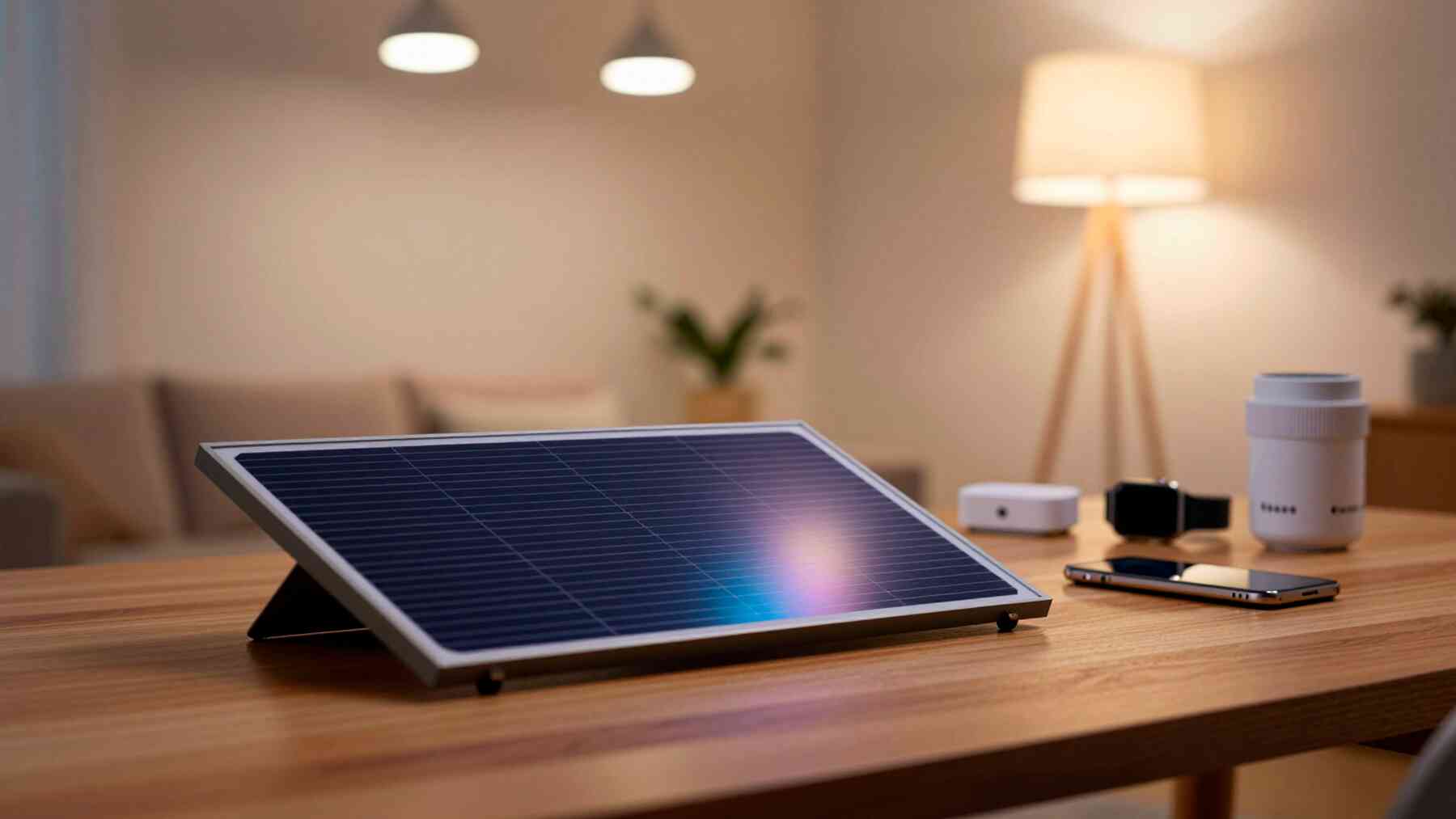
Indoor solar cells can now harvest enough electricity from your living room light to keep your devices charged all day
 AI-made
Every day, light pours through office windows and bounces off living-room LEDs — and almost none of that energy is ever captured. A small team of chemists at Kaunas University of Technology in Lithuania has developed a new organic semiconductor material designed specifically to change that, targeting the dim, artificial light of indoor spaces rather than direct sunlight. Their results are drawing attention from researchers worldwide.
The energy hiding in your living room
Light fills your home and office constantly — from LED bulbs, ceiling fixtures, and daylight filtering through the windows. Yet virtually all of that energy disappears without doing any useful work. Outdoor solar panels can’t solve this problem; they’re built for intense, direct sunlight and perform poorly under the dim, diffuse conditions typical of indoor environments.
Other renewable options face their own barriers. Wind and hydroelectric power are constrained by geography and steep infrastructure costs. Solar energy is more flexible and relatively inexpensive — but only when the technology can be adapted to where people actually live and work.
It required coordinated work across three countries: material synthesis in Lithuania, theoretical modeling in Saudi Arabia, device fabrication and testing in Taiwan.
That adaptation is becoming urgent. The rapid expansion of Internet of Things (IoT) devices — smart sensors, wearables, connected appliances — has created a growing need for compact, self-sufficient power sources. Replacing or recharging batteries at scale is neither practical nor sustainable, and indoor photovoltaics could fill that gap directly.
A new material built for dim light
The key advance from KTU comes from Dr. Asta Dabulienė, a senior researcher in the Chemistry of Materials group. She synthesized a series of new compounds called thiazol[5,4-d]thiazole derivatives, designed specifically as hole-transporting layers in perovskite solar cells.
These layers have a precise role: they selectively move positive charge carriers — called holes — through the cell while blocking electrons from traveling in the wrong direction. When charges recombine too early, energy is lost before it can be harvested. That recombination problem sits at the heart of building efficient low-light solar cells, and it’s what the new compounds were engineered to address.
“An ideal hole transporting semiconductor for these applications would possess high hole mobility and good energy level alignment with those of adjacent layers,” Dr. Dabulienė explains. Getting those properties right under indoor lighting conditions requires careful molecular design — which is exactly what the new compounds were built to deliver.
37% efficiency under LED light
To test the materials in real devices, researchers at Ming Chi University of Technology in Taiwan used one of Dr. Dabulienė’s compounds — a thiazol[5,4-d]thiazole derivative containing a triphenylamine donor fragment — to build perovskite solar cells optimized for indoor use.
The results were notable. Under 3000 K LED illumination at 1000 lux — conditions that closely resemble a well-lit indoor space — the cells achieved a power conversion efficiency of 37.0%. That figure represents a meaningful benchmark for indoor photovoltaics and demonstrates the real-world potential of this new class of semiconductors. Theoretical modeling of the compounds was handled separately by scientists at King Abdullah University of Science and Technology in Saudi Arabia, adding analytical rigor to the findings.
From mobile phones to smart sensors: the market opportunity
The practical applications are easy to picture. Perovskite indoor solar cells are thin, flexible, and can be integrated directly into consumer electronics — mobile phones, pocket flashlights, small connected devices. Rather than depending on wall chargers or disposable batteries, these products could draw continuous power from the ambient light already present in any room.
For IoT applications, the implications reach further still. Harvested electricity could regulate device operation dynamically, cutting energy waste and extending hardware lifespan. As IoT adoption accelerates, demand for high-performance, low-cost indoor photovoltaic cells is growing alongside it. Indoor solar isn’t a replacement for large-scale renewable energy — but as an inexpensive, flexible complement, it addresses a niche that nothing else currently fills well.
Science without borders: how the breakthrough came together
This result didn’t emerge from a single lab. It required coordinated work across three countries: material synthesis in Lithuania, theoretical modeling in Saudi Arabia, device fabrication and testing in Taiwan. That kind of distributed collaboration is increasingly how frontier materials science gets done.
The Chemistry of Materials group at KTU reflects that reality internally as well. Its members come from Lithuania, Ukraine, India, Pakistan, Armenia, Egypt, and Nigeria. Prof. Gražulevičius credits that diversity directly with the group’s creative output, noting that different cultural perspectives generate new ideas and that each researcher brings skills expanding the team’s overall range.
The group’s momentum is building. In 2024 alone, they secured four European Horizon Programme projects and received invitations from colleagues in the UK and Germany to collaborate on additional proposals. For a field where the next efficiency record could unlock an entirely new category of self-powered devices, that pipeline of international work is exactly what to watch.

Carlos is an engineer with strong expertise in technical and industrial topics. He previously worked at international companies such as Siemens and is multilingual.
