
Orcadian Energy launches assessment phase for North Sea gas fields to power offshore data centre with carbon capture
 AI-made
A North Sea gas field that sat untouched for three decades because of its unusually high carbon dioxide content may finally be heading for development — just not in the way anyone originally imagined. Orcadian Energy has formally launched the Assessment Phase for its Earlham and Orwell gas fields, with a preferred concept that skips pipeline export entirely and instead burns the gas offshore to power a co-located data centre, capturing the CO₂ and reinjecting it underground.
Orcadian starts formal assessment of Earlham and Orwell gas fields
Orcadian has kicked off the Assessment Phase for Earlham and Orwell on its 100%-owned licence P2680, in the UK North Sea. The immediate next step is preparing and submitting a Concept Select Report to the North Sea Transition Authority — a document that lays out the preferred development concept in detail and seeks a Letter of No Objection before any further approvals can move forward.
To run the project, Orcadian is setting up a new subsidiary called Earlham Gigagrid Ltd, or Gigagrid for short. The P2680 licence interest would be assigned to a subsidiary of Gigagrid, pending NSTA approval. That structure lets third-party investors participate directly without diluting existing Orcadian shareholders’ stakes in its other assets.
The offshore location also enables direct-to-chip liquid cooling, which the company says is a feature specialist data centre developers actively seek out.
High CO2 content drives gas-to-wire concept over pipeline export
Why did Earlham sit undeveloped for thirty years? Chemistry. The gas contains approximately 49% carbon dioxide — a proportion that makes conventional pipeline export commercially unattractive. When BP drilled an appraisal well in 1996, it curtailed the well test and walked away precisely because of that CO2 content.
Orcadian’s answer is to flip the problem into an asset. Rather than exporting gas, the preferred concept generates power at the field, captures the CO2, and reinjects it into the Earlham reservoir. Reinjection provides pressure support and boosts gas recovery. The reservoir’s own geological history backs the approach — Earlham has held onto CO2 over geological timescales, which suggests the rock is well-suited to long-term storage.
Because Earlham gas is so CO2-rich, it can’t run turbines on its own. Orcadian plans to blend it with gas from the adjacent Orwell field to reach an average methane content of around 50%. Finding the right turbine to handle that low-calorie blend — and integrating it with a carbon capture system — is one of the key tasks the concept select process needs to resolve.
Proposed offshore complex would supply 200 MW to a dedicated data centre
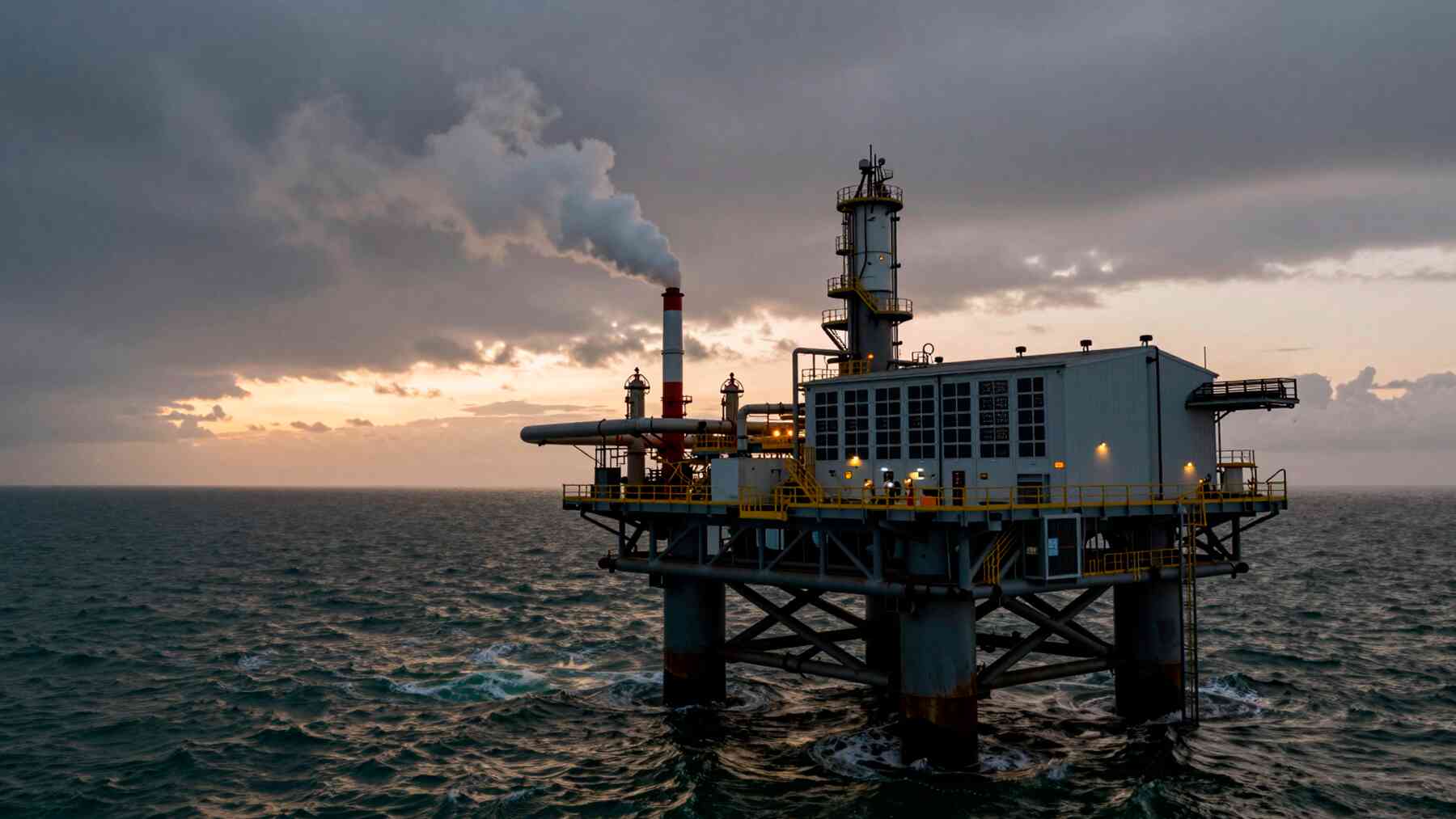
The physical setup Orcadian has in mind is a three-platform complex, all bridge-linked. A wellhead platform would support two production wells and one CO2 injection well, connecting to a power station platform, which in turn links to a dedicated data centre platform. The power station is designed to supply approximately 200 MW of electrical power — measured as IT load — directly to the co-located data centre.
Building everything offshore cuts out a long list of onshore infrastructure: no high-voltage cable to shore, no CO2 disposal pipeline, no natural gas export pipeline, no high-voltage transformers or AC/DC converters. The offshore location also enables direct-to-chip liquid cooling, which the company says is a feature specialist data centre developers actively seek out.
Orcadian expects the ultimate investors and operators to come from major hyperscalers — Google, Amazon, Meta, and Microsoft are all named — as well as AI-focused neo-scalers including CoreWeave, Nebius, Lambda Labs, Crusoe Cloud, and Vultr. The company is explicit that it sees no need for government subsidy and believes the concept places no additional demand on the national grid.
AI-driven compute demand cited as key motivation for offshore data centre strategy
Orcadian’s directors are upfront about what’s driving the concept: the global surge in AI-related compute demand has, in their words, upended electricity demand forecasts around the world. Offshore data centres, they argue, offer one way to meet part of that demand without piling pressure on onshore grid infrastructure.
Two structural advantages stand out. The offshore location puts the facility far from populated areas, and cooling systems benefit from proximity to the sea as a natural heat sink. Co-locating the data centre with a dedicated power source removes reliance on costly onshore transmission and distribution networks entirely.
On emissions, CEO Steve Brown stated that Scope 3 emissions from the project are expected to be less than 10% of those from a conventional unabated gas-to-power development. The company also argues the concept supports the UK government’s clean power goals for 2030 and its broader energy security objectives.
Separately, Orcadian has agreed a deferred repayment schedule with The Independent Power Corporation Limited for approximately £1.34 million ($1.74 million) in loans, including capitalised interest as of 30 June 2026. Those amounts are now repayable by 31 December 2027, at a fixed interest rate of 8.5% per annum.
Background: Earlham field history and resource estimates
Earlham was discovered in 1995 by Talisman. It’s described as a high-quality Leman sand accumulation with roughly 95% net-to-gross ratio, 18% porosity, and approximately 250 millidarcy permeability — reservoir characteristics Orcadian says should make development relatively straightforward, with no well stimulation anticipated.
Orcadian estimates Earlham holds a P50 methane resource of 114 bcf. Redeveloping the previously depleted Orwell field could add a further 31 bcf. Licence P2680 also contains the Clover prospect, mapped as potentially holding 153 bcf of gas with a 38% geological chance of success, though that remains an exploration-stage estimate.
In short: Orcadian has formally entered the Assessment Phase for Earlham and Orwell, with a preferred concept built around offshore gas-to-wire power generation, integrated carbon capture, and CO2 reinjection to supply a 200 MW offshore data centre. A new subsidiary, Gigagrid, will hold and develop the project. The next formal milestone is submitting a Concept Select Report to the NSTA, with all further steps subject to regulatory approval.
Kelly is an experienced writer with 15 years of experience exploring the big stories that shape our world, from tech breakthroughs and space exploration to climate, energy, and the fascinating quirks of science. She has a talent for turning complex ideas into sharp, memorable insights that stay with readers long after they’ve finished reading.
