
A floating wind turbine rocked with the waves, and the turbine behind it produced up to 26% more power while absorbing new fatigue loads
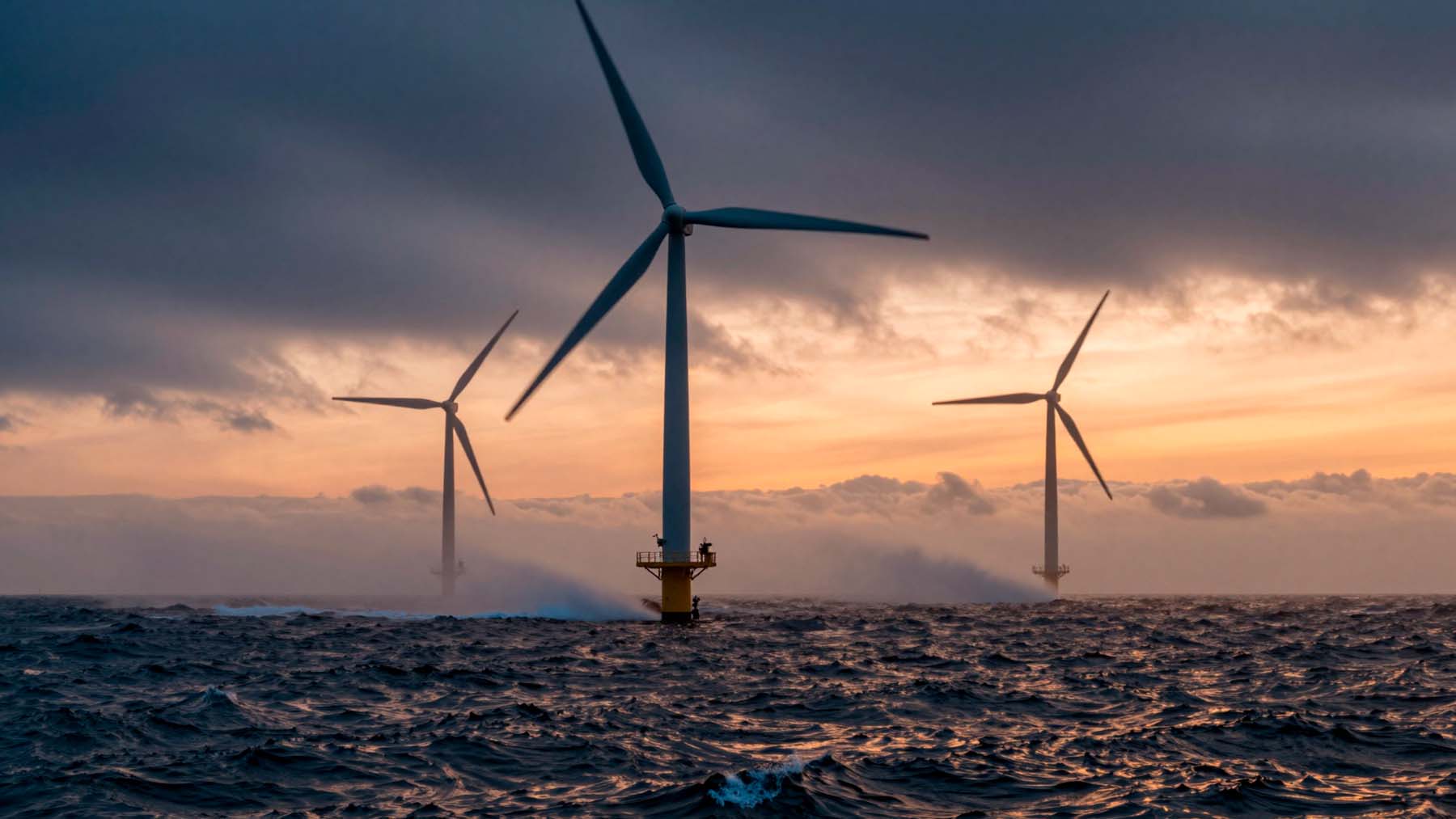
A floating wind turbine never stands perfectly still. Its platform rolls and pitches on ocean swells, and that constant motion has long been treated as a structural nuisance — something to manage, not a variable that might reshape the invisible column of disturbed air trailing behind the rotor.
New research suggests otherwise. In the large wind tunnel at Politecnico di Milano, a team of researchers set up two scale-model turbines and deliberately made the upstream one rock, while instruments on the downstream turbine recorded exactly what arrived in the wake. What they measured challenges a basic assumption in floating wind farm design.
When the platform moves, the wake moves with it
Floating wind turbines live in two mechanical worlds at once. At low frequencies, wind turbulence and wave forcing excite the platform’s natural eigenmodes, producing large, slow oscillations. At higher frequencies — roughly 0.05 to 0.2 Hz — ocean waves directly shake the platform in the wave-frequency range. Both regimes produce real motion at the rotor hub, and that motion doesn’t stay local.
Peak-to-peak lateral displacements reached up to 0.3 rotor diameters — roughly 11 to 18 times larger than the actual lateral displacement of the rotor itself.
Unlike a fixed-bottom turbine, a floating one injects periodic velocity fluctuations into the flow behind it. Along-wind motions pulse the wake in rhythmic bursts; crosswind and yaw motions push it sideways, making it meander like a river changing course. Previous experiments had studied these effects on isolated turbines. What happened when that disturbed wake hit another rotor downstream had never been directly measured — until now.
The Politecnico di Milano team used 1:75-scale models of the DTU 10 MW reference turbine. The upstream unit sat on a six-degrees-of-freedom robotic platform reproducing realistic floating motions, while the downstream turbine was fixed and instrumented to capture thrust and torque at spacings between three and five rotor diameters.
More motion, more power — but only under the right conditions
The headline result is striking: large-amplitude, low-frequency motions of the upstream turbine increased the downstream turbine’s power output by up to 26% compared to the fixed-platform baseline. The biggest gains appeared in aligned configurations at short spacings of three to five rotor diameters, under low-turbulence inflow of 1.5%.
The absolute numbers deserve equal attention. That 26% relative gain translated to only about 2–3.5 W at model scale — roughly 0.3 to 0.5 MW at full scale. Partially offset configurations produced larger absolute gains, up to about 5.4 W, or 0.82 MW at full scale.
Wave realism matters too. When irregular waves were aligned with the wind at 0°, power gains were comparable to idealized sinusoidal pitch tests. But waves arriving at 30° to the wind — exciting combined crosswind and yaw motion — erased those gains entirely. Real sea states may limit the beneficial effect that clean sinusoidal motions can produce.
Platform rocking also amplifies fatigue loads on downwind rotors
The same periodic structures that carry extra energy downstream also carry a mechanical cost. Coherent velocity patterns arrived at the downstream rotor organized at precisely the upstream platform’s motion frequency, and the downstream turbine responded in kind.
In fully aligned configurations, torque fluctuations reached up to 12% of mean torque, while thrust fluctuations reached up to 3% of mean thrust. These cyclic loads repeat at the platform motion frequency — and cyclic loads drive fatigue.
One important boundary emerged clearly. Higher-frequency platform motions — at a reduced frequency of around 1.2, representative of wave-peak excitation — didn’t significantly increase downstream loads. The coherent velocity structures dissipated before reaching the second rotor. Irregular wave-driven motion reproduced the same basic patterns but with lower amplitudes and broader spectral content.
Pulsing vs. meandering: two distinct load mechanisms
Along-wind motions — surge and pitch — create wake pulsation. A turbine sitting directly in line receives the full effect, with torque and thrust oscillating at the platform frequency.
Crosswind and yaw motions work differently, creating lateral wake meandering instead. Peak-to-peak lateral displacements reached up to 0.3 rotor diameters — roughly 11 to 18 times larger than the actual lateral displacement of the rotor itself. For meandering, the strongest loads hit a turbine offset by about half a rotor diameter, where one side of the rotor swings in and out of the moving wake without cancellation.
Pitch motion at low reduced frequency added yet another wrinkle: a second-harmonic load response caused by the rotor periodically deflecting the wake vertically, producing load oscillation at twice the pitch frequency.
What this means for floating wind farm design
Platform-induced wake dynamics directly shape how much power a downstream turbine extracts and how hard its structure works to do it. The same low-frequency motions that modestly improve energy capture also introduce cyclic loads that could accelerate wear on downstream rotors — a tradeoff that can’t be ignored at commercial scale.
The results were obtained under low turbulence and short spacing. Higher atmospheric turbulence — the norm in real offshore environments — would accelerate natural wake recovery and likely shrink both the power gains and the load amplitudes.
Future work will need to put both turbines in motion simultaneously, account for wave propagation across the array, and incorporate active blade-pitch control to potentially mitigate fatigue loads. As floating wind farms move toward commercial-scale arrays, platform dynamics and wake aerodynamics must become first-class inputs to turbine design and farm layout — not afterthoughts modeled away.
The full study is available here: Fontanella, A., Cioni, S., Papi, F., Muggiasca, S., Bianchini, A., and Belloli, M.: Experimental investigation of the effects of floating wind turbine motion on a downstream turbine performance and loads, Wind Energ. Sci., 11, 1821–1851, https://doi.org/10.5194/wes-11-1821-2026, 2026

Carlos is an engineer with strong expertise in technical and industrial topics. He previously worked at international companies such as Siemens and is multilingual.
