
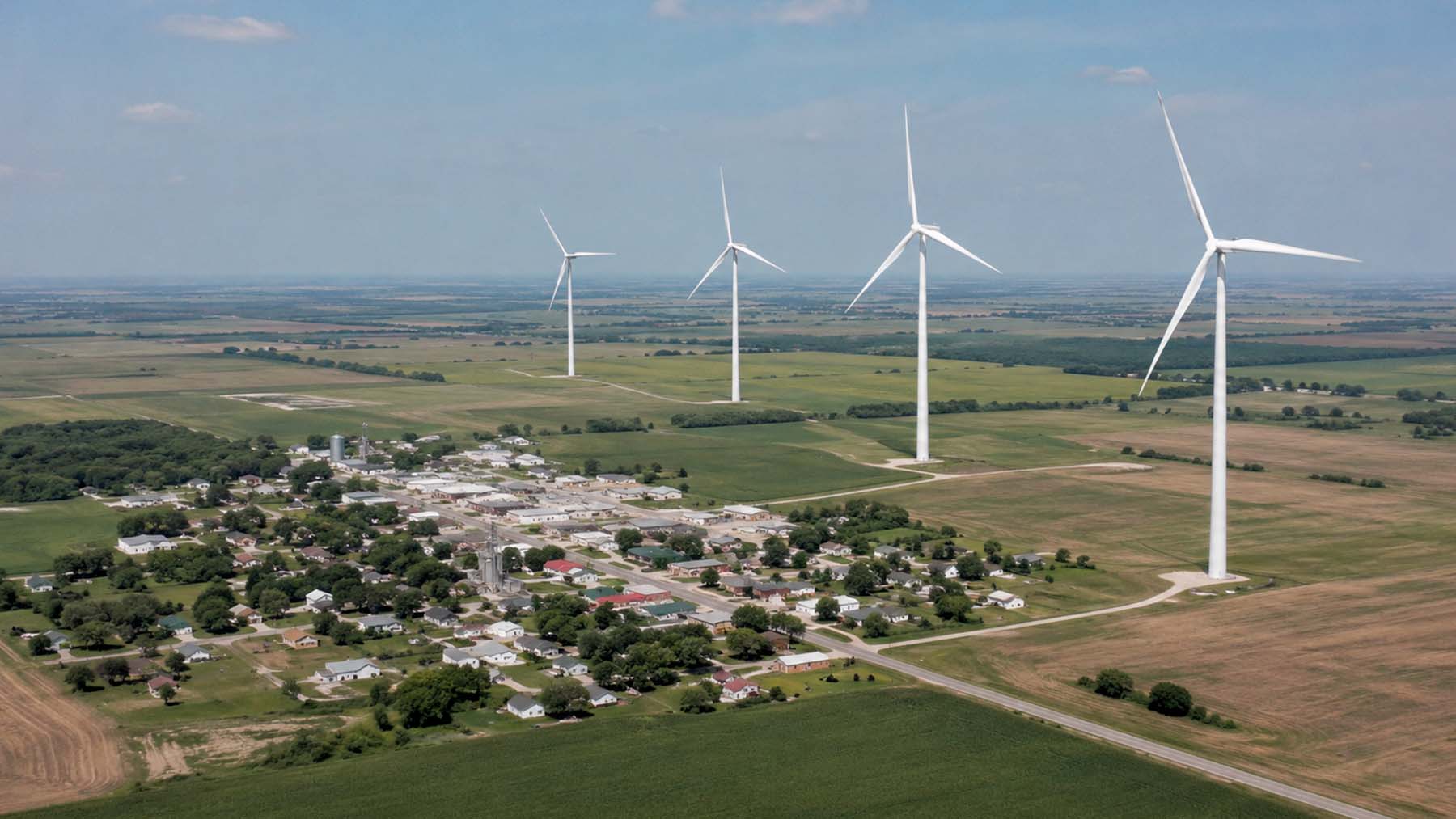
In Missouri, a farming town of just 1,300 people installed four giant turbines visible from 15 miles away and ended up producing more energy than it knew what to do with
 Credits: AI-made
A small community in Missouri installed four giant turbines and became a prime example of quietly embracing sustainability.
Some major economies are struggling to decarbonize their national grids as electricity demand outpaces green generation.
Meanwhile, localized power production showed that massive grids are not the only way to overcome climate challenges.
Ultimately, Rock Port serves as a timeless standard for similar communities, where sustainability begins with just a few local turbines.
An agricultural hub in the U.S. has proven what decentralized wind projects can do.
Will this local effort end up inspiring renewable development globally?
How major grids ended up falling behind
Some of the biggest city centers worldwide have become primary hubs for the digital era.
Giant data centers are emerging at nearly every corner as several sectors become digitized.
Beyond the AI boom, vehicles are increasingly going electric, which is driving an unprecedented surge in global energy demand.
Green infrastructure has also significantly increased over the past few years.
However, this growth is not enough to keep up with the digital era’s high demand for electricity.
Existing grid infrastructure is aging, and modernizing it is a timely, expensive process.
More often than not, wind and solar facilities are built remotely from major urban regions.
This requires building new transmission lines to transmit the clean energy, which also takes time.
Furthermore, national grids were designed to handle centralized power generation, not the intermittent output of wind.
For this reason, numerous major economies still rely on fossil fuels for backup production.
Carbon-heavy reliance is slowing progress
Ever since the effects of climate change became public knowledge, nations have been actively working to mitigate them.
Yet, the record-high additions of green capacity become moot when the energy sector continues to burn fossil fuels.
The combustion of coal, oil, and gas accounts for almost 90% of all global carbon emissions.
Consequently, global warming accelerates as these emissions trap heat in the atmosphere.
The key goal is to limit these temperature increases to 2.7°F above pre-industrial levels.
Unfortunately, the past three years have been the hottest years ever recorded, and 2026 is set to join this trend.
Should mankind exceed the critical temperature threshold, it will trigger extreme, irreversible ecological damage.
This is why global greenhouse gas emissions must be halved by 2030.
While major cities are struggling to lower their carbon footprints, a community in Missouri made it look extremely easy.
In fact, it has excess green energy.
Northwest Missouri’s four turbines that are “farming” energy
Missouri is not among the top five wind-generating states in the U.S., but it remains a prime example of resilience.
More specifically, the small agricultural town of Rock Port is showing what should be done.
The town is located in the rolling Loess Hills and enjoys consistent wind.
In 2008, the town developed the Loess Hills Wind Project, which consists of four giant wind turbines.
The turbines are 280 feet each, and each one has a generation capacity of 1.25 MW.
The combined output is enough to power the entire community of 1,300 people.
It also generates approximately 125% of Rock Port’s total energy needs. But the excess electricity does not go to waste.
Capitalizing on surplus green power
The turbines are connected to the local grid.
During excess energy production, the surplus is exported.
The extra electricity is sold to the Missouri Public Utility Alliance in Columbia.
This secures long-term economic benefits for Rock Port residents while decarbonizing the broader grid.
It has been almost two decades since the Loess Hills Wind Project’s launch.
The wind farm remains fully operational today, with the four turbines continuing to anchor the community’s zero-carbon legacy.
The long-term success proves that decarbonization does not always need substantial budgets or massive footprints.
Ultimately, Rock Port serves as a timeless standard for similar communities, where sustainability begins with just a few local turbines.
Anke Maree is a writer with a clear and engaging editorial style. Her work focuses on making complex topics accessible, informative, and relevant for readers across different areas of interest.
