
Farmers let solar panels share their fields instead of replacing them, and nearly half the public said they would pay more for the electricity
 AI-made
Solar panels are spreading far beyond suburban rooftops.
Across Europe and the U.S., massive photovoltaic systems are taking over open fields, lush meadows, and rolling hillsides. Communities living nearby are rarely thrilled.
Locals often feel like fertile farmland is being quietly turned into industrial power sites. They are pushing back hard against these developments.
If policymakers back these dual-use setups with targeted tax credits and subsidies, agrivoltaics could remove the biggest roadblock facing solar expansion.
This resistance is not just a minor headache. For governments trying to hit aggressive clean energy targets, local pushback can freeze projects completely.
Combining solar panels with active farming—a concept known as agrivoltaics—has been floated to help ease this tension. But until recently, no one knew if the public would actually react differently to it.
Researchers at the University of Bonn set out to test if sharing land with crops could change minds.
What agrivoltaics actually looks like
Agrivoltaics is not a single, cookie-cutter setup. It covers a wide range of designs with one core rule: farming never stops.
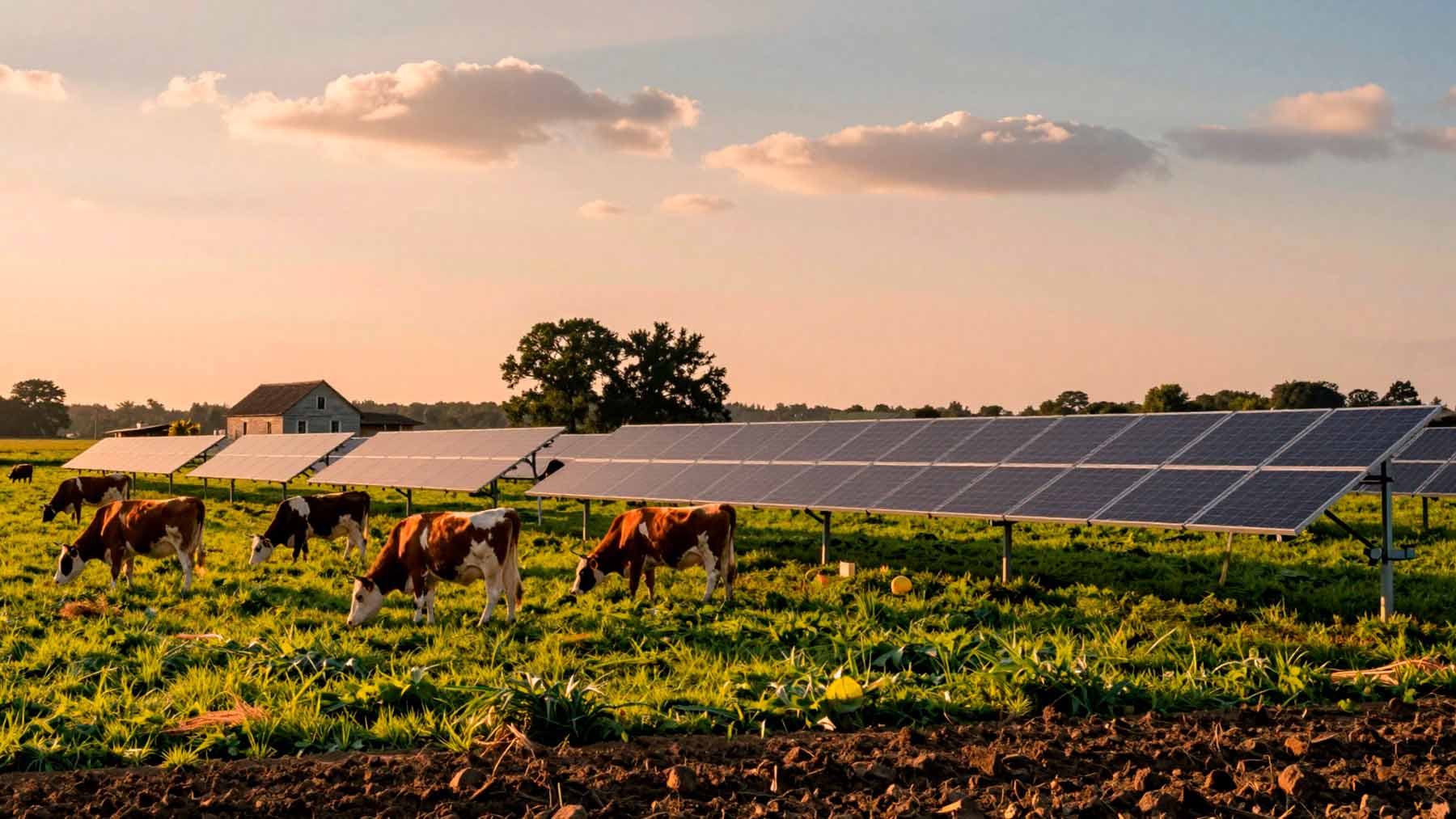
On a grain farm, tall panels act as windbreaks to protect delicate wheat crops. Over vineyards or orchards, semi-transparent solar canopies protect grapes and apples from hailstones and intense heatwaves. On livestock pastures, cattle graze freely in the shade between long rows of equipment.
Hendrik Zeddies, a lead researcher at the University of Bonn’s Center for Development Research, points out that these setups usually lower total crop yields slightly.
Yet they also create surprising wins. Crops stay safer during extreme weather, and the panels generate clean power at the same time.
Unlike traditional solar parks, agrivoltaics turns farmland into a dual-purpose site instead of wiping out agriculture entirely.
How the study was designed
To measure how people really feel, the research team surveyed nearly 2,000 citizens. The group mirrored the overall German population across age, sex, education, income, and region.
Each person was shown pictures of real agricultural landscapes—pastures, wheat fields, and vineyards.
They were shown the original farmland alongside two options: an agrivoltaic setup and a standard open-land solar farm.
Participants answered questions about landscape beauty and recreation value. They were also asked about their wallets: Would they pay a price premium on their power bills for agrivoltaic energy? Or would they pay out of pocket to block a nearby solar park from being built? The findings were published in the scientific journal Land Use Policy.
What the numbers revealed
The survey results showed a clear public preference.
Nearly 44% of respondents said they would gladly pay extra on their monthly electric bill for agrivoltaic power. For standard, land-consuming solar parks, that support plummeted to just 29%.
Strong opposition dropped significantly, too. Only 2.9% of people said they would spend their own money to block an agrivoltaic setup near their home. For traditional solar parks, nearly 5% were ready to pay to stop them.
People still felt that solar installations hurt natural views overall. But that negative impact was far milder when active farming continued alongside the panels.
Psychologically, combining food and clean power generation feels completely different to voters than kicking farmers off their land.
Promise and limitations ahead
These findings offer huge promise for clean energy advocates, but Zeddies remains realistic.
The survey was hypothetical, and people do not always spend their real money the way they promise in surveys. Still, the data clearly reveals a huge shift in public perception.
The bigger hurdle is basic economics. Agrivoltaic systems cost significantly more to build than standard ground-mounted panels because they require elevated, specialized frames. They also produce slightly less electricity per acre.
“Without subsidies, it will presumably not be possible to install many systems,” Zeddies notes.
That puts the ball squarely in government court. If policymakers back these dual-use setups with targeted tax credits and subsidies, agrivoltaics could remove the biggest roadblock facing solar expansion.
The University of Bonn study gives leaders clear proof that citizens prefer solar power when it supports local farms instead of replacing them.
What comes next
Solar developers have spent years fighting local communities over open land.
Agrivoltaics proves that clean energy growth does not have to come at the cost of traditional agriculture.
Which brings us back to those farmers letting solar panels onto their fields.
Why did nearly half the public say they would willingly pay higher power bills for agrivoltaic electricity?
Because people don’t actually hate solar panels—they just hate losing their local farms. By letting clean energy share the land instead of taking it over, we can build a stronger power grid without losing the fields that feed us.
Kelly is an experienced writer with 15 years of experience exploring the big stories that shape our world, from tech breakthroughs and space exploration to climate, energy, and the fascinating quirks of science. She has a talent for turning complex ideas into sharp, memorable insights that stay with readers long after they’ve finished reading.
