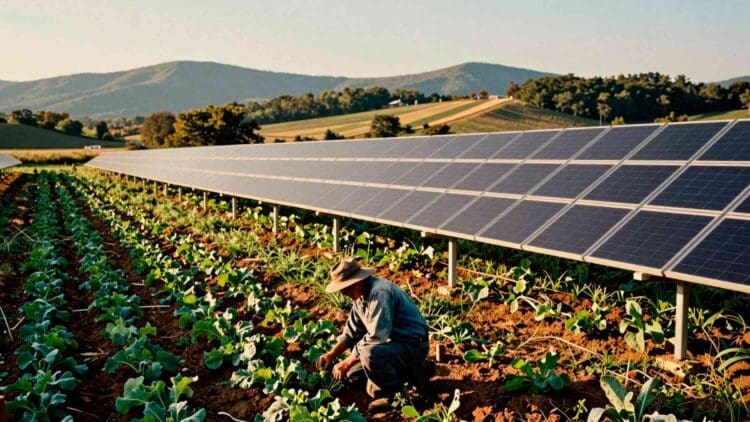

Virginia just made a massive decision about the future of farming and clean energy.
The state passed a law proving solar panels and crops can thrive on the same dirt.
Governor Abigail Spanberger signed the bill at a unique farm in Loudoun County. It is the state’s first official crop-based agrivoltaic project.

For the first time, Virginia law formally recognizes that solar fields and working farms can coexist.
The timing is absolutely critical. Virginia has lost nearly half a million acres of farmland since 2017. Meanwhile, the pressure to build solar projects on open land keeps growing.
How can this new movement reshape the situation in Virginia?
How a definition opens doors for agrivoltaics
Virginia’s new law does something deceptively simple. It gives agrivoltaics an official legal identity.
The law defines it as intentionally putting agricultural production and solar energy on the exact same land. That specific phrase carries massive weight for local planning offices across the state.
This new definition also comes with real teeth.
Solar projects must prioritize and protect farming productivity for the long haul. They must remain part of an active, commercial agricultural operation.
They also need clear cleanup plans to protect the soil for future generations.
One major clause completely stands out.
How can this new movement reshape the situation in Virginia?
Where Virginia stands today
Right now, Virginia’s actual agrivoltaic footprint is real but fairly modest. The National Renewable Energy Laboratory lists 13 of these dual-use projects operating across the state.
Only a single site—Roundabout Meadows—focuses entirely on growing food crops.
The rest of the projects focus on livestock grazing or creating pollinator habitats.
The overall scale of these installations varies dramatically from place to place. The largest site is Skipjack Solar Center, a massive sheep-grazing operation covering 2,200 acres.
Roundabout Meadows presents a starkly different picture.
It is a tiny, 17-kilowatt direct current installation built on a working community farm. Yet, it generates roughly 130% of that specific farm’s total energy needs.
How can this new movement reshape the situation in Virginia?
Farmland loss and the solar pressure problem
Virginia lost 488,292 acres of farmland between 2017 and 2022. This staggering data comes directly from the official USDA Census of Agriculture report.
That means nearly half a million acres disappeared in just five short years.
Meanwhile, commercial solar development has been accelerating across the state’s open land.
A 2024 university study uncovered some deeply concerning details. It found that 41% of solar-disturbed land in Virginia was actually prime farmland.
That specific loss represents more than 12,500 highly productive acres.
This growing problem prompted Virginia to take quick action. The state legislature passed a major new environmental law back in 2022.
You can read the specific details in the Virginia House Bill 206 statute.
This bill specifically addresses how solar projects impact prime agricultural and forest soils.
Agrivoltaics does not completely eliminate this painful tension. However, it gives communities a smart framework to navigate the issue. How can this new movement reshape the situation in Virginia?
Reviving fallow land through solar grazing
One compelling argument for agrivoltaics involves recovering land that was already lost.
Lauren Glickman, who leads the Agrivoltaics Solutions advisory group, describes a clear pattern playing out nationally.
Farmers frequently abandon their land because the basic economics simply no longer work.
Agrivoltaic development could offer these struggling landowners a steady, reliable new revenue stream.
This is especially true when it comes to solar grazing with livestock. Leasing out shaded land to a grazing operation does not require heavy, active management. Yet, it successfully keeps that valuable property in active agricultural use.
Glickman notes that this approach goes beyond preservation to actually grow new farmland.
This unique vision serves both traditional crop farmers and livestock grazers.
Many parts of the country are exploring similar programs as Texas becomes the face of agriculture and solar expansion.
These are two distinct industries with genuinely different operational needs.
Ultimately, it creates a brand-new, thriving market for solar-grazed land across the country. How can this new movement reshape the situation in Virginia?
Building the coalition to make it work
The passage of Virginia’s groundbreaking new law was only the very first step. The harder work involves defining the exact permitting criteria and setting state monitoring standards.
An informal advisory group of clean energy and agricultural leaders will come together to work out these complex details.
The Spanberger administration plans to coordinate with these key stakeholders relatively soon.
A joint agricultural voice will ensure the new legal definition works for everyone.
This team approach reflects how Virginia just rewrote its community solar rules to help more people access clean energy.
The output from these collaborative groups will shape how agrivoltaics functions across the state for years.
Establishing durable standards could turn small local partnerships into massive, scalable clean energy operations.
This structural layout ensures that green energy and agriculture can coexist in absolute harmony.
Virginia has successfully laid down a very strong foundation for this movement. What the state actually builds on top of that foundation is still being decided today. How can this new movement reshape the situation in Virginia?
Kelly is an experienced writer with 15 years of experience exploring the big stories that shape our world, from tech breakthroughs and space exploration to climate, energy, and the fascinating quirks of science. She has a talent for turning complex ideas into sharp, memorable insights that stay with readers long after they’ve finished reading.