
In the California desert, a robot named Maximo has already installed 182,000 solar panels, and it still has nearly 2 million more to place as it works through the night on mechanical caterpillar tracks
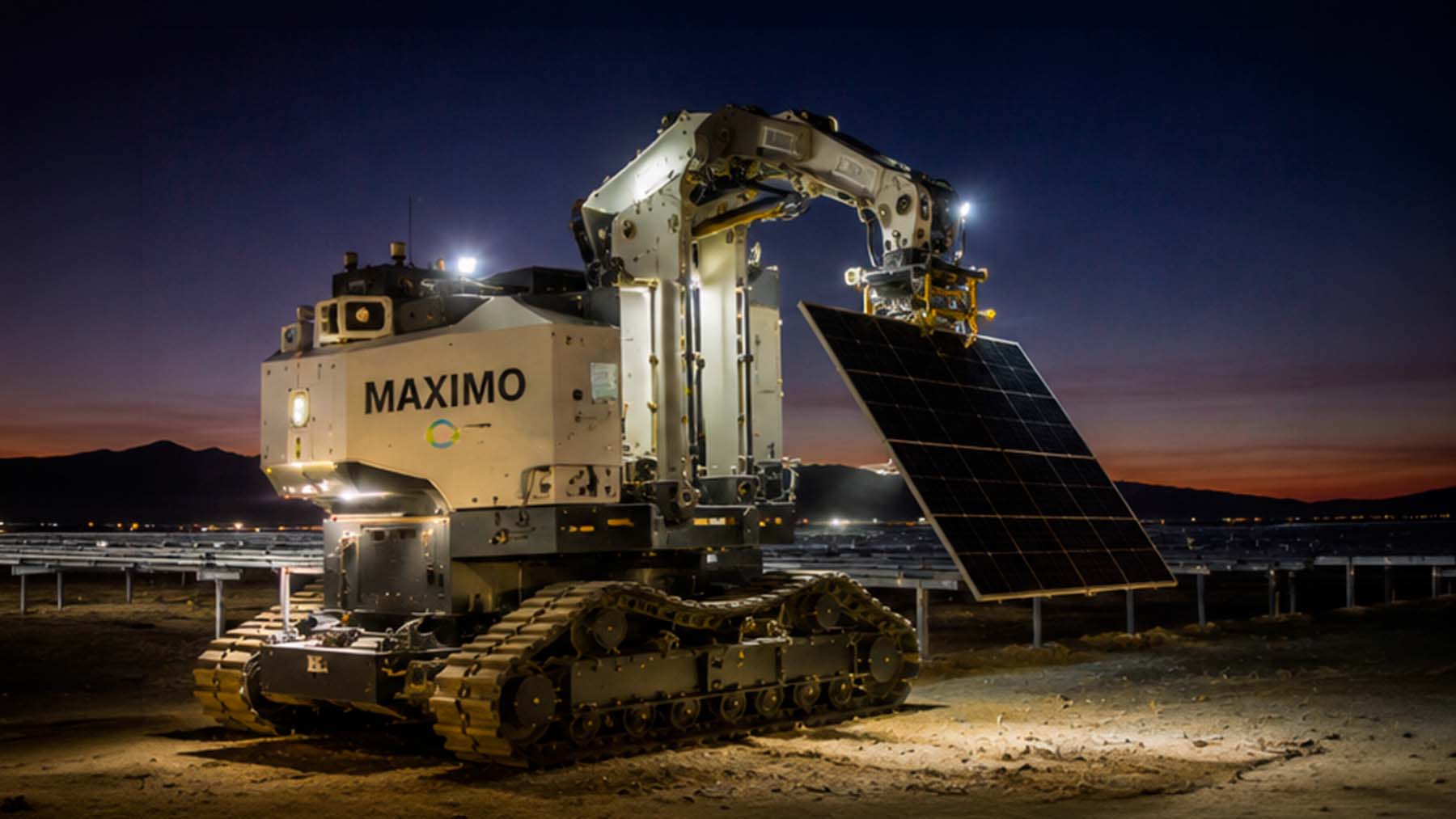
The Maximo robot shows how it can transform solar projects by streamlining development.
International climate targets have become stricter as the world’s electricity demands continue to soar.
To meet both, the leading renewable energy source globally must scale at a much faster rate.
Ultimately, the California milestone proves that robotics and automation are set to become scalable, commercial entities in the solar industry.
Yet, project developers face certain challenges that can significantly slow green expansion.
Will reimagining the development stage help to bridge this gap and pave a faster way to sustainability?
How digital growth and green targets create a dual strain
Society is in the Information Age.
In this era, the economy revolves around global connectivity, data, and information technology.
Consequently, this period has also driven the world’s electricity needs to unprecedented heights.
The International Energy Agency predicts that this demand will grow at an average annual growth rate of 3.6%.
This means that grids will have to manage an additional 1,100 TWh annually.
Now, existing infrastructure is being pushed to its limits as rapid industrialization and widespread EV adoption continue.
Data centers are also accelerating this load, with their power consumption set to reach roughly 950 TWh by 2030.
This soaring demand complicates meeting international climate goals.
Achieving net-zero has become increasingly difficult as the power sector still relies on fossil fuels to balance demand.
That is why large-scale solar has to expand rapidly to bear the brunt of this load.
But this is often easier said than done.
The challenges faced by large-scale solar development
Utility-scale solar farms require thousands of acres for installation.
This, of course, necessitates highly intensive physical labor.
However, project developers are presently facing a significant labor crisis worldwide.
In the U.S., employers are grappling with a deficit of nearly 500,000 workers.
Construction is generally known to create hundreds of jobs. Yet, over 90% of solar companies report difficulty filling available positions.
Consequently, projects become delayed, and total development costs inflate.
Furthermore, the installation process is known for strenuous labor.
Crews must handle heavy physical burdens, which raises the risk of workplace hazards.
The environment also plays a role in complicating field operations.
These solar projects are often constructed in remote, dry regions. Extreme sun glare, dust, and heat stress are common daily dangers.
Altogether, daily installation slows significantly due to high turnover rates and safety protocols.
To overcome the limitations of manual human labor, AES designed an innovative robot.
The robot that transforms solar development
Robotics and automation are set to shift large-scale solar construction into the future.
Global energy developer AES created Maximo, an AI-enabled, mobile field robot.
The goal is to automate heavy solar construction, but without entirely replacing human workers.
The robot works as a mechanical assistant alongside an on-site crew. This cuts panel installation time and labor expenses in half.
The automated mechanics of Maximo
The robot moves on heavy-duty tracks across the desert terrain.
Its specialized arm is fitted with suction tools to lift heavy panels without damage.
Individual modules are picked up, aligned with precision, and attached to tracking racks. A lower arm automatically tightens the securing clamps.
AI vision combined with LiDAR, camera sensors, and computer vision algorithms is used for navigation.
The robot also runs off-grid thanks to an onboard microgrid, which is powered by LiFePO4 batteries.
Maximo can operate extended shifts fully autonomously or in crew-supervised modes.
This robot has moved past theory, proving its real-world potential at the Bellefield solar-plus-storage complex in California.
A fleet of four Maximo robots successfully installed 100 MW of solar panels in Kern County. Together, they placed over one module per minute, doubling regional installation speeds.
Ultimately, the California milestone proves that robotics and automation are set to become scalable, commercial entities in the solar industry.

Anke Maree is a writer with a clear and engaging editorial style. Her work focuses on making complex topics accessible, informative, and relevant for readers across different areas of interest.
