
Floating offshore wind turbines that rock and surge on the ocean can actually produce more power and a new simulation explains why
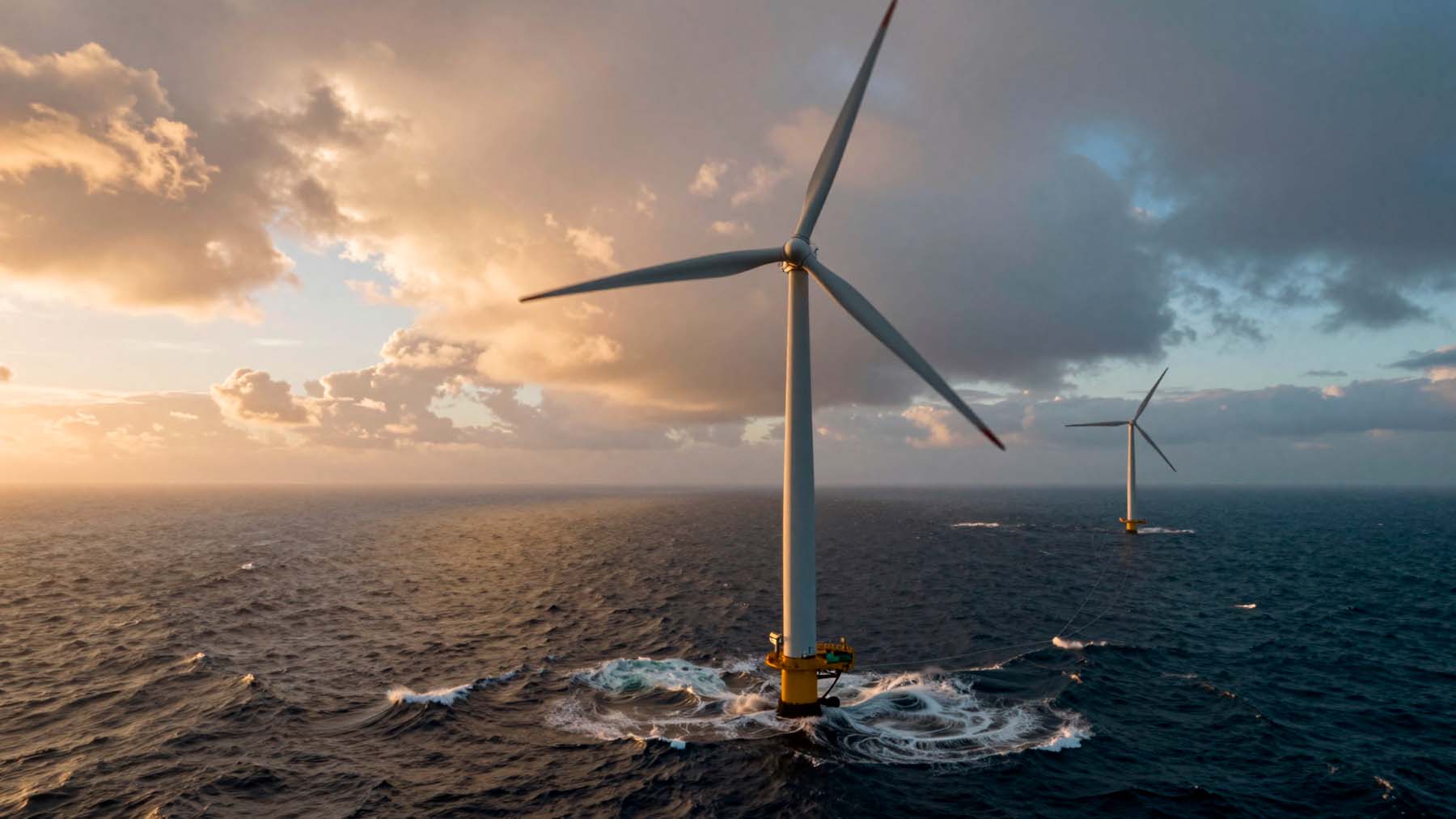 AI-made
Offshore wind energy is moving into much deeper ocean waters. Fixed-bottom wind turbines work great near the shore, but deep waters require floating platforms tethered to the seafloor. Engineers long assumed that wave motion was purely an obstacle. The constant rocking and swaying seemed like a problem to manage.
Recent computational simulations have upended that traditional view. Floating turbines moving on high ocean waves can actually produce noticeably more electrical power than rigid, stationary turbines.
The challenge of deep ocean wind energy
Deep ocean waters contain some of the strongest, most consistent wind resources on Earth. Capturing that energy requires floating platforms anchored miles off the coast. Fixed towers become far too expensive in water deeper than 200 feet.
Designers are testing flexible materials and smart dampeners that capture wave-induced power while protecting internal gearboxes from excess wear.
Floating platforms solve the depth issue, but they introduce constant motion. Ocean waves cause turbines to tilt, pitch, roll, and surge back and forth.
Engineers initially designed these floating structures to mimic rigid ground towers as much as possible. They feared that dynamic motion would disrupt airflow across the blades, cause unpredictable aerodynamic drag, and lower total power output.
Simulating dynamic blade aerodynamics
Advanced fluid dynamics simulations reveal a very different physical reality. High-fidelity computer models now simulate how complex airflow interacts with moving rotor blades in real time.
As a floating turbine pitches forward into incoming wind, the effective speed of the air hitting the blades increases. This movement creates a temporary boost in aerodynamic lift across the rotor disk.
When the platform rocks backward, it moves with the wind flow. That action alters the wake pattern behind the turbine, shedding trapped turbulent air faster than a fixed tower can. This continuous back-and-forth cycle helps refresh the local airflow around the blades.
Quantifying the power boost from wave motion
The power increase from this motion is not just a rounding error. High-resolution numerical simulations show localized power gains ranging from 2% to over 5% under specific wave conditions.
The primary driver behind this boost is the surge motion. When wave action pushes the entire platform forward, the relative velocity of the wind spikes instantly.
Wind power generation scales exponentially with relative wind speed. Even minor forward movements yield measurable jumps in electricity generation. The kinetic energy gained during the forward motion easily outweighs the slight reduction experienced during the backward tilt.
Rethinking structural controls and farm layouts
These simulation findings are changing how engineers design turbine control systems. Standard control algorithms try to dampen platform motion to maintain steady blade speeds.
Newer control strategies allow controlled pitching and surging to exploit natural wave energy. Operators can tune the blade pitch dynamically to capture peak power during forward surges.
This discovery also impacts offshore wind farm design. Floating turbines shed their turbulent wakes differently than fixed towers. As a result, downstream turbines experience cleaner airflow and less wind shadow, boosting total power output across the entire offshore array.
Validating the simulations in ocean environments
Computer simulations provide clear theoretical proof, but ocean validation remains essential. Researchers are currently testing scale models in wave basins to match simulation predictions with physical data.
Engineers also measure structural fatigue. While wave motion boosts power generation, it adds mechanical stress to turbine components and anchoring cables.
Finding the right balance between higher power output and long-term hardware durability is key. Designers are testing flexible materials and smart dampeners that capture wave-induced power while protecting internal gearboxes from excess wear.
Transforming the future of marine renewables
Harvesting offshore wind energy plays a critical role in global renewable energy goals. Floating wind farms open up vast ocean regions previously deemed unbuildable.
Discovering that wave motion can boost power generation reframes how we view marine environments. Engineers no longer see rough ocean waves as an obstacle to fight against.
Instead, ocean movement acts as a free partner in energy production. Combining offshore wind with ocean kinetic forces creates a far more efficient energy capture system.
What makes this ocean energy breakthrough so surprising? The hidden key to boosting wind output turned out to be the exact thing engineers tried to stop: the ocean’s natural waves were pushing the turbines forward like a person swinging on a playground.
Kelly is an experienced writer with 15 years of experience exploring the big stories that shape our world, from tech breakthroughs and space exploration to climate, energy, and the fascinating quirks of science. She has a talent for turning complex ideas into sharp, memorable insights that stay with readers long after they’ve finished reading.
