
Somewhere off Scotland’s Angus coast, a ship made around 11 round trips through a Scottish winter, and each haul it carried steel cylinders weighing around 2,300 tons that the North Sea floor was about to swallow whole
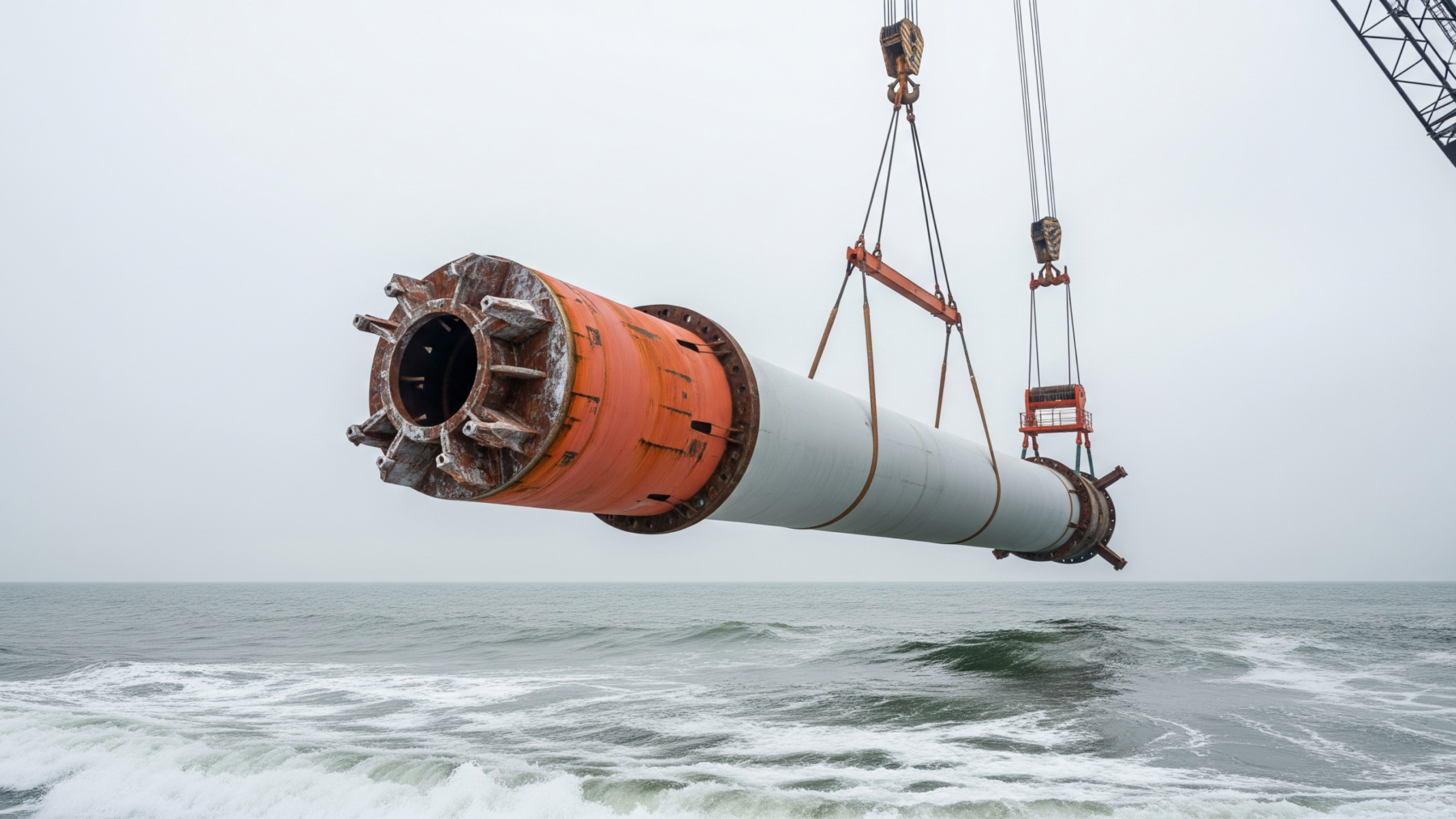
In the grey of a Scottish December, something almost unimaginable happened just off Scotland’s east coast.
A ship the length of two football fields lowered a hollow steel cylinder into the North Sea.
The cylinder weighed as much as 2,300 family cars.
The 1.1-gigawatt Inch Cape Offshore Wind Farm sits in the North Sea 15 kilometers off Scotland’s Angus coast, owned equally by ESB and Red Rock Renewables.
It was not an anchor, not a drill, not a submarine.
It was just the first of 54.
And before a single blow of the hammer fell, the crew had to listen for something breathing in the water below.
A vessel that turns the sea into solid ground
Most ships must work around waves.
The most sophisticated vessel needed for this kind of work carries a giant crane and uses jack-up legs that extend to the seabed, turning a floating hull into a fixed platform.
Once the legs grip the bottom, the sea can roll and the vessel does not move at all.
The crane aboard this ship could reach 160 meters at full height, enough to stack a 50-story building below its hook.
Each voyage began at a purpose built berth at the Port of Leith in Edinburgh.
The vessel collected five monopiles per voyage and made its way to the installation site across the winter North Sea.
Eleven round trips through North Sea swells, five foundations at a time.
Each transit took place regardless of season, through spray and cold that most industrial work simply stops for.
What the hammer sounds like underwater
Driving a 2,300-ton steel tube into the seabed is not quiet work.
A hydraulic impact hammer strikes the top of the pile with enough force to send it meters deeper with each blow.
The sound does not stop at the waterline.
It radiates outward through the sea for kilometers in every direction.
To protect marine mammals, the project deployed acoustic deterrent devices and ran a continuous noise monitoring program.
The soft start procedure ramped up hammer energy gradually: move away now, something loud is coming.
Porpoises and grey seals that patrol this stretch of the North Sea were the intended audience.
Only once observers confirmed the area was clear could the hammer build to full operating power.
Six months, 54 cylinders, one Scottish winter
The campaign started in December 2025 and was completed over the following six months, despite challenging soil and winter weather conditions.
That is roughly one enormous steel structure planted in the seabed every three to four days.
The monopiles were fabricated by CWHI and Dajin Heavy Industry.
They are among the largest installed to date in the offshore wind industry, with diameters of 11.5 meters, lengths of up to 102 meters, and weights of around 2,300 tons each.
At 102 meters long, each one is taller than the Scott Monument in Edinburgh.
Around 100 personnel were based at the Port of Leith throughout the campaign, loading components for ongoing offshore works.
Every departure carried five foundations stacked on deck, and coordinating that rhythm across six months of Scottish winter required continuous logistics work onshore and off.
The 1.1-gigawatt forest now growing beneath the waves
What those 54 cylinders will eventually hold is the real story.
The 1.1-gigawatt Inch Cape Offshore Wind Farm sits in the North Sea 15 kilometers off Scotland’s Angus coast, owned equally by ESB and Red Rock Renewables.
The finished farm will carry 72 Vestas 15-megawatt turbines on a combination of 54 monopile foundations and 18 jacket foundations supported by 54 pin piles.
Each turbine is rated at 15 megawatts, enough to power roughly 15,000 homes on its own.
The steel now buried in the seabed will stand there for decades, and marine life will colonize every centimeter of it, as it already has on older Scottish wind projects up and down the coast.
That is the quiet bargain buried in the mud: a machine built to harness the sky ends up being colonized by the sea.
What comes next on the North Sea floor
The project is scheduled to produce its first electricity in late 2026 and aims to reach full commercial operation in 2027.
Remaining offshore work includes transition pieces, jacket foundations, the second export cable section, array cables, and the first turbines.
Transition pieces are the collar like connectors that sit atop each monopile and give the tower its level footing above the waves.
Cadeler, contracted in June 2024, will install the 72 turbines.
For engineers who design offshore wind systems that must endure years of wave loading, the foundation campaign just completed is the bedrock on which everything else depends.
For the porpoises and seals that heard the soft start hammers build to full power through the winter, the loudest part is already over.
What rises from those 54 steel roots by the end of 2026 will be something far steadier: 72 turbines turning in the North Sea wind, sending power ashore to Scottish homes for the next quarter century.

Hugo is an engineer with strong technical expertise. Multilingual from an early age, his writing combines technical clarity with a strong interest in science and energy.
