
A camera at a Florida solar plant captured an unexpected nightly visitor, and workers were so careful not to scare her that they let her keep the site as her private walking route
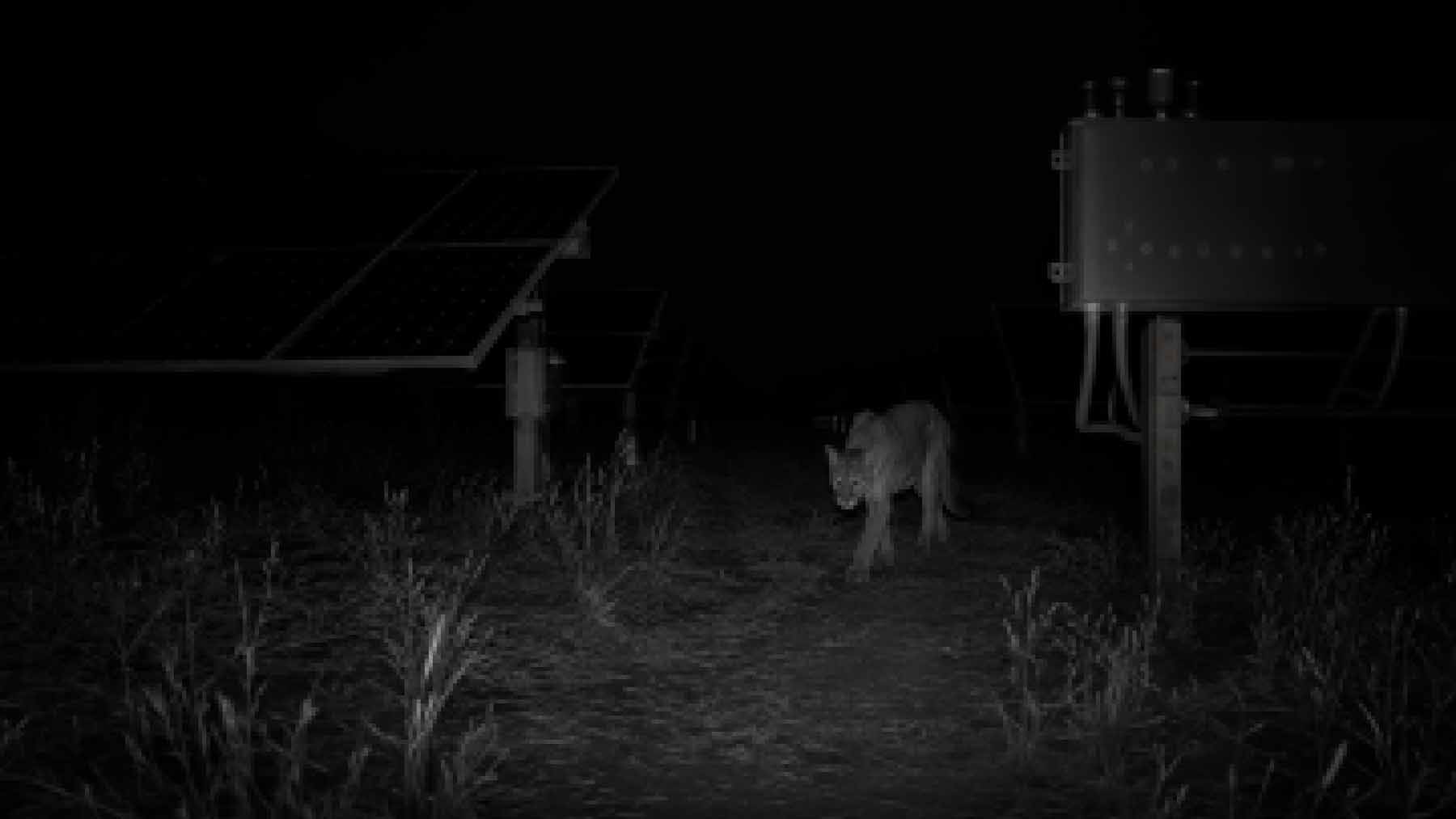 Image generated with artificial intelligence
A tawny cat moved between rows of solar equipment after dark, its presence captured only by a remote camera. Solar plants may seem like places wildlife would avoid or move around. Yet cameras repeatedly photographed a Florida panther crossing FPL’s Sawgrass Solar Energy Center in Hendry County.
The sightings matter because every blocked route reduces the land available to this endangered animal. The panels were still there, as was the perimeter fence. So how did the panther manage to move through an industrial site?
How cameras discovered the visitor
During the summer of 2022, cameras installed inside and around Sawgrass photographed a Florida panther at the operating solar center on several occasions.
The repeated sightings confirm that the panther could access the site, but they reveal little about whether it fed, rested, bred, or spent significant time there.
The facility is located along County Road 833 in Hendry County. Its 74.5-megawatt array can produce enough electricity to power roughly 15,000 homes.
It also sits within what remains of the Florida panther’s South Florida habitat, a fragmented landscape where roads, farms, development, and protected areas converge.
While planning solar projects in the region, FPL worked with the Florida Wildlife Federation and Defenders of Wildlife. Their goal was to reduce habitat fragmentation and preserve routes that animals could use to move through the landscape.
The photographs offered the clearest evidence yet that those measures were working. They showed a panther entering and traveling through the solar property.
They did not prove that the animal lived there. There was no evidence that it slept beneath the panels, hunted regularly on the site, or treated the facility as part of its territory.
What the cameras captured was more limited, but still important: an endangered predator successfully crossing an active energy site.
Why a single route can matter
Florida wildlife officials estimate that only 120 to 230 adult panthers remain, with most of the breeding population concentrated in South Florida.
These animals need enormous territories. An adult male may roam across an area of nearly 200 square miles.
That makes connectivity essential. A solar plant may occupy a single parcel of land, but if it blocks an established route, its effects can extend far beyond the project boundary.
Research from Florida Atlantic University has found that poorly located solar facilities can weaken wildlife corridors, particularly when animals have no practical alternative route.
For the Florida panther, every remaining connection matters.
The Sawgrass photographs do not prove that solar development is inherently beneficial to wildlife. They show something more specific: this particular site had not become an impassable barrier.
Reports did not identify the sex of the photographed panther, and assigning a human-style story to the animal would add little. The important detail was that it entered the property repeatedly.
One relatively simple design decision appears to have made that possible.
The opening in the perimeter
Sawgrass used wildlife-friendly fencing designed to allow animals to move through the property.
The panther was likely able to cross because the solar center remained connected to the surrounding landscape. Instead of forcing the animal to make a long detour, openings in the fence allowed it to continue along its route.
FPL and conservation groups included those openings for panthers and other wildlife. The camera images later showed that animals were using them.
No workers guided the panther through the facility. The visits were recorded remotely, without anyone needing to approach or disturb it.
The solar center also usually operates without permanent on-site staff, which reduces regular vehicle and human activity around the panels.
Together, these features made the property passable. They did not turn it into new panther habitat, nor do they show that the animal was attracted to the solar equipment.
That distinction matters. The site did not need to become a sanctuary to avoid becoming a complete obstacle.
The fencing may also allow prey species to move through the property, preserving more natural ecological relationships than a fully sealed industrial perimeter would.
What the photographs cannot tell us
The repeated sightings confirm that the panther could access the site, but they reveal little about whether it fed, rested, bred, or spent significant time there.
They also cannot prove that the fencing alone caused the visits. The animal’s destination and reasons for crossing remain unknown.
Broader research still gives planners reason for caution. Solar facilities built in the wrong locations can remove habitat and disrupt the same corridors panthers rely on.
Sawgrass is therefore best understood as a design lesson, not evidence that every solar project is compatible with wildlife. Location, fencing, wetlands, nearby roads, and the condition of surrounding habitat all affect a project’s impact.
The most defensible conclusion is also the simplest: at this property in Hendry County, solar generation and panther movement were not mutually exclusive.
Planners left a route through the perimeter, and a rare cat used it.
Seen in that context, the nighttime photographs become more than an unusual wildlife sighting.
The panther was not posing beside renewable-energy equipment or choosing the solar field as its home. It was moving through a landscape that people had altered without completely closing the way forward.
That is a small but meaningful form of coexistence. The site continued producing electricity while the land remained passable for an endangered animal.
On camera, the panther crosses the frame and disappears into the darkness. The hopeful part is not that it entered the solar plant, but that its journey did not have to end there.
Daniel García is an Editor-in-Chief with strong expertise in structural work and engineering principles. He combines this technical foundation with deep knowledge of energy, spatial design, and emerging technologies, bringing a forward-thinking and analytical approach to editorial leadership.
