
Five vessels now work one field, and the ancient vanished sea beneath 2,000 meters of Atlantic water is why Brazil just pumped more oil than ever before in its history
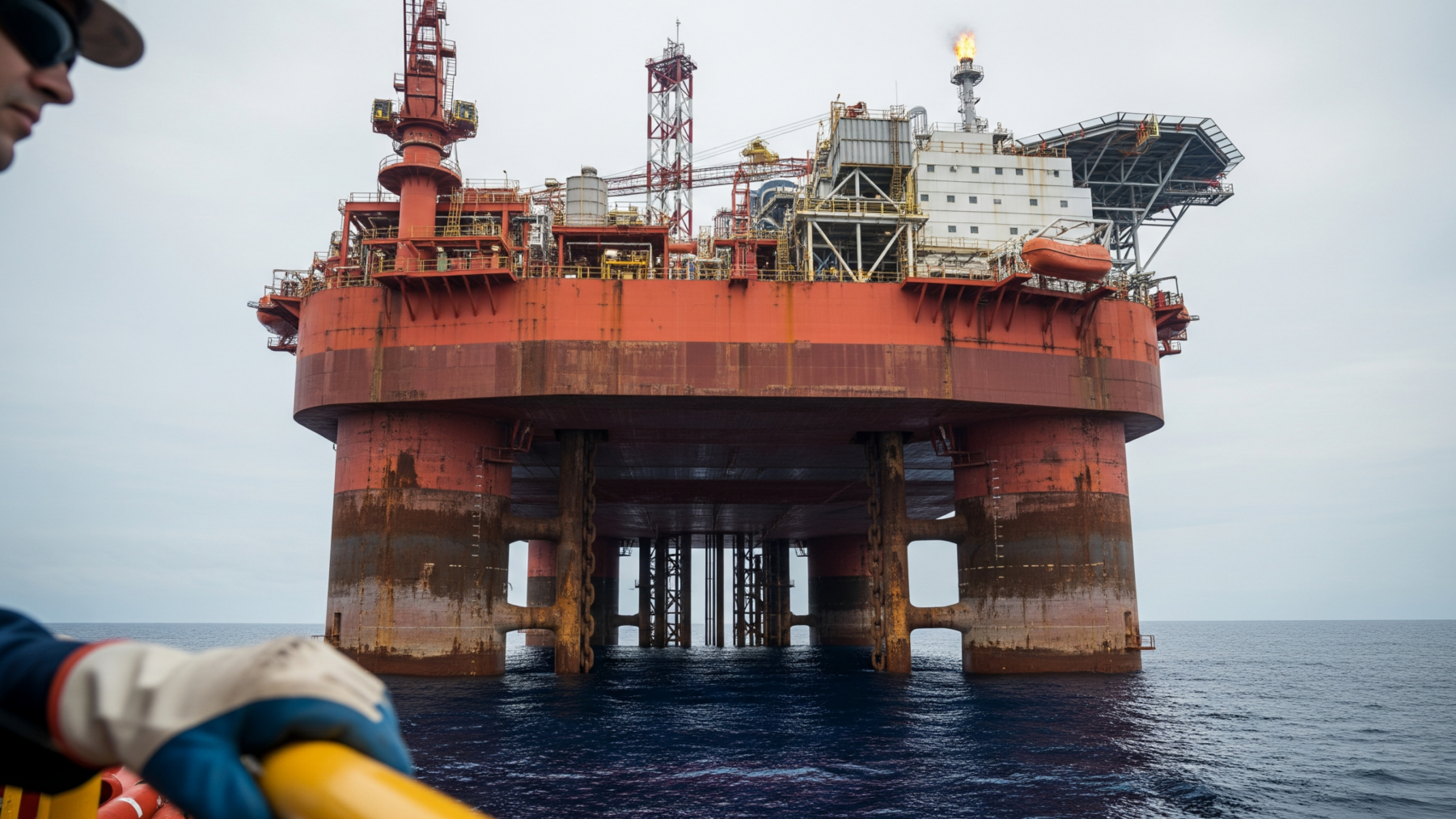
On a grey December morning in 2024, a record towing convoy began moving out of a shipyard on China’s Jiangsu coast toward the Yangtze River.
At its center sat something that dwarfed every tugboat and patrol vessel surrounding it.
A single floating structure, longer than three football fields laid end to end, was beginning the first leg of a journey that would end at the bottom of an ocean that no longer exists.
Getting to it requires drilling through water more than 2,000 meters deep, then punching through kilometers of shifting salt before hitting stone that breathes oil.
The convoy set a new tonnage towing record on the Yangtze before it even reached open water.
What came next was stranger still: a months-long crossing of two oceans, followed by a descent into geology older than the dinosaurs, and a production milestone that nobody expected to arrive so soon.
A river that had never seen anything so large
The vessel was built in Jiangsu Province, China, and departed on December 16, 2024, setting a new tonnage towing record along the Yangtze River.
Engineers on the riverbank watched a structure go past that most of them had never expected to see move at all.
The vessel is 335.31 meters long, 60 meters wide, and 33.5 meters high.
Its storage capacity reaches up to 1.4 million barrels, enough oil to fill roughly 560 Olympic swimming pools.
Its daily production capacity stands at 180,000 barrels of crude oil and 12 million cubic meters of natural gas.
By tonnage, this is one of the world’s largest FPSOs, built by COSCO Shipping (Qidong) Offshore.
But where it was going, and why it was going there, is the part of the story that changes the scale of everything.
Two oceans and a geology lesson waiting at the end
The vessel arrived in Brazil in March 2025, after a crossing of the Indian and Atlantic Oceans that took the better part of three months.
Its destination was a stretch of water roughly 180 kilometers off the coast of Rio de Janeiro, above a field called Mero in the Santos Basin.
These reservoirs sit beneath a layer of salt sometimes three kilometers thick, deposited by an ancient inland sea that dried up around 120 million years ago.
The oil trapped inside that vanished sea is extraordinarily light and clean by global standards.
Getting to it requires drilling through water more than 2,000 meters deep, then punching through kilometers of shifting salt before hitting stone that breathes oil.
The reservoirs show superior porosity and permeability compared to conventional offshore formations, enabling high flow production that continues to exceed operator projections.
The schedule that nobody believed could hold
Even before the vessel left China, planners had set an ambitious target for its first day of production.
Industry watchers assumed that target would slip, as large offshore projects almost always do.
They were wrong.
On May 24, 2025, Petrobras announced that the FPSO Alexandre de Gusmão had started production at the Mero field, more than two months ahead of schedule.
The project was designed to minimize greenhouse gas emissions, with reinjection of associated gas into the reservoir and zero routine flaring.
That early arrival reflects repetition at scale, hard-won lesson by lesson, platform by platform across the Santos Basin.
The machine that rewrote the record books
The vessel’s official name is FPSO Alexandre de Gusmão, honoring an 18th-century Brazilian diplomat who reshaped his country’s borders through negotiation rather than war.
Chartered by Petrobras from SBM Offshore, it produces 180,000 barrels of oil per day and processes 12 million cubic meters of gas per day.
With the new FPSO operating, the Mero field’s installed production capacity jumped from 590,000 to 770,000 barrels per day, a gain of 31%.
Petrobras reported a record Q2 2025 total operated production of 4.19 million barrels of oil equivalent per day, fueled by pre-salt ramp-ups and new FPSOs across the Santos Basin.
Investors tracking hidden reserves being unlocked globally are watching the Santos Basin as closely as any basin on earth.
What a floating city leaves behind it
The FPSO Alexandre de Gusmão is not alone at Mero.
Four other vessels now work the same field alongside it, their mooring chains fanning out across the seafloor like the spokes of a wheel no one on the surface can see.
Mero is now Petrobras’s third-largest oil field, behind only Tupi and Búzios, both in the pre-salt layer.
Búzios reached one million barrels of oil per day with just six platforms, making it one of the most productive deepwater field developments ever executed.
Petrobras has pledged full gas reinjection at Mero, measures that reduce the carbon footprint of each barrel produced.
The infrastructure required to sustain production at this depth places enormous demands on engineering, supply chains, and crews who rotate on and off a vessel that becomes their entire world.
Out at Mero, the Atlantic wind runs unbroken across 180 kilometers of open water before it reaches the deck of the largest floating machine in the ocean.
Somewhere far below, an ancient sea keeps giving up what it stored a hundred million years ago, barrel by barrel, into the hull of a ship that had to break a river record just to begin its voyage.

Hugo is an engineer with strong technical expertise. Multilingual from an early age, his writing combines technical clarity with a strong interest in science and energy.
