
Tracked across 2 Swedish wind farms in a central pine forest, 13 GPS-tagged birds revealed what turbines do to a creature that almost never leaves the ground
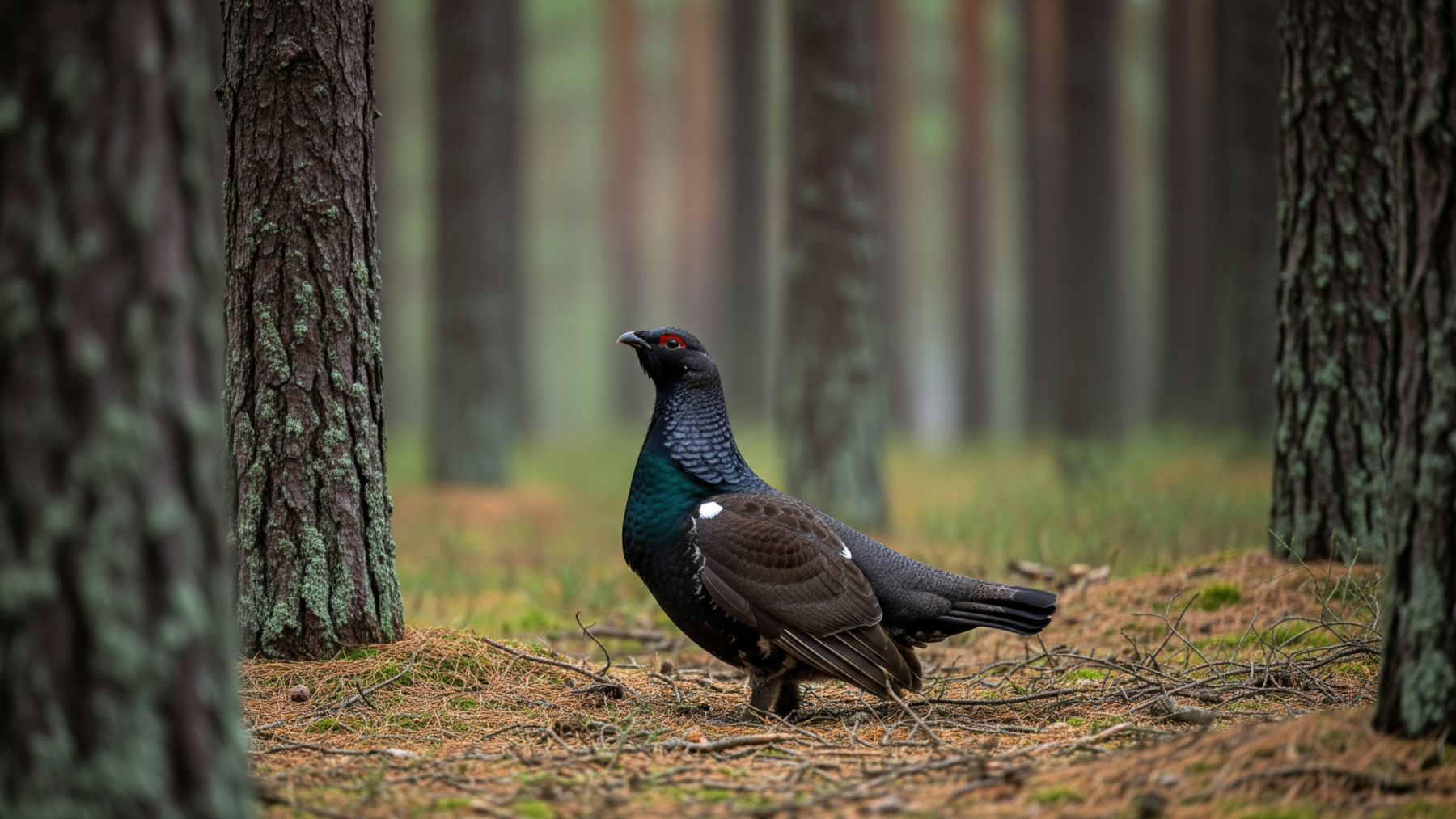
A bird the size of a small turkey stood in the middle of a central Swedish pine forest and did something researchers had never measured so precisely before.
It simply stopped moving.
No predator nearby.
Researchers found clear daily and seasonal variation in speed and directionality, reflecting behavioral adjustments to biological and environmental change.
No storm rolling in.
Nothing visible in the data to explain it, except the tower that had just appeared through the trees.
The moment was one of thousands recorded by scientists tracking creatures whose fate inside a wind farm no one had fully mapped, because these animals rarely left the ground.
And the pattern those frozen moments made, replicated across an entire boreal forest, would eventually force a rethink of a risk that wind energy permitting had barely begun to measure.
A forest that was already changing
Forests in central Sweden once echoed with the heavy wingbeats of capercaillie moving freely between feeding grounds.
Then the turbines started appearing gradually, and roads cut deeper into woodland areas.
Capercaillie are among Europe’s largest forest grouse, with males averaging around four kilograms, and they depend heavily on old woodland habitat for feeding, nesting, and seasonal shelter.
They are also famously sensitive to human disturbance, abandoning leks at the first sound of machinery.
Researchers worried large wind farms could disrupt those routines in ways that no one had fully measured.
The question was whether the problem stopped at the fence line or ran deeper into the forest itself.
Thirteen birds, one forest, a continuous pulse
Scientists studied movement traits of 13 capercaillie over two summer seasons in a Swedish wind farm using high-resolution GPS tracking data collected at a five-minute sampling interval.
The study was conducted across two adjoining wind farms: Mombyåsen with ten southernmost turbines, and the larger Jädraås site to the north.
GPS devices recorded travel speed, direction changes, and habitat use across every hour of every day.
Each fix created a data point.
Thousands of fixes eventually built something close to a living map of fear.
Capercaillie are a primarily ground moving forest bird species inhabiting coniferous forests.
That ground hugging life turned out to be exactly why the signal was so clear.
Speed as a language
Birds in the sky can simply bank away from a tower.
A capercaillie on the forest floor cannot.
Each new turbine requires roads, cleared ground, and open corridors through previously continuous forest.
Capercaillie evolved in dense woodland environments where tree cover offers protection from predators, and wind farms alter that balance.
Across the broader research programme at these same sites, the probability of site selection during the lekking season decreased with increasing turbine noise, turbine visibility, and turbine shadow.
Researchers noticed some individuals avoided crossing between towers entirely.
Others paused longer inside denser forest cover before moving again.
The data kept pointing to the same mechanism: visible turbines triggered caution.
The slow, ground level existence of this bird made the behavioral signal unusually easy to read.
What the GPS finally said
Here, at last, was the animal at the center of the story.
Capercaillie moved slower when more turbines were visible, and faster when they were close to turbine access roads.
The roads offered a kind of flight response: open lanes where a bird could accelerate to escape.
But the open gaps between towers triggered the opposite impulse: freeze, shelter, wait.
Researchers found clear daily and seasonal variation in speed and directionality, reflecting behavioral adjustments to biological and environmental change.
That slow erosion of range is harder to photograph than a blade strike, but the data suggest it may affect far more individuals, much like the grouse case that forced turbine removals in South Dakota.
The study did not conclude that wind farms automatically drive capercaillie away entirely, and some individuals continued using parts of the landscape.
A number that changes the math
Thirteen birds is a small sample, and the researchers say so plainly.
The results provide novel insights into seasonal and environmental correlates of capercaillie movement and supplement previous observations on lekking behavior with a more mechanistic understanding.
That mechanistic detail matters: planners can now model sight lines, not just buffer distances.
Sweden has among the most ambitious wind expansion targets in Europe, and capercaillie are a protected species under EU habitat law.
The finding has drawn attention to how little movement behavior, as opposed to collision mortality, currently shapes turbine siting decisions, a gap that researchers studying turbine noise have been pressing on for years.
Two summer seasons at two farms cannot speak for every capercaillie forest in Scandinavia.
But the GPS trail those 13 birds drew through the pine trees of Jädraås and Mombyåsen tells a story that will be difficult to ignore the next time a project boundary is drawn across old boreal woodland.
The birds are still in the forest.
They are just moving through it very differently now.

Hugo is an engineer with strong technical expertise. Multilingual from an early age, his writing combines technical clarity with a strong interest in science and energy.
