
Four wind turbines in South Dakota were removed after engineers realized they stood too close to a grouse “dance floor”
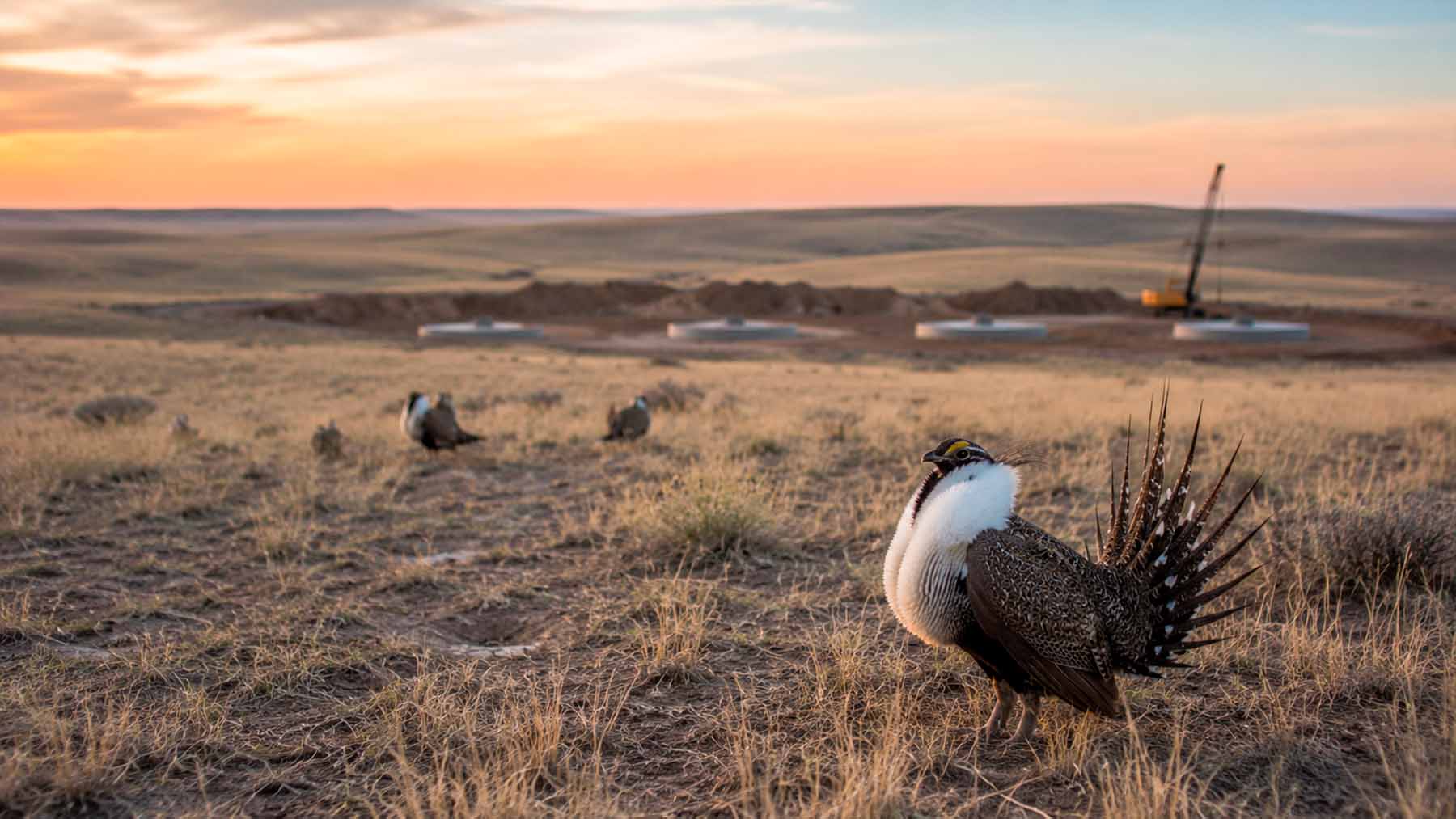 Image generated with artificial intelligence
In South Dakota, developers met their match after a grouse lek led to the removal of four wind turbines.
The United States is actively working toward its clean energy goals, with renewable infrastructure rapidly expanding.
However, project development in rural landscapes often faces unforeseen environmental challenges.
Beyond meeting climate deadlines, this green capacity growth is essential in satisfying surging national electricity consumption.
Usually, these installations can unintentionally disrupt the wildlife they were meant to protect.
Will small adjustments help strike a balance and get green projects back on track?
How green infrastructure is essential to meeting high American energy demands
The U.S. is among several nations that have adopted ambitious renewable energy targets.
Federal goals include achieving a carbon-free electrical grid by 2035.
Another goal is to achieve net-zero emissions nationwide by 2050.
To achieve these targets, aging fossil fuel plants must be rapidly replaced with carbon-free power sources.
Renewable energies such as solar and wind have become the cornerstone of this transition.
These developments have been accelerating across rural states to provide clean supplies to regional power networks.
The latest projections indicate that America’s total onshore wind capacity is set to increase to nearly 269 GW by 2035.
Beyond meeting climate deadlines, this green capacity growth is essential in satisfying surging national electricity consumption.
The rise in electric vehicles, industrial electrification, and AI data centers is driving this unprecedented demand.
This is why utility-scale wind projects are key to satisfying these demands while keeping carbon footprints low.
The widespread growth of American wind
Wind energy is the top source of renewable electricity in the U.S., surpassing 160 GW.
Across the country, over 75,000 large-scale turbines produce enough clean power for more than 46 million homes.
Currently, roughly 26 GW of new land-based wind projects are in the pipeline, representing more than $52 billion in investment.
Consequently, rural communities enjoy substantial economic benefits.
Each year, wind projects generate almost $2.7 billion in state and local tax payments.
Ranchers and farmers receive land-lease payments.
This additional income is crucial during lean agricultural years caused by increasingly unpredictable extreme weather events.
Furthermore, the local property tax revenues fund road maintenance, emergency services, and public schools.
The industry also drives domestic employment.
Despite these advantages, some projects can experience unforeseen complications.
As indicated by the SD Renewable Energy Association, the largest wind farm in South Dakota had to navigate ecological issues.
The loss of giant turbines due to small birds
South Dakota is set to receive its biggest wind farm yet.
Located in Haakon County, the 333 MW Philip Wind Project will stretch across 110 square miles.
It will consist of 87 turbines and a 5.5-mile transmission line to connect to the regional grid. The Department of Energy conducted an Environmental Assessment.
Potential impacts on local wildlife, water, and soil had to be evaluated before approval was granted.
Biological surveys indicated that four proposed turbine sites would directly overlap with active prairie grouse breeding grounds.
The impact of wind turbines on grouse behaviors
Prairie grouse need open leks for seasonal courtship display rituals.
These “dance floors” are used by male grouse each spring to stomp, vocalize, and attract mates.
The giant turbines can disrupt these mating behaviors by driving away females.
Additionally, these massive structures provide perches for predatory birds.
Developers had to agree to remove those four turbines from the project layout.
Despite having to make small adjustments to the project, it remains fully viable.
Regulatory approval has been secured. This means the Philip Wind Project will bring vast amounts of clean electricity to the regional grid.
Thousands of homes will benefit, while local long-term employment also gets a boost.
The project will support 200 construction jobs and provide millions in tax revenue.
Most importantly, the project proves that wind energy expansion and wildlife conservation can strike a balance.
Anke Maree is a writer with a clear and engaging editorial style. Her work focuses on making complex topics accessible, informative, and relevant for readers across different areas of interest.
